
Most Christians know and can quote John 3:16 from memory: “For God so loved the world that he gave his one and only Son, that whoever believes in him shall not perish but have eternal life.” Fewer can recite what follows: “For God did not send his Son into the world to condemn the world, but to save the world through him” (John 3:17). John 3:17 is an important addition to the thought—Christ came to save not just a group called “the elect” but to open the door to the salvation of the world, the entirety of the human race.
For many weeks, Kathy and I have attended a liturgical church. During what they call the “Eucharistic Prayer,” the priest says, “Thine own of Thine own we offer unto Thee, in behalf of all and for all.”[1] It reminds us that the church performs its liturgy and sacraments not just on behalf of a small group of believers, but on behalf of the entire world for whom Christ died. It’s also a reminder that, while not everyone may be saved, and while people still reject Christ, he died even for those who rejected him. It also reminds us that the Church’s work is to redeem a lost and broken world.
For the Life of the World
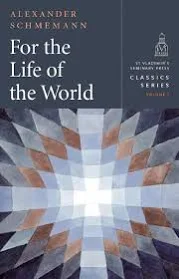 This brings me to For the Life of the World by Alexander Schmemann, one of the most important books in 20th-century theology.[2] Schmemann was an important Orthodox thinker and dean of St. Vladimir’s Orthodox Seminary. He first published For the Life of the World in the mid 1960’s. It has been republished in numerous translations worldwide. The book remains in print and is studied by Orthodox, Protestant, and Roman Catholic scholars, as well as interested laypeople everywhere. The book’s central thesis is that the liturgy of the Christian Church is the core way Christians relate to and witness to Christ in an increasingly secular world.
A Sacred as Well as a Spiritual World
For the Life of the World begins by recognizing the materiality of human existence. Schmemann quotes the 19th-century atheist philosopher Ludwig Feuerbach (1804-1872), who famously said, “Man is what he eats.”[3] In Feuerbach’s view, this meant that human beings are made of matter. Schmemann turns this vision of reality upside down: Yes, human beings are what they eat, but human existence encompasses more than a materialistic Western culture can understand. We think of humans as inevitably hungry for knowledge, money, power, pleasure, and wealth, for all the material things the universe offers. The Church thinks of human beings as made in the image of God. It thinks of the sacrament as an actual feeding of the body of Christ for the salvation of the entire world.
The spiritual hunger of Western intellectuals and the citizens of Western countries, so wealthy and well-fed by any historical or current standard, has not been quenched by the vast increase of material wealth and affluence in these nations. The last three hundred years have not quenched the human hunger for a truly joyful, joy-filled way of life. The problem with Feuerbach’s belief is an assumed opposition between the spiritual and the material, the sacred and the profane, and the supernatural and nature itself. Underlying this assumption is a great divide between God, perceived as either absent or distant, and human daily material existence. Christianity rejects such oppositions. Christians believe the world is a divine creation intended to mirror the beauty and fullness of God.
As Paul puts it to the Athenians, who were much like contemporary people:
Men of Athens, I perceive that in all things you are very religious; for as I was passing through and considering the objects of your worship, I even found an altar with this inscription: TO THE UNKNOWN GOD.
Therefore, the One whom you worship without knowing, Him I proclaim to you: God, who made the world and everything in it, since He is Lord of heaven and earth, does not dwell in temples made with hands. Nor is He worshiped with men’s hands, as though He needed anything, since He gives to all life, breath, and all things. And He has made from one blood every nation of men to dwell on all the face of the earth, and has determined their preappointed times and the boundaries of their dwellings, so that they should seek the Lord, in the hope that they might grope for Him and find Him, though He is not far from each one of us; for in Him we live and move and have our being, as also some of your own poets have said, ‘For we are also His offspring.’ (Acts 17:22b-28).
The Christian insight that God is everywhere, in everything, and remains present to his creation, including the human race, is well attested. “He is before all things, and in him all things hold together” (Colossians 1:17). “…Christ is all, and is in all” (Colossians 3:11). For Christians, there is “one God and Father of all, who is over all and through all, and in all” (Ephesians 4:6). God’s presence is “real.” The world is God’s creation, and God is present with and in it through the Word of God and the Holy Spirit. Therefore, there is no separation between the supernatural and the natural or the sacred and the profane. The world is, in fact, a sacred place God created, marred by human sin and the separation of the human race from its original intention. The Liturgy is a weekly Christian proclamation of the creating and redeeming presence of God in his creation and in our daily lives.
Liturgy as Recapitulation of Life
For the Life of the World is a meditation on the significance of Christian liturgy for understanding and reacting to the modern world and the growth of secular society. It is grounded in the view that the God who is everywhere and in everything is present in the worship of God’s people, in a special and life-transforming way. Schmemann’s theological vision is, then, grounded in the worship of the local congregation. The Liturgy (the work of the worshiping congregation) takes the congregation on a journey from everyday unconsciousness of the divine human existence, with its unspoken assumption that the sacred is absent, into the presence of God in Christ and the Kingdom of God.[4] It moves from the reality of the local congregation’s secular life to celebrating the consummation of human hopes in the Kingdom, where Christ has table fellowship with his people once more (Matthew 26:29; Luke 22:16). The Eucharist is the symbol of the reality of Christ’s presence in human space and time, even in the midst of an imperfect, unjust, and often violent world.[5]
The weekly celebration of the liturgy is the primary means by which the congregation is brought into the presence of Christ, transformed by the power of the Spirit, given a new vantage point for understanding reality, and enabled to experience the Kingdom of Heaven. The congregation then goes back into the world as instruments of God’s redeeming work, for God wills that all this world and everyone in it be saved from brokenness, sin, and the rest of the sufferings of fallen human existence. Weekly worship and the sacraments are not an escape from reality; they are a journey to the great reality of God’s presence and redeeming work in the world.[6]
Journey in the Liturgy
Many Protestant congregations pass the peace (or wholeness, shalom in Hebrew) of Christ at some point in the service. In the Orthodox liturgy, it is part of the entrance, when the priest turns to the congregation and says, “Peace to you.”[7] This recognition of Christ’s peace present in the congregation is followed by the liturgy of the Word, or the reading of scriptural passages and a sermon by the priest. The proclamation of the Word is meant to be a transforming moment, as the congregation finds its life transformed by hearing and appropriating the Word of God in everyday life. In the liturgy of the Word, the teachings of Christ and their meaning for our daily lives are heard and experienced, preparing the congregation to live the life of the Kingdom in a world that is often alienated from God.
The second half of the liturgy brings the congregation to the Sacrament of the Eucharist. In the Eucharist, the body of Christ enters the human subject’s biological life. In other words, those who, by faith, receive him know the reality of Christ’s presence in the sacraments. Schmemann believes that the Western tendency to focus on the precise nature of the presence, along with modern attempts to accommodate a materialistic worldview, has blinded many to the liturgical symbolism of the act and to the importance of Christ’s real presence with and in the elements and in the congregation as it receives the body and blood of Christ.[8]
Schmemann, therefore, rejects the artificial and reductive arguments prevalent in Western theology. Western theology has tried to define Christ’s presence in the Eucharist in human categories. Schmemann rejects this enterprise.[9]The liturgy remembers the Last Supper and the Crucifixion. It is a symbolic action, but more than that. Christ is present in the Sacrament, and Schmemann believes that recourse to theologians’ disputes ignores the act’s liturgical significance. Furthermore, the entire debate relies on the modern notion that mystical and symbolic things are not “real,” a proposition that Schmemann rejects.
How, then, does the Liturgy approach the Eucharist? One facet of the liturgy that Schmemann does not discuss in For the Life of the World concerns the liturgy’s structure as part of a cycle of prayers in which the congregation prays for the entire world. After the gospel lesson, there are prayers for catechumens who are in the process of joining the church. Then there is an exclamation in which the catechumens are asked to depart, a remnant of the persecutions the early church endured and of its unwillingness to submit those who have not been baptized into the faith to understanding the deeper mysteries of the Christian faith. Then comes the Hymn of Entrance and the Litany of Supplication, in which the priest and congregation pray for the gifts about to be offered to God and for God’s mercy. This is followed by an exclamation from the priest, reaffirming the peace of Christ present in the congregation, and then the confession of faith, the Nicene Creed. Only after these liturgical acts does the congregation come to the liturgical prayer and the blessing of the elements.[10]
During the epiclesis, the Priest lifts the eucharistic bread and wine to the Father, prayerfully asking the Holy Spirit to come upon them and the congregation. This sacred moment is when the bread and wine, offered in remembrance of Christ, are believed to become the very Body and Blood of the Lord, reflecting a beautiful act of faith and devotion—as the Liturgy of Saint Basil describes, to be shown as such.
The Orthodox cherish the prayer for the Holy Spirit’s coming as a vital part of the Divine Liturgy. Known as the epiklesis, meaning “calling upon” or “invocation,” this prayer helps Protestants, who often question the Spirit’s presence, grasp the powerful reality the liturgy proclaims. The Orthodox Church firmly believes, as it prays, that the Holy Spirit is already present everywhere and fills all things. That’s why I started with Biblical quotes—to highlight this truth: The invocation of the Holy Spirit during the Divine Liturgy affirms that everything exists through God’s Spirit. The Holy Spirit dwelt in Jesus, who was fully God and fully human. He enabled Christ’s incarnation from the Virgin Mary. He guided Christ to the cross as the innocent Victim and raised Him from the dead as the triumphant Victor.[11]
Here is how St John of Damascus describes the event in his Exposition of the Orthodox Faith:
“You ask how the bread becomes the Body of Christ, and the wine the Blood of Christ. I shall tell you: the Holy Spirit comes upon them and accomplishes what surpasses every word and thought.”[12]
John goes on to admit that, while the Holy Spirit brings about the change, its nature remains a mystery. God ordained the bread and wine as the elements because humanity cannot fully understand heavenly things. Because the exact nature of the mystery cannot be explained, the Orthodox reject Western theories of transubstantiation, consubstantiation, spiritual presence, and symbol. They try to explain what lies beyond human capacity for explanation.[13]
Conclusion
 Next week, I’m going to publish a long meditation on the structure of the Divine Liturgy. I believe readers will see that it is one long series of prayers, fulfilling Christ’s desire that his house be a house of prayer. One key to restoring the church in modern Western society is recovering a liturgical and mystical understanding of the world and the church’s place within it.
Copyright 2026, G. Christopher Scruggs, All Rights Reserved;
[1] The Divine Liturgy (Yonkers, New York: St. Vladimir’s Seminary Press, 1975). This quote is from the Orthodox Church of America version of the Liturgy of St. John Chrysostom. Other versions of the liturgy may vary slightly.
[2] Alexander Schmemann, For the Life of the World (Yonkers New York: St. Vladimir’s Seminary Press, 2018). All references are from this edition. The book was developed from a series of lectures Schmemann delivered to students in 1964 and has become a standard text of liturgical theology studied and appreciated by many Christians worldwide.
[3] Id., 17. For a scholarly attempt to place this quote in context, see Melvin Cherno, “Fuererbach’s ‘Man is what he Eats”: A Rectification. 24 Journal of the History of Ideas 3:397-408 (1963). Cherno argues that Feuerbach was more than simplistic materialism. Feuerbach viewed the Eucharist as a sensorial religious act in which food was valued as divine and sacralized. The host becomes the flesh of Christ in the imagination, but the host, or bread, once eaten, is transformed into human flesh. John Hymers, “In Defense of Feuerbach’s Moleschott Reception,: Feuerbach’s Open Dialectic”, LaSalle University (2006) found at https://hymers.eu/pdf/feuerbach_moleschott_EN.pdf?kat/1626.html, downloaded September 11, 2026)/
[4] Id., 38.
[5] Id., 34.
[6] Id., 25. Those wishing to ponder this thought further can study Zachary Porcu’s, Journey to Reality: Sacramental Life in a Secular Age (Chesterton, IN: Ancient Faith Publishing, 2024).
[7] Id., 42.
[8] Id., 152. I cannot go into this particular argument any further in this blog, but I promise to return to it. Schmemann makes a deep philosophical point, rejecting modernity’s nominalism in favor of the reality of symbols such as the Eucharist, a faithful reenactment of the Last Supper in which Christ, the Holy Spirit, and the holy Trinity are present.
[9] Schmemann believes that this rejection is sound on religious, theological, and philosophical grounds. He devotes two appendices to For the Life of the World to setting out the grounds for Orthodox rejection of the Western project. I hope to address these appendices at another time.
[10] The Divine Liturgy, note 1 above. Again, I rely on the form of the Divine Liturgy used in the Orthodox Church in America. Various Orthodox groups use liturgies with minor differences. I am going to publish next week a longer meditation on the liturgy centered in cycles of prayer and meditation.
11 To avoid errors in faithfully setting out the Orthodox position, I have relied on the description found in The Orthodox Faith, Vol. 2, Worship, Epiclesis, at https://www.oca.org/orthodoxy/the-orthodox-faith/worship/the-divine-liturgy/epiklesis, downloaded September 12, 2026.
[12] John of Damascus, “Exposition of the Orthodox Faith” in A Select Library of Nicene and Post-Nicene Fathers, 2nd ser., vol.9, ed. Philip Schaff and Henry Wace (Peabody, MA: Hendrickson, 1994), 83.
[13] Id. The faithful must accept the transition by faith without complete understanding. It is enough to know that, in the Eucharist, we are united with Christ and increasingly transformed into his likeness.


