
 The other morning, I received a message in my inbox from one of my favorite church consultants, whom we had worked with many times during my ministry. The title of his missive was something like, “The Church of the Future Will be Nothing Like the Church of the Past.” American evangelicals have a seemingly endless appetite for discovering the ancient faith by doing something new, and this particular communication was designed to tap into this desire we have for something new that will improve (or “return to the early church”) the modern church.
In the past, I wouldn’t have paused to question whether this was true. This time, I did. At the urging of one of our children, we have occasionally attended an Orthodox congregation. In this case, their form of worship is several centuries old, dating back to around 1400. At the same time, we live very close to an Anglican congregation, whose form of worship is highly liturgical and only slightly updated from the Anglican worship of the Reformation. Both churches are growing and prosperous. One is in one of the least Christian communities in Texas, and our neighborhood is one of the most progressive in San Antonio. What is going on here?
When I first attended my daughter’s church, I was struck by how young and diverse it was. There were people from all over the world in attendance, many of whom worked in the high-tech industry. The average age was younger than that of my former church, which was young for a Presbyterian congregation. As I read and visited with the priest in the Orthodox congregation (a former main-line evangelical), I was interested to hear him say that one of the things he came to realize was that the worship of the early church was considerably more like the worship in an average Orthodox church than that of the average American Bible Church. As I researched the history of worship, I concluded that he was more right than wrong.[1]
I am pretty typical of a Protestant in many ways, so when I first started attending an Orthodox Church, I found the liturgy confusing. Later, when my wife and I visited several Episcopal and Anglican congregations, we noticed that their liturgies were often eerily similar to the Orthodox worship. Sometimes, the wording was even the same. When I was asked to preach for a traditional Lutheran congregation in an emergency, I noticed the same thing. Over time, I realized that Protestants might have a lot to learn from those congregations that practice more liturgical worship. It could be that the church of the future will also resemble the church of the past.
Balancing Word and Sacrament
Most of the churches that I served had communion either quarterly or once a month. Even before I retired, I was aware that this was an anomaly. Until the Reformation, there is no known period in church history during which communion was not a weekly practice. Several years ago, my wife and I became involved in a renewal ministry where communion played a central role. Over the next several years, I began to appreciate the Catholic view of the Eucharist, as well as the importance of receiving communion weekly. In retirement, I almost always attend an evening service at a local Episcopal Church if I have not been in a communion service on that day. It may seem like a small thing, but communion is a physical action involving a physical body. We take communion. It’s a constant reminder that Christian faith is not merely a mental thing. Faith involves the whole person.
At the same time, I began to appreciate the practice of weekly communion, I also began to notice how truncated many Protestant services have become. Often, sermons can be 30 minutes or longer. If the service is timed in an hour or an hour and 15 minutes, this is a substantial amount of the entire service. To make this work, numerous traditional elements of worship must be eliminated. One enormous difference between the ancient liturgies and much contemporary worship is a minute of prayer involved and (most surprisingly for evangelicals, the many readings from scripture and prayers based on scripture.
I’ve also noticed that “Bible preachers”, of which I was one, often speak too long. My wife is known to comment about one particular preacher that “He usually says everything he has to say in 15 minutes and then repeats it for another 15 minutes.” Unfortunately, the same thing might’ve been said of me upon occasion. The preaching of the word is important, but practically speaking, the average layperson gets the most out of a good sermon. That’s about 15 minutes long. This leaves plenty of time for liturgical elements.
Prayer
One characteristic of the Orthodox liturgy is that the entire service is punctuated by prayer. In some cases, one may pray for the very same things on more than one occasion during a given service. Once again, to the reductionistic Protestant mindset, this may seem excessive until one understands that the central element of their worship is prayer. In almost every case, the congregation repeats a refrain and joins in the prayer being spoken by a priest or the deacon in charge.
This leads me to another observation about liturgical worship. Often, Protestants pride ourselves on the fact that our worship is “participatory.” Actually, our worship is less participatory because much of the praying is done from the front by a church leader, and there is little to no participation from the people in those prayers. Liturgical churches avoid this by using refrains in their worship. Since a number of these refrains are sung, the rhythm of the prayer is powerfully reinforced.
Music
There is probably no aspect of Orthodox worship that differs more from Protestant worship than the role of music. Usually, a small choir leads the congregation in certain parts of the service, especially during the refrains in prayers. Although I miss traditional Protestant hymns and praise music, I have come to understand that a somewhat different perspective guides them. The goal of the music, like the prayers, is to draw the worshiper into the harmony with God’s being—Father, Son, and Holy Spirit. The aim of worship is not to evoke an emotional response, but to draw the congregation into God’s presence and very being.
In one of my favorite Orthodox congregations, I’ve noticed that after the worship service, when they eat together (another characteristic of the early church), some of the younger members take out their guitars and begin singing praise songs that I recognize immediately. It’s not that the church rejects contemporary music; it’s that the role of contemporary music is not in worship. The same might be said of highly orchestrated organ music or similar arrangements. It’s not a central part of the worship because it’s not aligned with what the worship is trying to do. The worship attempts to bring the worshiper into relationship (not contact) with the being of God.
What This Has to Do with Evangelism
One of my daughter’s favorite stories involves a church member who was unconnected to God or the church in any way. One morning, he got up and thought to himself, “I’m going to church this morning”. Right at the beginning, it is worth noting that Grace is proceeding with any activity of this young man. He got up, having not been to church in forever, and began thinking, “I’m going to church this morning.”
He then had to decide which church he would attend. He remembered having been in a Greek Orthodox church, admiring the artwork. He decided to visit an Orthodox church. He happened to end up at my daughter’s church. Just like me, he walked into the room. The liturgy began, and he was a bit lost. It’s also unfamiliar. It certainly isn’t anything like what you might see flipping through channels on television. By the time the worship service ended, he was in tears.
He began to attend the church. Eventually, he decided to become a Christian. He spoke to the priest. Now, he’s a member of the church. As someone who’s been involved in the leadership of churches for nearly half a century, I can tell you that there’s almost nothing about an orthodox service that one might call evangelical. There wasn’t an altar call. There wasn’t a free cup for visitors. (There was an invitation to stay for lunch.) I’m not sure, but I would bet money that there was never a call from the evangelism committee. (At least, they’ve never called me.) But God, in his sovereignty, reached down into the heart of the young man.
The Limits of Technique
I recall taking a course in seminary where we studied the evangelism techniques of the great 19th-century evangelist, Charles Finney, a Presbyterian, of all things! Finney believed that revivals and conversions could result from the use of specific techniques in worship. He advertised. He gave long emotional sermons in the vernacular of the day. He encouraged the active role of women and laypeople. Many 20th-century American evangelists have used updated versions of his techniques.
The key word here is “techniques.” Benjamin Warfield once famously observed that “God might be eliminated from it [Finney’s theology] entirely without essentially changing its character.” I am not sure that the criticism is entirely justified. Still, Warfield is making a point that all Christians should ponder: Are we so committed to the techniques of evangelism that our congregations might explode in size that we are forgetting the role that God plays in our efforts?
Crisis of Discipleship
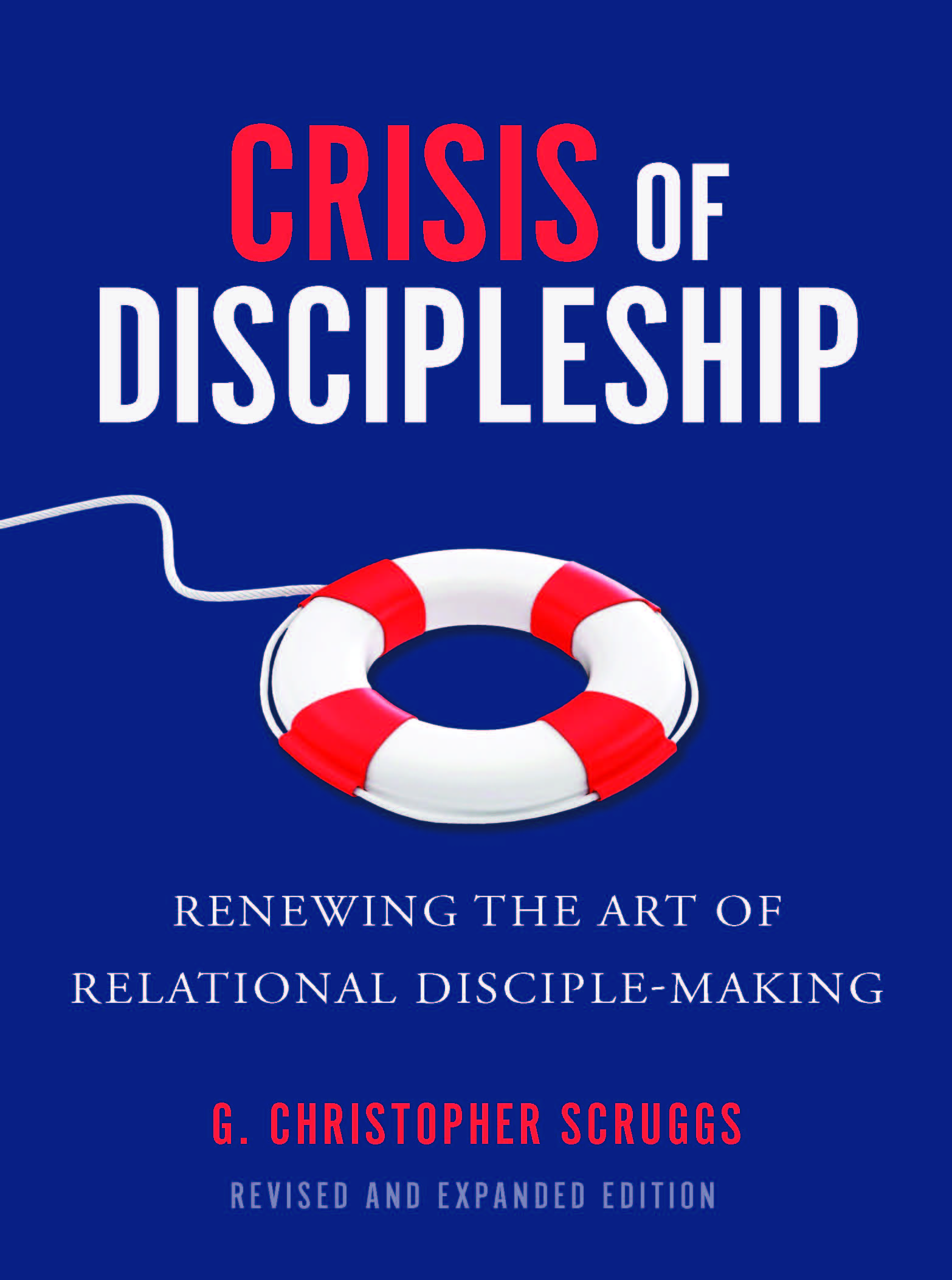 A few years ago, I published a book titled “Crisis of Discipleship.” I wrote the book out of a concern for the direction. The American Christian Church was heading in all denominations. It’s very obvious that the techniques and assumptions that we have been living under for the past several hundred years no longer work. For some, this is an invitation for continuous change. I would suggest the possibility that another tactic needs to be adopted as well: We need to make a return to the tradition of the church before the Reformation, before the split between the east and the west, back to the earliest Christian churches. Our Journey back to “the early church may need to include a journey to the church of Antioch, Alexandria, Constantinople, Ephesus, and Rome as well as into our current image of the early church. I think it is a journey worth taking.
The next blog will talk about community.
Copyright 2025, G. Christopher Scruggs, All Rights Reserved
[1] Stephen De Young, The Religion of the Apostles: Orthodoxy in the First Century (Chesterton, IN: Ancient Faith Publishing, 2021).