
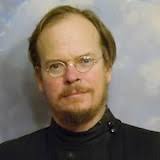
 This week, I’m going to be looking at a series of books by John Strickland, who an American Orthodox priest and scholar. He has published a look at Western civilization from the perspective of the Orthodox faith. It is in four volumes, the first of which is The Age of Paradise, which takes us from the Acts of the Apostles to around the year 1054, when the East and West divided.[1] The second book, entitled The Age of Division, includes the final separation of the Eastern Orthodox from the Roman Catholic tradition and the Protestant Reformation.[2] The third book, the Age of Utopia,covers the modern world from roughly the Enlightenment until the mid-19th century.[3] The final book, The Age of Nihilism, covers the period from Wagner and Nietzsche until today. It is an extremely ambitious undertaking, as you can see.[4]
I think Strickland’s project is important for the future and for understanding the past. The modern world is over, and the way forward is to look to the past for clues to recovering a holistic view of Truth, Goodness, and Beauty. For Christians, the Orthodox tradition offers us a window into the past that can point us to the future. For all Christians, the consequences of the shattering of the universal church that began with the Great Schism are significant. This is particularly challenging for Protestants because it requires reevaluating some of the positions developed during the Reformation in light of the Great Tradition embodied in what I might call “Universal Christianity.”[5]
For a number of years, I’ve been interested in Orthodoxy, which is important and interesting because it did not participate in the Christianization of the West, nor did it participate in the divisions in Western Christianity that produced modern denominations. Furthermore, for most of its history, it’s been a persecuted sect under both the Muslims and Soviet communism. Therefore, since the end of the Byzantine Empire, it has never been without its problems. Theologically, it is a less legalistic and more mystical form of Christianity. Once again, Latin Roman legalism never impacted the East in the same way it impacted the West.
Because it did not participate in the Reformation, it also avoided both what might be called the naked Biblicism of the Protestant and Reformed tradition and the dogmatic legalism of the Roman Catholic Church theology. I well remember being in Moscow during the years just after the fall of the iron curtain and being told by a Russian Baptist that they did not participate in American fundamentalist arguments and didn’t want them brought to Russia.
The Age of Paradise
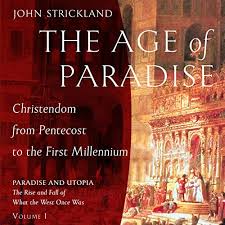 Protestants and postmodern readers may have a slight difficulty grasping the impact of the title, The Age of Paradise. Protestants may think that the pre-Reformation period is being portrayed as paradisical, and Roman Catholics may think that, in some sense, the period before the Great Schism was an earthly paradise. This is not what Strickland means by paradise. The age of paradise is intended to indicate a time when the church was united in one voice, pointing to what God had done in Jesus Christ and to the establishment of the kingdom of God, as reflected in the church. Strickland is very well aware of the misbehavior of both the early church and the Byzantine emperors. Nevertheless, one might say that this was a pre-dogmatic time, focused on the life, death, and resurrection of Christ, the church as the bearer of that revelation, and the church’s cooperation in improving the human condition within the confines of the undivided Roman empire.
The form of government the church developed during this period was called “Conciliar,” taking its cue from the Council of Jerusalem (Acts 15), where the church addressed difficult questions by convening councils. The most famous of these councils is the Council of Nicaea in the year 325, from which we get the Nicene Creed, which would be finalized in succeeding councils until a full-blown doctrine of the Trinity was established. During this period, the Bishop of Rome, whom we call the Pope, was merely the first among equals. It is a long story, but eventually the bishops of Rome began to claim that they had greater powers in the universal church than the conciliar form of government allowed.
In addition, in the West, under the influence of Augustine and the political demands of Charlemagne’s Empire, the creed was eventually supplemented with what is called the “filioque.” This adds “and the Son” to the creed with respect to the procession of the Holy Spirit from the Father. This may seem like a small, technical matter, but it was not a technical matter at that time.
There are two reasons why the East could not accept this. First, it was not done by a universal council. According to the concealer theory, no change can be made to the creed without the agreement of an ecumenical council of bishops. The pope had no right to insert this into the creed without calling a council. Second, it implies a kind of bi-theism, suggesting that the Father and the Son are independent entities and that the Spirit is derivative. In other words, it is not a proper way of describing the actual relationships. In the east, they felt that the Father was the source of both the Son and the Holy Spirit.
These two issues, together with the gradual cultural and legal separation of the eastern and western empires, resulted in the Great Schism of 1054. Personally, I found this first volume the most intriguing of the books, except for the last, because it is a part of history that we westerners rarely study.
The Ages of Division and Utopia
The Age of Division. The end of The Age of Paradise highlights how Italian politics and the waning influence of the Roman church contributed to widespread corruption. The Age of Division continues Strickland’s account of the rise and fall of key figures and events in Western history from around 1054 until the Protestant Reformation. Beginning with the Great Schism, it examines the papacy’s efforts to introduce meaningful reforms across Western Christendom. Aside from aiming to strengthen the spiritual vitality of church life, the Papal Reformation also inspired other movements, including the Crusades and, more indirectly, a penitential piety that gradually lessened the concept of paradise within Western culture. In other words, the Western Middle Ages embraced a cross-centered rather than resurrection-centered piety.
The book also recounts the story of Eastern Christendom during this period, when the Fourth Crusade and the Turkish invasion finally brought Constantinople to its knees. Yet in Russia, the Orthodox Church continued to foster the culture of the old Christendom, despite increasing isolation from the West and the destruction caused by Ivan the Terrible. The Age of Division ends with the sixteenth-century Protestant Reformation, which both continued the transformation initiated by the papacy in the eleventh century and, in significant ways, brought it to a close.
The Age of Utopia. Protestant scholars, who tend to be critical of the modern world, failed to recognize that the roots of modernity and the issues of the postmodern era trace back to the Reformation. During the Reformation, people in the West first challenged the authority of human tradition by asserting their personal judgment. Initially, this was limited to reforms within the Roman Catholic Church, which most people saw as unfortunate. Eventually, it extended to faith itself and to moral principles. Ultimately, the religious wars of the 16th century bred deep dissatisfaction with religion among intellectuals. It was the French Revolution that institutionalized this discontent, a concern that continues to influence the modern world.
When Thomas More wrote his great work Utopia, he was fully aware that he was describing nowhere. He also wanted to make clear that the Greek word utopia did not mean paradise. It meant nowhere. Unfortunately, as the modern world developed, especially after the French Revolution and Marx’s work, secular people began to transfer the notion of a paradise existing not on this earth but in communion with God to this world. The result has been a series of misadventures on both sides and much human misery. Both Marxist Communism in all its forms and Nazism are the results of this misguided attempt to create an earthly paradise.
Most recently, we see the romantic ideal of an earthly paradise, reflected in both the left and the right, and the notion that there can be an end of history within history in which all human problems have been solved. I’ve argued elsewhere that this is a grave mistake. Human beings are not capable of producing a paradise on earth. There will always be injustice and room for improvement. The best we can do is make the world a better place for ourselves and our families.
The Age of Nihilism
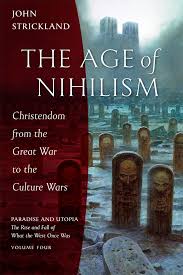 Strickland completes his survey in The Age of Nihilism. What makes the modern and postmodern world potentially demonic can be traced to the work of Wagner and Nietzsche, both of whom rejected Christianity, sometimes violently, and both of whom substituted a kind of pagan will worship that becomes fully developed in Nietzsche’s “Will to Power.” The first part of the Age of Reason involves the shift from the naive optimism of the Enlightenment to the extreme pessimism of postmodern theory. The first major postmodern theorist was Nietzsche. With Nietzsche came a hatred of Christianity and religion, a complete rejection of the Western Christian tradition, and the placement of human fulfillment in the Will, which finally reached a pathological level. Whatever the defenders of Wagner, Nietzsche, and their postmodern followers may say, there is a direct line from them to the Holocaust and to the deprivations of 20th-century communism in the East and West.
Both Wagner and Nietzsche were classic megalomaniacs (narcissists), unable to sympathize with others or to keep their thoughts and actions within moral boundaries. Ultimately, their ideological commitments led to the modern and postmodern glorification of power. This obsession with power is not unique to Marx. Western capitalism, in all its forms—social and otherwise—has been influenced by the idea that power can create a paradise. Strickland spends a significant amount of time criticizing Western liberalism (in its original sense) to show that the three major experiments of the modern world—Soviet communism, Nazi oligarchy, and Western liberal social democracy—have all failed to offer a meaningful purpose for human life or a guiding principle that limits the use of power to achieve political goals. The result has been progressive cultural and political decay in the East and West.
Conclusion
Strickland’s work is truly monumental. The attempt to summarize Western civilization from an Eastern perspective over more than 2,000 years is a monumental task. If one quibbles with an occasional conclusion, most of what it said is both historically accurate and a reasonable interpretation of the history involved. If occasionally I became overwhelmed by the amount of detail being delivered, generally speaking, the books kept my interest from beginning until end. Most importantly, it was fascinating to look at certain historical events that we westerners are familiar with from the perspective of a different cultural heritage.
People who are mostly secular might not find the entire series particularly appealing or the main message it aims to convey. However, they will definitely find the historical details within the book quite enlightening. For instance, I was especially captivated by the era spanning from the fall of the Roman Empire, during Augustine’s lifetime, to the reign of Charlemagne and his successors. This is a fascinating period of history that rushed by in school!
For Christians and others seriously concerned about the state of our culture, the four volumes, especially The Age of Nihilism, are long, serious commentaries on the difficult situation in which Western civilization finds itself. Strickland holds that Westerners need to recover their Eastern heritage to overcome our current cultural decline. I believe he makes a very good case for this view.
I will give Strickland the final word:
Without a transcendent anchor, the saeculum inevitably degenerates into self-destruction. The holy father Augustine, who more than any other established the concept of secularity, would have frozen in horror, had he foreseen the fruits of cosmological desecration. The secular disorientation of the West degenerated into an indignation with no outlet but violence. This was especially true after the rise of Communism, Nazism, and liberalism. Within the space of a single half century, for instance, collectivization (10 million peasants killed), General Plan East (45 million Eastern Europeans killed) and Roe v. Wade (65 million unborn children killed) made this clear enough. Only repentance can save the world. [6]
My reason for these blogs is to hopefully, in some small way, assist in forestalling the continuation of this tragedy.
Copyright 2026, G. Christopher Scruggs, All Rights Reserved
[1] John Strickland, The Age of Paradise: The Rise and Fall of What the West Once Was, Vol. 1 (Chesterton, IN: Ancient Faith Press, 2019). The author has a website (https://johnstrickland.org/), which I recommend and used in preparing this blog.
[2] John Strickland, The Age of Division: Christendom from the Great Schism to the Protestant Reformation Vol.2 (Chesterton, IN. Ancient Faith Press, 2020.
[3] John Strickland, The Age of Utopia: Christendom from the Renaissance to the Russian Revolution Vol. 3 (Chesterton, IN. Ancient Faith Press, 2021.
[4] John Strickland, The Age of Nihilism: Christendom from the Great War to the Culture Wars Vol. 4 (Chesterton, IN. Ancient Faith Press, 2019.
[5] This term “Universal Christianity” avoids the use of the word Catholic. It is nearly equivalent to what C. S. Lewis called “Mere Christianity.”
[6] Age of Nihilism, 380.
Very helpful review. Thank you.