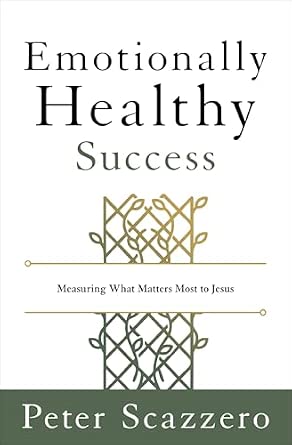
 This is the third week we’re exploring the upcoming book, Emotionally Healthy Success: Measuring What Matters Most to Jesus by Pete Scazzero.[1] You can pre-order the book on Amazon and other platforms. In this inspiring work, Scazzero continues to emphasize how vital emotional health is for pastors, church leaders, members, and entire religious communities. I’ll never forget the first time I read Pete’s powerful words: “There are many people in the church who cannot be the disciple God calls them to be because they lack the emotional maturity to become mature disciples.” That moment truly changed my life and perspective on ministry. It helped me realize that his words resonate with many people I’ve known in the church—including myself.
When I was in seminary, a New Testament professor discussed the great reversals Jesus brought about in people’s lives and in the expectations of the people of God. The Beatitudes summarize the reversals Jesus instituted. God’s blessings, it turns out, are for the poor in heart, the poor in spirit, those who are hungry and thirsty for righteousness, and those who are persecuted. This week, we’re going to focus on how Jesus requires us to reverse our thinking about success if we are to receive the kind of success the gospel offers.
The reversals Jesus offers require us to accept that success includes suffering, vulnerability, a willingness to go unnoticed, sacrifice, servanthood, and, above all, humility. If we embrace the reversals of Jesus, we will need to adopt a different way of measuring success, a different scorecard, than the world around us. Unfortunately, the church, and perhaps particularly the Western evangelical church, has long been dominated by the values of achievement, control, size, and visible success. It really doesn’t matter what pastors preach from the pulpit if the lives they lead in the churches they build are grounded in values indistinguishable from those of corporate leaders with extremely talented staffs.
 In order for us to change the secularization and worldliness of the contemporary church, we need four great rehearsals which Scazzero describes as follows:
- From prayer for results to prayer for communion
- From charisma to weakness and limits
- From our best ideas to discerning God’s voice
- From critical mass to critical yeast. [2]
From Prayer for Results to Prayer for Communion
Most pastors keep some form of prayer list. Unfortunately, studies have shown that many pastors rank prayer lower than other aspects of ministry, and many admit to having an inadequate prayer life. One study I read years ago found that pastors of larger congregations were especially likely to have an inadequate prayer life. Among Protestants, the problem is even worse. Protestants, with their historical skepticism of mystical religion, often underestimate the importance of communion with God compared with vocal or silent prayer. Among charismatics, there can be an emphasis on what used to be called “prayers of power.” I used to have a friend who ordered God to do a lot of things on the theory that this was the appropriate thing to do.
For me, the change came with exposure to Centering Prayer. For Scazzero, the change first came with his exposure to the Trappist monks:
The first gift came through exposure to Trappist monks who had dedicated their lives to prayer. Their commitment to silence and stillness as a means of surrendering their will to God’s will, along with their focus on listening to God more than talking to him, quietly unsettled me.[3]
The second change came through his study of and immersion in Jesus’ prayer life. Jesus, it turns out, made prayer a priority, and his first goal was simply to be in communion and constant fellowship with God. This is why the Father could say of the Son, “This is my beloved son in whom I am well pleased” (Matthew 3:17; Mark 1:11; Luke 3:21-22).
Communion, Clarity, and Direction
This, then, should be the first item in the scorecard of a Christian leader: Become a simple child of God, sitting at the Father’s feet, listening for wisdom, experiencing the Father’s love, and being content with the status of a beloved child of God. Unfortunately, too many Christian leaders drift slowly away from the Father’s feet, caught up in ceaseless activity on behalf of the Son, and, in the end, lose the power of the Holy Spirit.
Jesus withdrew to pray at decisive points in his ministry. He withdrew in order to renew his sense of purpose, discern the Will of God, and make important decisions, such as choosing his disciples.[4] When I’ve faced difficult decisions as an administrator, I’ve found that taking time to pray quietly can be incredibly helpful. Over the years, through many successes and setbacks, I’ve learned to rely on silent prayer in challenging moments. Sometimes it may seem like a waste of time, but I’ve discovered that this quiet time often brings a deep sense of guidance. After praying, I might not hear a clear voice, but I do feel a nudge toward certain actions. Once I follow that lead, I often feel assured that I am aligned with God’s will. I believe that for every Christian leader, pausing for listening prayer is a vital way to connect with God and find clarity in making good decisions.
Prayer and Power
One primary delusion in our society concerns power and its ability to force others to adopt our way of thinking, acting, and believing. This is a kind of power that Christian leaders must reject. However, there is another kind of power that Christian leaders receive when they make prayer their first priority. It is not the overt power the world worships. It is a quiet power that reveals itself in weakness, servanthood, occasional suffering, and even failure. Here is how Scazzero makes the point:
Prayer is where we, too, receive power. Not the power to make things happen on our terms, but the strength to persevere, wait, obey, and stay faithful through testing and setbacks. No strategy or support system can give us that. Only God can.[5]
 One of the most challenging times I faced in ministry was dealing with a staff member at a large church who had committed financial wrongdoing. Even though I was trained as a lawyer and had years of experience as a senior pastor, this issue, along with others I was handling at the time, felt overwhelming. It quickly became clear that I needed to meet with the church leadership responsible for finance. I spent twenty minutes alone in my office, praying for God’s mercy and wisdom. After that, I picked up my pen and quickly listed ten steps essential to address the problem. I’m not sure how long it would have taken me to come up with that on my own, but I was confident that God had granted me the wisdom to identify the first important steps needed to resolve the situation. The group met just before noon, and by 1:00 in the afternoon, the church’s lay leadership had taken charge of the problem.
Abandoning the False Lure of Charisma
Another false scorecard item pastors are tempted to believe is that extreme charisma is a sign of spiritual power and sound decision-making. Anyone who pays attention to the dramatic failures of popular, visible charismatic Christian leaders should realize this is false. Charisma, as our society counts it, is a rare combination of physical, emotional, personal, and other characteristics that gives a person the power to get others to do what they want. As pastors, we are not seeking that kind of power. We are seeking the power to do God’s will.
Interestingly, this insight isn’t just for religious professionals. When Jim Collins wrote his book Good to Great, he found that the most impactful changes in organizations weren’t led by charismatic leaders. Instead, they came from individuals who genuinely prioritized the organization, its employees, and its customers, always humbly serving the company’s best interests above all.[6]
Discerning God’s Will
During the 1990s, at the height of the Mega-Church movement, many pastors attended large conferences where pastors from very large churches urged them to imitate those churches’ leadership, worship, programming, and other practices as a key to success. More than one returned to his local church, attempted to implement changes, and failed miserably, sometimes ending his ministry.
A third problem with using the wrong scorecard and refusing to follow the humble path of Jesus is substituting one’s own will for that of some celebrity leader concerning what God wants from a particular local congregation. Discerning God’s will means slowing down, refusing to act impetuously, listening carefully to God and others, and then acting. It also means recognizing the limits of a particular church, a particular situation, and most importantly the limits of a particular leader. This means we must slow down, surrender control to God, and listen for God to direct our steps.[7]
Nothing is more indicative of an immature leader than an unwillingness to slow down, surrender control, embrace humility, and listen carefully to God and others. This means we must abandon the notion, so common in America and in the media, that leadership is primarily about being decisive, quick to act, and uncompromising. The truth is that the best leaders listen to everyone with humility, take whatever time is necessary to make a good decision, and are more than willing to compromise, change direction, or even abandon a course of action if it turns out to be outside God’s will.
As one inclined to embrace a worldly vision of leadership and the character of a worldly leader, I can testify that nothing is more spiritually liberating than giving up the false ideal so common in our culture, the leader as master of everything. There is a wonderful freedom in submitting ourselves to God, to those God has brought around us as leaders, to the limits God has placed on us and those around us, and to the tendency to overreact out of fear or anxiety. All these things distort our decision-making and prevent us from making the best decision in God’s world.[8]
An Ignatian Moment
Pete Scazzero directs our attention to Ignatius of Loyola’s insight that we need to reach a point of “indifference” in our prayer life and decision-making to make good decisions. In summary, we need to listen to God in the movement of God, not just in our minds, but also in our Will and emotions as we make decisions. What we are waiting for is the moment when we want God’s will more than anything else and, so to speak, are indifferent to the worldly consequences of the answer to our prayer. In other words, when making decisions, leaders should feel that they, their organization, and the people closest to them will be drawn closer to God by the decision. This kind of decision-making takes time.
From Numbers to Discipleship of Future Leaders
One important discovery a Christian pastor or other leader can make is that the number of followers is less important than their quality. Success depends not on the actions of a large number of people, though many may be involved in the end, but on the actions of a few people who do the right things at the right time and in the right place. Christian leaders need to remember that, while Jesus did speak to large crowds, he focused his attention on a relatively small number of people who would carry his ministry to the ends of the Earth. Skipping personal discipleship with small groups deprives Christian leaders of their greatest potential for impact.[9]
Conclusion
By now, it should be clear that Jesus calls Christian leaders to a different kind of leadership and a different measure of success than the world elevates. In recent years, my wife and I have primarily attended relatively small congregations. Some were new church plants; others were ancient churches led by priests. One thing I have appreciated learning is that the best church leaders are personally humble, love their congregation, get close to members, act carefully and wisely, and try to imitate Christ.
Becoming this kind of a leader requires adjustment. Here’s how Scazzzero puts it in Emotionally Healthy Success:
Jesus is not asking us to make small adjustments to our leadership. He is inviting us to stop playing the old success game entirely— to step out of the world of scale, hurry, worldly influence, comparison, and visibility— so we can learn a new way of seeing what truly matters.[10]
Next week, I will move on to the kinds of changes that Christian leaders and others need to make to become leaders like Jesus who focus on what truly and eternally matters.
Copyright 2026, G. Christopher Scruggs, All Rights Reserved
[1] Pete Scazzero, Emotionally Healthy Success: Measuring What Matters Most to Jesus (Grand Rapids, MI: Zondervan, 2026. The blogs in this series are inspired by this book. I was given the opportunity to review an advance copy of the book, which I recommend to interested readers.
[2] Id, 57.
[3] Id, 58-59.
[4] Id, 62.
[5] Id, 63.
[6] Jim Collins, Good to Great (New York, NY: HarperBusiness, 2001).
[7] Emotionally Healthy Success, 71.
[8] Id.
[9] Id, 76.
[10] Id, 79.