Emotionally Healthy Success No. 6: Choose the Way of Life

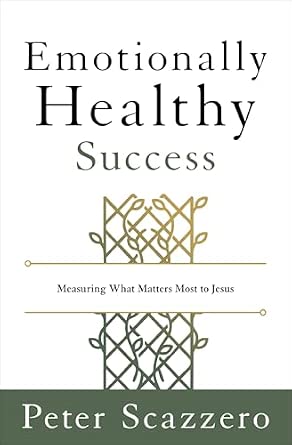
This is the sixth and final week of a multi-week look at a uniquely Christian measure of success as presented in Pete Scazzero’s new book, Emotionally Healthy Success: Measuring What Matters Most to Jesus.[1] Emotionally Healthy Success is the latest in a series of books that Pete Scazzero and his wife, Geri, have written on emotional health and on emotionally healthy pastors and congregations. The underlying thesis is simple: Many Christians (including many pastors) cannot become the disciples and leaders they are called to be for Christ because of emotional blockages from their childhoods. Therefore, the church of Jesus Christ needs to undertake this work to remedy the problem. The remedy involves bringing to bear on our discipleship programs and leadership both the insights of modern psychology and the most ancient insights of the Christian church. It’s a worthy undertaking.[2]

You can pre-order Emotionally Healthy Success on Amazon and other retailers. I am attaching links to all the blogs in the series. However, these blogs are not a substitute for the book, which contains much more information and anecdotes than I can provide. Please purchase the book and sign up for training in Emotionally Healthy Discipleship,which describes what this movement is about. You can find a lot of additional information on the Emotionally Healthy website at https://www.emotionallyhealthy.org/.

One of my favorite Bible passages concerns Moses and the people of Israel. As they completed their time in the wilderness, Moses set before the people the blessings and curses involved in the decision to follow and asks the people the most important question they would ever be asked:

See, I set before you today life and prosperity, death and destruction. For I command you today to love the Lord your God, to walk in obedience to him, and to keep his commands, decrees and laws; then you will live and increase, and the Lord your God will bless you in the land you are entering to possess. But if your heart turns away and you are not obedient, and if you are drawn away to bow down to other gods and worship them, I declare to you this day that you will certainly be destroyed. You will not live long in the land you are crossing the Jordan to enter and possess. This day I call the heavens and the earth as witnesses against you that I have set before you life and death, blessings and curses. Now choose life, so that you and your children may live and that you may love the Lordyour God, listen to his voice, and hold fast to him. For the Lord is your life, and he will give you many years in the land he swore to give to your fathers, Abraham, Isaac and Jacob (Deuteronomy 30:15-20).

All too often, we read this passage as a relic of the past—a reminder of the choices Israel faced and the consequences of failing to remain faithful to God after entering the Promised Land. However, we must remember that we are also citizens of God’s heavenly city. We to have entered our own Promised Land through our commitment to be faithful to Christ and to be members of this Church. We can’t expect our churches, families, or other communities to thrive if we don’t honor the promises we’ve made.

As pastors, priests, church leaders, and members of a local congregation, we have to answer a fundamental question: Will I continue living by culture’s faster, louder standards, or will I choose God’s slower, truer way?[3]Unfortunately, our churches are full of leaders who teach or lead proclaiming one definition of success week after week, but in fact, live by a completely different and culturally conditioned definition of success. Every leader, including myself, has been tempted to live by the world standard of success, while preaching Jesus’s standard of success from the pulpit. Every church leader who has led more than one congregation, or has any long-term experience with multiple congregations, has seen firsthand the damage caused when a church or its leadership imitates the world.

, many years ago, I learned of a tragic situation in a large corporate-style church. The pastor and senior leadership had adopted an extremely centralized corporate model of church management. Unfortunately, they made poor decisions, some of which were financial. Over time, they lost the congregation’s trust, and during an economic recession, the church was badly damaged. It took years to recover—and the leadership’s reputation was permanently damaged by this failure. The failure ultimately stemmed from following this world’s standards instead of Jesus’.

I’ve shared before some words from my mentor, Dave Schieber, who, early in my career, warned me not to seek success or become too involved in church politics. “Everyone who does eventually comes to a bad end,” he advised. I’ve seen the truth of that advice play out in churches, intermediate church bodies, and even in national church bodies. It is easy to fall into the trap of emulating the world in our Christian leadership and in how we structure and manage our churches.

The Slow and Humble Way

If we are to be the church leaders God calls us to be, we must choose a humbler, secret, almost invisible, and slow way of leadership. Today, we look at the American Church and see a magnificent edifice in decline. Throughout church history, the church has emerged from persecution and insignificance into leadership, only to return to insignificance as it became proud, losing the gift of humility.

We should not be surprised at this because, throughout scripture, God warns us that he builds his people slowly and incrementally. He does so through the activity of people who were unknown to the world at large. The great empires of the ancient world probably did not know  much of anything about Abraham, Isaac, Jacob, or probably even David. It’s almost certain that Ceasar Augustus never heard of the little baby born in a manger in Bethlehem in Judea at the fringes of his empire. If he had known, he probably wouldn’t have cared.

David gives us a great example of what happens when we lose our willingness to humbly wait upon God. In his early career, he was a great success despite persecution. Then came pride and the lust pride brings. In his relationship with Bathsheba, he undid much of what he had accomplished and brought a curse upon himself and his whole household. The apostle Paul, who was not always patient, seem to recognize by the time he wrote First Corinthians that his individual leadership was not the essential point. He planted the church and then Peter, Apollo, and others made visits. All of them together, built the church (1 Cor. 3:5-6).

One of my friends, who is not a pastor but an attorney and a Roman Catholic, once advised me to remember that “we are all interim pastors.” Even if we’re the founder of the church, it doesn’t belong to us, just as the church of Corinth did not belong to Paul. Even if we’re the best preacher in the history of the church, the church does not belong to us, just as the Corinthian church did not belong to Apollos. Even if we are a great leader of the church, the church does not belong to us, just as the Corinthian church did not belong to the apostle Peter. We are all servants with a small part in advancing the kingdom of God. Someday, our time will pass and someone else will take over.

When we come to realize this, we can be liberated from the fallen standards of our world. We can see ourselves as servants of Christ, called to a particular task, large or small, in confidence that God will continue the work through other hands. America is a relatively new country, and it is hard for us to see the world through the eyes of one for whom 1000 years is like the passing of the night. God is building his church even when we see failure. It may be that we will see failure all the days of our life. But from God’s perspective, the work we are doing, however small, is of infinite value to God.

Trusting God

I’ve probably preached 100 sermons on faith and trusting God, and I’ve heard just as many on the same subject. It’s easy to talk about trusting God, but it’s harder to trust God and let God work without referring to our timetable. Pete Scazzero offers three basic principles to guide us in taking the Longview and trusting God:

  1. Do the internal work of maintaining a close relationship with God before the external work of building the church.
  2. Remember that small things may end up being very big and that big things may end up being very small. Concentrate on discipling the people at hand and trust God for growth.
  3. Finally, be faithful and trust God during the long middle time between the beginning and the end of a pastorate or project.[4]

Everyone who knows me knows I struggle with all these anchors for ministry. I tend to be hyperactive and would always prefer to be in action rather than sitting still and waiting on God. I love to begin new programs with a splash. I resist the very small task of being present to the person across the table from me right now. Finally, it can be difficult for me to put up with the boring time between the exciting beginning and the exciting end of any project. Yet success or failure lies in our spiritual life, in being willing to be small, in trusting God, and in continuing on through the depressing time between the exciting beginning and the glorious end of ministry.

Being before doing, being willing to be small, and trusting God in the middle are not techniques that can be taught. They involve forming character and living a lifestyle. They begin with prayer, the meditative study of Scripture, time alone in contemplation, a rule of life to keep one centered, and the patience to do things God’s way rather than the world’s way. In Emotionally Healthy Success, Pete outlines many small techniques and habits any pastor can develop to cultivate the character and lifestyle of Jesus.

I like the way Pete ends his discussion of these three principles:

As I look back over these three anchors—doing the work before the work, learning to see small and big differently, and trusting the long middle—I’m struck by how unremarkable they sound. And yet these three truths have steadied me through decades of loss, mountaintops, and long stretches in which nothing seemed to change. They have taught me that the deepest work of God is rarely rushed, rarely obvious, and almost never completed on our timetable.[5]

Once again, before signing off, I want to remind people that I have only covered a small part of the richness of Emotionally Healthy Success related to these three principles. Pete offers many important examples and suggestions that have changed how I view success and leadership.

I’m concluding my review of this book with this blog post. I haven’t had a chance to delve into the details of the various appendices. When I first reviewed the book and spoke with someone from Emotionally Healthy Discipleship, I noted that I found the appendices among the most valuable parts of his writings. He outlines a clear path for a local church to become an emotionally healthy congregation. He also discusses church succession as a way to validate an Emotionally Healthy Church. Additionally, he provides a brief overview of church history and explains how the monastic movement, which underpins many rules of life, changed the world. Finally, he offers a Rule of Life for Emotionally Healthy Leaders—a Ruule of Life I wholeheartedly endorse. In outlining the specifics of this Rule of Life, he discusses practical ways to weave it into a busy schedule and even suggests a simplified version for those who find a longer rule daunting. If you remember my critique of Protestant Rules of Life, you’ll recall my concern about the lack of discipline and community accountability. In one appendix, he addresses that specific issue.

Here are all the links to the past blogs:

  1. Measuring What Matters Most to Jesus: https://wp.me/p4CzBH-1av
  2. A Deep Dive into False Metrics: https://wp.me/p4CzBH-1aC
  3. Jesus’ Four Great Reversals: https://wp.me/p4CzBH-1aF
  4. A New Scorecard: https://wp.me/p4CzBH-1aP
  5. Structuring a Life for Christ-like Success: https://wp.me/p4CzBH-1aSChoose the Way of Life

Good luck, readers, and if you need help or clarification, please let me know.

Copyright 2026, G. Christopher Scruggs,  All Rights Reserved

[1] Pete Scazzero, Emotionally Healthy Success: Measuring What Matters Most to Jesus  (Grand Rapids, MI: Zondervan, 2026. I was given the opportunity to review an advance copy of the book, which I recommend to interested readers. The basic ideas for this blog are found in Chapter 7 of Emotionally Healthy Success.

[2] Scazzero’s thesis is set out in a series of books and programs that a local congregation can adopt. See Peter Scazzero, The Emotionally Healthy Church (Grand Rapids, MI: Zondervan, 2003, 2010). Emotionally Healthy Discipleship: Moving from Shallow Christianity to Deep Transformation (Grand Rapids, MI: Zondervan, 2021). For those who wish to read all of his books, see Emotionally Healthy Spirituality, updated ed. (Grand Rapids, MI: Zondervan, 2017), and The Emotionally Healthy Leader: How Transforming Your Inner Life Will Deeply Transform Your Church, Team, and World (Grand Rapids, MI: Zondervan, 2017). All the blogs in the series are worth reading, but if you have no prior experience with the materials, start with Emotionally Healthy Success, then read Emotionally Healthy Discipleship.

[3] Emotionally Healthy Success, 141.

[4] Id, at 144.

[5] Id, at 161.

Emotionally Healthy Success No. 5: Structuring a Life for Christ-like Success

Anyone who wants to follow Christ needs to create a positive plan and build meaningful practices into their daily routine to achieve their goal. Simply having a little self-awareness, setting a goal to be more like Christ, and attending church once a week or giving some money during the offering isn’t enough. Growing in faith takes much more effort and commitment.

In 1992, shortly before graduating from seminary, I did an independent study on mystical theology. As part of that study, I read the Rule of Saint Augustine for the first time. For my semester project, I constructed a rule of life incorporating certain aspects of the Augustinian rule.[1] Less than five years later, I had a spiritual director who was a Benedictine monk in an Anglican order. At that time, I became interested in the Benedictine rule as it has been applied from time to time. When I became interested in Centering Prayer, I joined a group at a local Episcopal Church. Interestingly, this church had a lawyer as a prominent member who had drafted a highly modified, almost non-binding Benedictine rule that he used for his life and suggested for others. During this time, on and off, I tried to follow a rule of life, generally some modification of the rule I worked on in seminary.

I would like to report success in my endeavors, but the truth is that the story of my rule of life is a story of half-hearted attempts followed by periodic failure. In the process, however, I learned a great deal and formed three opinions:

  1. It is easy to draft a personal rule of life.
  2. It is hard to follow it.
  3. In monastic and other orders, it can be done because regular accountability makes it possible.

The conclusion of my struggles is simple: If you want to have a workable rule of life to keep you and your ministry centered in Christ, don’t try to do it alone. It is simply too hard in our culture to follow a rule of life consistently without some degree of accountability. Personal rules unconnected to a group of people who are attempting to follow it are too likely to fail to produce the kind of deep spiritual change most pastors need and want.

Embracing a Rule of Life Strong Enough to Hold Your Calling

When I began learning about and teaching Emotionally Healthy Discipleship, I eventually merged some of Pete Scazzero’s ideas with my own to create a rule of life that integrates his general framework into my Augustinian forma.[2]I’ve shared it from time to time with a small group of people and at least once in this series of blog posts. Still, I struggle to make it meaningful. What is needed is a community committed to the rule. Therefore, it is not surprising that Pete has encouraged pastors to adopt a rule of life in Emotionally Healthy Success and has attempted to create a public rule of life that churches and leaders can use to foster an emotionally healthy culture in their churches.[3]

Here is what Pete says in Emotionally Healthy Success:

The truth is, Geri and I are still learning too. After more than three decades, we’ve come to see that every pastor and ministry leader needs both a clear Rule of Life rooted in emotional health and a community of those also committed to living it out together. Conferences and intensive cohorts are valuable, but they can’t provide the kind of ongoing formation and mutual support we all need to sustain deep transformation.[4]

I like the way he puts it: Christian leaders need a rule of life strong enough to support our spiritual life as we seek to help form the spiritual life of others.

The Crisis of American Spirituality

I’ve told people many times that I feel lucky to have entered the ministry after a professional career and after many years as a Christian leader, serving as an elder, Deacon, Sunday School teacher, and endless committee member in a very good church. I was accustomed to maintaining my Christian faith under stress. In my first ministry, I served a small church that desperately needed to grow spiritually and numerically. Although our seminary did not offer classes in spiritual formation, I did an independent study on Reformed spirituality and the ancient Catholic practices. That study left me better prepared than most students for the pressures of ministry. Then, with another local pastor, I had a monastic Spiritual Friend, with whom I could share and who gently encouraged me to maintain a healthy spiritual life. For a time, two of my congregations had a trained counselor and spiritual director on staff. It helped a great deal.

The truth is, as I’ve mentioned before, our seminaries often don’t do enough to nurture spiritual growth. I believe most seminaries do a decent job of encouraging pastors to study the Bible beyond lesson planning, to pray, and to participate in other spiritual practices. The key word here is encouragement. There is a noticeable difference between encouraging people and simply training them. Unfortunately, many professors have little hands-on experience in ministry.

From my own experience, the most well-known professor at my seminary had only a three-year pastorate before pursuing a doctorate. Thereafter, he worked in academia. He ever again served a local church. In my view, three years isn’t quite enough time to fully develop as a pastor. For example, in a small church, those three years often just cover the honeymoon phase, without encountering and overcoming the real pressures that follow. In addition, what is most important is that the pastor face and successfully survive those pressures. Finally, the challenges pastors face do not always fit neatly into a three-year timeline. My professor was a wonderful person and a brilliant scholar, but I recognize that his understanding of pastoral ministry was somewhat limited.

It is fair to compare modern pastor training with how Timothy, for example, was trained by Paul. They were partners in ministry for an extended time. They lived together, worked together, and traveled together. Timothy saw Paul handle difficult situations. Paul sent Timothy on short-term trips to solve problems in churches he had planted. He then had an opportunity to talk about what had happened during the visit. In other words, Timothy’s spirituality was not formed in a classroom but right onsite, next to an established and experienced evangelist.

In a similar way, when a novice joins a monastery, they don’t take a class on spirituality. They begin living the spiritual life together with older, more experienced monks. There might be some amount of teaching, but there’s a large amount of imitation, day-to-day correction, and modeling. We can’t really escape the problems with pastoral formation in America until we get ourselves accustomed to the notion that it’s primarily the job of existing pastors to train future pastors, whatever help is received from seminaries, colleges, graduate schools, or a host of other institutions.

ete Scazzero puts the problem this way:

We’ve minimized the spiritual formation of leaders by rushing them into ministry before their inner life has been anchored in God, essentially bypassing the slow, hidden work required to sustain a lifetime of rooted, fruitful service. We prioritize theological information over spiritual formation when we need to do both. We offer conferences that inspire and cast vision but lack the ongoing relational structures and depth necessary for lasting fruit. We assume that calling plus gifting plus opportunity equals great leadership for God.[5]

Adapting Monastic Rhythms for Contemporary Ministry

In Emotionally Healthy Success, Scazzero does a wonderful job of showing from Church history how the monastic movement arose to meet a need for greater and deeper Christian spirituality among leaders. He also does a good job of dealing with the fact that most church leaders are not monks. We have spouses, children, extended family, a network of friendships, and, of course, a local congregation of which we are a part. We don’t have the same ability to have the kind of structured life that a monastery provides. Furthermore, most of us don’t even desire to have that kind of structure. We need something else. So did Pete and Geri Scazzero.[6]

As the structure of Emotionally Healthy Discipleship emerged, the Scazzero’s realized they needed a way to incorporate some of the ancient church’s wisdom into a new approach to encouraging spiritual growth and emotional maturity in the conditions of the 21st Century. The result has been the slow development of a new way of looking at a rule of life for emotional and spiritual health today.[7] This rule of life centers around our need for prayer, rest, relationships, and meaningful work. Scazzero helpfully includes a practical chart that helps readers work out for themselves what that means for their particular life.

Here is how Pete describes the results over time:

I won’t pretend that following any of these four rhythms is easy, much less quick or popular. In fact, living by this Rule of Life will challenge everything our culture believes about leadership and success. It will slow you down so you can listen deeply. It will make you appear less productive while making you more fruitful. It will lead you to surrender outcomes and find a deep, holy freedom in doing only what God asks. But here’s what I’ve discovered after decades of living this way: It works. Not according to the metrics of a performance-driven model, but in ways that bear fruit that lasts. Those who embrace this Rule of Life don’t just survive—they flourish.[8]

Becoming Part of a Group

Remember when I mentioned my doubts about whether I and most people I know can stick to a rule of life without outside help? I think Pete and Geri Scazzero feel the same way. That’s why they’re offering churches and pastors a chance to be part of something bigger. They’ve started the “Order of Emotionally Healthy Leaders,” a movement dedicated to living by a rule of life that fosters emotional and spiritual growth and to sharing that vision within the churches they serve. This movement provides the kind of order and discipline I think is necessary for pastors to maintain spiritual maturity. It’s probably not the only way, but it’s one way. It is worth checking out.

I suggest that every religious leader who reads this blog consider, once again, reading, exploring, and getting the kind of training that will enable them to bring this movement into their own local congregation. I wish I had discovered this many years earlier. I’m retired now, but I also wish that I had been part of this kind of movement to give me better support in my often-on attempts to live by a rule of life that would allow me to be an authentically balanced Christian leader in our home and in the churches I served. I might have avoided many mistakes and failures.

Copyright 2026, G. Christopher Scruggs, All Rights Reserved

[1] In a prior blog, I gave a brief outline of that Rule of Life, a version of which I still follow. For a rendition of that rule, see “Adopting a Rule of Life for Healthy Spirituality” July 18, 2023, July 18, 2023 ChrisScruggs at www.gchristopherscruggs.com.  

[2] Peter Scazzero, The Emotionally Healthy Church (Grand Rapids, MI: Zondervan, 2003, 2010). Emotionally Healthy Discipleship: Moving from Shallow Christianity to Deep Transformation (Grand Rapids, MI: Zondervan, 2021). For those who wish to read all of his books, see Emotionally Healthy Spirituality, updated ed. (Grand Rapids, MI: Zondervan, 2017), and The Emotionally Healthy Leader: How Transforming Your Inner Life Will Deeply Transform Your Church, Team, and World (Grand Rapids, MI: Zondervan, 2017). All the blogs in the series are worth reading, but if you have no prior experience with the materials, start with Emotionally Healthy Success, then read Emotionally Healthy Discipleship.

[3] Pete Scazzero, Emotionally Healthy Success: Measuring What Matters Most to Jesus  (Grand Rapids, MI: Zondervan, 2026. I was given the opportunity to review an advance copy of the book, which I recommend to interested readers. Pete has advised me that Emotionally Healthy Success can be preordered. If you pre-order today, you can start reading chapter 1 immediately. Hopefully this offer is still available.

[4] Id, 134.

[5] Id, 118.

[6] I’ve been aware that I’m not giving Geri Scazzero full credit for her role in Emotionally Healthy Discipleship. Geri’s encouragement and insistence led Pete to begin his journey toward emotional maturity in ministry. She has also been active in the emotionally healthy ministry throughout its existence. In addition, she wrote The Emotionally Healthy Woman, which is a course in its own right. See The Emotionally Healthy Woman: Eight Things You Have to Quit to Change Your Life (Grand Rapids, MI: Zondervan, 2005). She was an active leader in the various teaching sessions Kathy and I attended during the leadership course.

[7] Emotionally Healthy Success, 125.

[8] Id, 133- 134. Once again, I have summarized many pages that readers need to digest on their own.

Emotionally Healthy Success No. 4: A New Scorecard

This is the fourth look at Emotionally Healthy Success: Measuring What Matters Most to Jesus by Pete Scazzero.[1] You can pre-order the book on Amazon and other sites. If you pre-order today, you can start reading chapter 1 immediately. I recommend that all interested readers do so. You will not regret time spent reading the book.

In Emotionally Healthy Success, Scazzero continues his focus on the role of emotional health in the life of pastors, church leaders, church members, and religious groups.[2] These blogs are not a substitute for the book, which contains much more information and anecdotes than I can provide. Please purchase the book and sign up for some kind of training in Emotionally Healthy Discipleship, which describes what this movement is about. You can find a lot of additional information on the he Emotionally Healthy website at https://www.emotionallyhealthy.org/.

In my earlier blogs, I’ve explored some common misunderstandings about success that many Christian leaders might fall into, along with the misguided ways we often measure success and failure. Thankfully, Scazzero shares the key elements of a fresh, more meaningful scorecard that can help us assess our ministry more honestly. He also introduces two important steps that can genuinely help pastors follow Jesus more closely and disciple others as Jesus envisioned. The two movements are:

Movement 1:  Prioritize Personal Formation— breathing in the life of God by the Spirit of Christ. This is the inward work of cultivating your relationship with God and allowing God to deeply form your character.

Movement 2: Prioritize Culture Formation— breathing out the life of God by creating an authentic Christian community. This is the outward work of building community and bearing witness to Christ.[3]

These are two basic changes pastors must make to have an emotionally healthy impact.

Personal Formation in Christ

Traditional Christian leadership formation, especially among Protestants, often lacks an emphasis on personal spiritual formation, leaving pastors emotionally and spiritually ill-equipped to help individuals and the body of Christ in their personal lives. For Protestants, this is a failure of sanctification and intense discipleship, and it results in what Dietrich Bonhoeffer called a kind of unchristian discipleship born of “Cheap Grace.”

Bonhoeffer felt that the Christian church in the West has too often preached and offered what he called Cheap Grace. This perspective highlights his concern about the need for a more genuine and committed approach to faith. [4]  Bonhoeffer compared “cheap grace” with “costly grace.” Costly grace is the grace Christ speaks of when he says, “If anyone would come after me, let him deny himself and take up his cross and follow me” (Mark 8:34). Cheap grace is the offer of forgiveness of sins in a way that costs a believer nothing and requires no faithful response. Bonhoeffer describes cheap grace as “preaching of forgiveness without requiring repentance, baptism without church discipline, Communion without confession, absolution without personal confession. This was a terrible mistake. “Cheap Grace,” he said, “is the deadly enemy of our Church.” [5] Cheap grace is grace without discipleship, grace without the cross, grace without Jesus Christ, living and incarnate.”[6]

In terms of pastoral preparation, especially in what used to be called “mainline” churches in America, the emphasis was on preaching and on pastors as “theologians in residence,” as one of my seminary leaders put it. Unfortunately, this is not what Jesus had in mind, nor is it what the church needs. What the church needs is “Little Imperfect Jesuses in Residence.” Generations of pastors have been prepared and sent out to serve churches without developing the spiritual character needed to truly move people along the path of discipleship. The resulting devastation is all around us.

For about six years, I was either on or served as the chairman of a committee within the ministry of a local church body. During that time, I had the opportunity to help congregations recover from what I can only call pastoral spiritual malpractice. Many of these failed pastors were emotionally immature and brought that immaturity into the life of a local congregation in an unhealthy way. Occasionally, they also lacked fundamental pastoral skills and the emotional intelligence to get along with people. Mainline seminaries and the supervisory bodies that send people to seminary are responsible for failing to detect serious emotional problems before a person is admitted to seminary and for failing to provide every student with the spiritual and emotional tools needed to be successful.

In Emotionally Healthy Success, Scazzero outlines eight qualities from the life of Jesus that are necessary for an emotionally and spiritually successful religious leader:

  1. Be with God. Jesus prioritized being with God before doing for God (Luke 3:21–23; 4:1–14; 5:15–16).
  2. Listen to God. Jesus slowed down to listen for God’s voice before

making decisions (Matthew 26:36–46; Mark 1:35; Luke 6:12; John 5:19–20; 8:28).

  1. Break Free of the Broken Past. Jesus broke free from family and cultural expectations to form the new family of God (Mark 3:20–22, 31–35; John 8:48–49, 59).
  2. Embrace Holiness of Life. Jesus stewarded his sexual life (in his case singleness) as a prophetic sign of God’s love for the world (Matthew 19:11–12; John 10:30; 17:21–23).
  3. Seek Emotional Wholeness. Jesus engaged the full range of emotions— from painful to joyful— as a doorway to God and deeper wisdom (Matthew 26:37; Mark 3:5; 6:6; 14:34; Luke 10:21; 19:41).
  4. Be Present with People. Jesus was intentional about being fully present with others (Mark 5:25–34; 10:13–16; 10:21; John 3–4).
  5. Learn to Communicate Honestly, Wisely, and Lovingly. Jesus cultivated honest relationships by engaging in difficult conversations when necessary (Matthew 16:23; 23:27; Mark 8:31–38; 10:17–22).
  6. Live within Your Limits. Jesus joyfully received the gift of limits to fulfill God’s

will and purpose (Matthew 15:24; Mark 1:35–38; 4:38; Luke 5:15–16; John 5:19; 17:4).[7]

Community Formation in Christ

If seminaries do a poor job of personal Christian formation, they do just as poor a job in training pastors in the art of forming a Christian community. This is surprising on several levels. Fundamentally, it involves a failure to recognize that Jesus spent his entire ministry forming a community, training its future leaders, and creating what would become his church, which is to be the family of God or even the kingdom of God on earth. If we are to send representatives of Christ into local congregations, they need to be equipped and trained to do what Jesus did.

The reasons for the failure to adequately prepare pastors are complex, but fundamentally the church formed an early alliance with the Roman government that let it rely on external factors for its presence and importance in society. In America, where no church was established, there was still a cultural expectation that large numbers of people would attend church, and some would find meaning and purpose in providing Church leadership. Unfortunately, those days are past.

Churches today must take seriously the need to create leaders who can create congregations with a church culture that enables the growth of what is sometimes called “the provisional Kingdom of God,” that is, a healthy church that models for the world what God intends for human relationships and reaches out with the wisdom and love of God to transform its community.  Scazzero sets out eight marks that a local church is forming a culture in the Way of Jesus:

  1. Divine Relationship. Jesus fostered a culture in which being with him came before doing for him (Mark 3:14; Luke 10:38–42).
  2. Divine Listening. Jesus cultivated a culture in which decisions flowed from listening to God’s voice (Matthew 17:5; John 10:27; Acts 1:12–15; 13:1–4).
  3. New, Healthy Community. Jesus formed a culture that enabled people to break free from unhealthy family-of-origin patterns and past emotional and spiritual wounds, so they could live freely in the new family of Jesus (Luke 9:57-62; 14:25-35).
  4. Marriage and Singleness. Jesus formed a culture that equipped both married people and singles to live as prophetic signs of God’s love for the world (Matthew 19:4–6, 10–12; 22:29–32).
  5. Caring Community. Jesus fostered a culture of honesty, love, and trust, in which people no longer needed to hide or pretend (Luke 6:35–37; John 13:34–35).
  6. Personal Deep Discipleship. Jesus cultivated a culture that prioritized deep discipleship among the few and employed a layered strategy throughout his ministry (Matthew 28:18–20; Luke 6:12–18; 10:1–17).
  7. Inclusive Community. Jesus proclaimed the gospel in ways that broke down walls among people and brought good news to the poor and marginalized (Matthew 9:35–36; 15:24; 25:31–36; John 20:21).
  8. Christlike Leadership. Jesus cultivated a culture in which leaders taught and exercised authority rooted in their transformed lives with God (Mark 1:35–39; Luke 4:1–17; 22:31–32).[8]

I am sure that readers and others could develop a slightly different list, but the point is simple: The primary duty of a Christian leader is to create a community that models the triune love of God in a particular place.

The Truly Transformed Leader

These lists might make developing a post-corporate Church culture and a Christ-centered ministry seem simpler than it is. The fact is that even the most committed church leaders with strong biblical and theological backgrounds are part of contemporary American corporate and bureaucratic culture. It is best, therefore, to think of these characteristics as helpful markers. You can add your own specific markers for your local church or denomination to show that leaders and churches are steadily making progress. The goal is to become the kind of people and organic Christlike church body that God ultimately intends for everyone.

A strength of Emotionally Healthy Discipleship, which is also a point of incompleteness, is that Pete is trying to write a book to help churches, both traditional and contemporary, across all historic denominations. One thing he can’t address, therefore, is the specifics of leadership in terms of whether it is Episcopal, Reformed, Free Church, Apostolic, Democratic, or whatever. This is an area in which every church or group that embraces Emotionally Healthy Discipleship must make its own choices and craft the underlying program and ideas suited to its situation and needs.

Similarly, various streams of Christianity would find minor differences in the kind of pastoral and community formation that best fits their particular way of being a church. In my case, and as a hint of where I believe all churches should be headed, the theological and other divisions of the Reformation no longer excite the next generation of Christians, nor do they point the way toward a renewed Christian culture. One reason I’ve been so interested in the Emotionally Healthy Discipleship movement is that Pete Scazzero is careful to draw on church history, especially the period before the Great Schism, for inspiration. I think it’s the right move. This may be a hard move for some groups, but it’s worth undertaking. This does not mean that groups must give up their unique identity. It means incorporating what has been lost into the present-day church.

Copyight 2026, G. Christopher Scruggs, All Rights Reserved 

[1] Pete Scazzero, Emotionally Healthy Success: Measuring What Matters Most to Jesus  (Grand Rapids, MI: Zondervan, 2026. This, the last and the remaining blogs in this series are inspired by this book. I was given the opportunity to review an advance copy of the book, which I recommend to interested readers.

[2] Peter Scazzero, The Emotionally Healthy Church (Grand Rapids, MI: Zondervan, 2003, 2010). Emotionally Healthy Discipleship: Moving from Shallow Christianity to Deep Transformation (Grand Rapids, MI: Zondervan, 2021). For those who wish to read all of his books, see Emotionally Healthy Spirituality, updated ed. (Grand Rapids, MI: Zondervan, 2017), and The Emotionally Healthy Leader: How Transforming your Inner Life will Deeply Transform your Church, Team, and World (Grand Rapids, MI: Zondervan, 2017).

[3] Emotionally Healthy Success, 82. A full examination of these two movements occupies Chapters 4 and 5 of the book.

[4] Dietrich Bonhoeffer, The Cost of Discipleship Rev. Ed. (New York, NY: Collier Books, 1963. See, G. Christopher Scruggs, Crisis of Discipleship: Renewing the Art of Relational Disciplemaking (Richmond, VA: Living Dialog 2023).

[5]Id, at 45.

[6]Id, at 47.

[7] Id, 92-93.

[8] Id, 109-111.

Labor Day 2026—Why a Nation without Laborers is a Bad Idea

Last week, I forgot to mention that I was going to take a Labor Day break from Emotionally Healthy Success to talk about Labor Day and the importance of labor. In the meantime, you can still sign up for an advance copy of Emotionally Healthy Success and get a free copy of one chapter. Take time to do this. You will not regret it.

One word about this post. All forms of economic organization, including free enterprise, communism, socialism, and state managed economies fail when not connected to the greater good of human flourishing. There can be no independently successful  economic organization separate from the transcendental goal of fairness and the search for harmony and the common good. I would not want this blog to be read otherwise.

In my first pastorate, our family lived in a small town in the third-poorest county in Tennessee. Our church was near the dividing line between wealthier and poorer areas. On my first day, a member asked to take me on a drive through an extremely poor part of the city. It was also a part of the city where unemployment, drug abuse, and violence were endemic. Much of the city’s crime stemmed from that neighborhood. The drive left a lasting impression. Before that ministry was complete, our church led a citywide effort to create a community center in that neighborhood. One of the community center’s goals was to provide educational opportunities that lead to work.

Biblical Background

The Bible begins with a story about two people living in a perfect world—a garden we call Eden. They were to be shepherds and gardeners, taking care of the creation God had given them. Very quickly, they fail in their task and are removed from the garden into a life marked by hard work, family difficulties, and a host of other problems.

Because of the way the story is structured, many people see work as a curse. I was one of those people for a long time. Our time in West Tennessee helped cure me of that misunderstanding. I’m not much of a gardener; however, we had a small yard, and I became a gardener. Gardening changed the way I looked at the book of Genesis and the creation story. One thing I can tell you for sure: even without the Fall, the human race was going to be hard-working. I learned very quickly that weeds don’t just get pulled up once; they get pulled up all summer. I learned that plants don’t need to be pruned only once; they need to be pruned more than once. I learned that trees have to be trimmed and that pests have to be dealt with. I learned that gardens have to be planted more than once. Gardening is a pretty demanding profession.

I’m telling the story because it’s important to read our minds of the idea that work is evil and to read the story of Creation as telling us that work, that is, work given to us by God for our own good, is a blessing, even though it’s hard. And idleness, especially that idleness that comes from an inability or unwillingness to work, is not a blessing. It’s a curse.

Labor Day

Each year, in early September, we celebrate Labor Day. Many of us have little idea why we celebrate Labor Day. We’ve celebrated Labor Day every year for most of our lives. On Labor Day, we go fishing, or camp out, or have a neighborhood block party, or spend time with our family and friends. What we don’t do on Labor Day is work with our hands. We also don’t think about those who do.

It used to be that in major cities, and even in the small town where I grew up, there was a Labor Day parade. The unions, which are much less influential than they were in my youth, sponsored the Labor Day parades because it was the time of year when they could celebrate labor’s victory over a period in our nation’s history when laborers were abused.

With the Industrial Revolution came a host of social problems. America, which had once been a land of small farmers, suddenly became a place where many people, eventually most people, lived in urban areas and many worked for large corporations in which they had little or no ownership. There was a division between management and labor. The extreme division between management and labor was caused by the Industrial Revolution.

In my own family, we owned a farm. Our great-grandfather was the primary farmer and went into the field every day, though his role was mostly managerial. The children and others provided most of the labor. When we lived in Brownsville, we lived in a farming community, where there had been a pretty big division between the landowner farmers and what were once called sharecroppers. One of the members of my congregation, who was in his late 80s, was famous for always going out into the field to work with everyone else. The only difference is it was his habit to wear a white shirt and tie underneath his overalls. Everybody else just wore the overalls. He was a wise and practical person who had spent most of his life on a tractor., though he owned a fairly significant farm.

With the advent of large corporations and significantly white collar cities, many in management never even see the laborers they distantly supervise.  They work in office buildings in places like Detroit, Houston, Los Angeles, or New York City. Laborers often work in oil fields or factories far removed from corporate headquarters. This builds a sense of psychic distance that I am not sure is healthy.

In the beginning of the Industrial Revolution,  women and children were forced to work excessive hours. Safety was largely ignored. Workers were poorly paid and taken advantage of, perhaps especially in the mining and manufacturing industries. The result was the growth of unions. Unions were formed to protect laborers’ rights against the social evils created by the Industrial Revolution.

In some ways, the Industrial Revolution was a time not much different from our own, when wealth had become extremely concentrated and power was exercised by just a few oligarchs. It was a time when the national economy was run for the benefit of the few. Some of you know that part of the blogs I’ve written deals with the legal problems created by the way state legislators, and even our national government, resisted regulating these enormous businesses.

Labor Day is an annual celebration that honors the social and economic achievements of American workers and recognizes their vital role in making the American Dream a reality. Since the late 19th century, there have been efforts to highlight the importance of labor and its value to our nation. For instance, in 1882, Peter J. McGuire, the general secretary of the Brotherhood of Carpenters and Joiners and a co-founder of the American Federation of Labor, proposed dedicating a day as a “general holiday for the laboring classes” to pay tribute to those “who from rude nature have delved and carved all the grandeur we behold.” Because revolutionaries adopted May 1 as their day, there was resistance to fixing American Labor Day in the spring. After a long period of ad hoc local celebrations, on June 28, 1894, President Grover Cleveland signed a law making the first Monday in September each year a national holiday. It remains America’s Labor Day.

Why a Labor-Free World is a Bad Idea

Many utopians envision a world in which people don’t have to work. Some people believe that the advent of artificial intelligence and robotics means that people will not only not have to work, but they also believe many people will not be able to work. Robotics empowered by artificial intelligence has the potential to eliminate many jobs. These utopians want a national minimum wage, allowing many, if not most, people to enjoy endless leisure. Even among white-collar workers, we already see the impact of artificial intelligence on employment. I think this is a problem that needs to be thought about by every American and our leaders.

Meaningful work, you see, is an ennobling experience. Those who work to produce goods and services for others have the satisfaction of knowing that they’re helping their fellow human beings while earning their own living and supporting their own family. There is a certain independence and healthy self-image that comes from knowing that one earns one’s own living and supports one’s own family.

Perhaps more importantly, it’s psychologically important to work. When I was young, I was pretty lazy. My father and his best friend conspired to get me to work on the Frisco Railroad, laying ties and working on bridge gangs for several summers. Today, some of my fondest memories are swinging a spike maul on a hot afternoon in Arkansas, barely able to keep going. I’m also extremely grateful for the friendships I made while living in a railroad car converted to house workers on a bridge gang. Even though I’ve spent the vast majority of my life as a white-collar professional, I am grateful for the experience of working hand in hand with laborers, belonging to a union, and sharing their lives as we traveled across southern Missouri and Arkansas, laying track and repairing bridges.

Most of the things we did have long since disappeared, but just occasionally, when I’m home, I pass a crossing or go over a bridge, and remember that I worked on that bridge at that crossing over a half century ago. I remember the foreman and a number of the workers who taught me how to work with my hands. Work draws a person out of isolation into a community of fellow workers.

Work is not just socially important or economically important. It’s emotionally and spiritually important for the worker. Going back to my first church, on that first day,we passed house after house in which young men were sitting on the porch, getting ready to go out for the night, or drinking or taking drugs. Every one of those young people was larger, stronger, and more capable than I ever was. Many of them would end up fathering children out of wedlock, engaging in illegal activities, drinking or taking recreational drugs, and spending a bit of time in and out of the county jail. They didn’t have to work because of welfare, but the absence of work was not a good thing.

Those who think we ought to do away with work sometimes forget that young men who are tired after a long day of swinging and using a spike maul don’t get into much trouble at night. My brother, my best friend, and I might occasionally have an illegal beer at a local bar on the way home, but by 8 o’clock we were getting ready for bed because 6:30 AM comes early, and by 7:30 I was swinging a spike maul again. The social cost of people who don’t work or who don’t have sufficient or appropriate work for their capacities is huge.

Conclusion

Labor Day reminds us of an important truth. We often view our economy as simply a system for generating money to support families and help some individuals become wealthy. Of course, earning money supports families, which is crucial. However, what we sometimes overlook is that the wealth of a few is actually the result of creating valuable work for everyone. The core purpose of our economy isn’t to make a select few extremely rich or to boost the net worth of the wealthiest Americans, fueled by the idea that wealth will gradually reach everyone else. At its core, our economy isn’t solely about money at all; it’s about providing meaningful, helpful, and, ideally, rewarding work for everyone who needs a job.

This is why I believe that even if we could make work optional, even if we could create a world in which no one has to work, it would be a bad idea. It would deprive most people of the ennobling experience of labor. It would be better to find ways to ensure that every person who can work has work. We ought to be thinking about work that is truly ennobling and productive, not make-work that benefits no one.

I mentioned that I have fond memories of the Frisco Railroad. It’s gone now, merged into a larger conglomerate. One day more than 50 years ago, I sat on the porch of a caboose with an elderly-looking black man who had once been a jockey and was now part of our bridge gang. He was only a short time from retirement. Both of us were drinking Coca-Cola in the twilight of a hot July Day near Black Rock, Arkansas.

He shared his life and his dreams with me. He grew up as a sharecropper and escaped poverty by working on the railroad. His family still lived on a small plot of land in Mississippi, from which he commuted. Upon retirement, he planned to return to that little farm. He intended to spend a good bit of time sitting on the porch in his rocking chair. But he knew enough about farming to know that’s not all he would be doing. Even old men can be useful at planting and harvest time.

I will remember that conversation for the rest of my life. My friend, so different from me in every possible way, rarely leaves my mind for more than a month. He’s one of the blessings of having been a laborer in one of the most difficult and exhausting jobs a person can do.

Happy Labor Day.

Copyright 2026, G. Christopher Scruggs, All Rights Reserved