
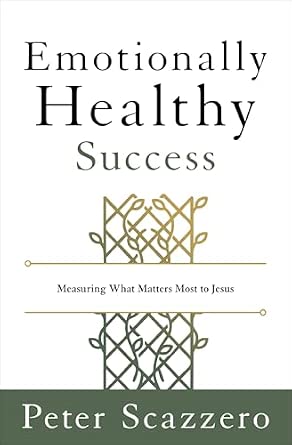
 This is the sixth and final week of a multi-week look at a uniquely Christian measure of success as presented in Pete Scazzero’s new book, Emotionally Healthy Success: Measuring What Matters Most to Jesus.[1] Emotionally Healthy Success is the latest in a series of books that Pete Scazzero and his wife, Geri, have written on emotional health and on emotionally healthy pastors and congregations. The underlying thesis is simple: Many Christians (including many pastors) cannot become the disciples and leaders they are called to be for Christ because of emotional blockages from their childhoods. Therefore, the church of Jesus Christ needs to undertake this work to remedy the problem. The remedy involves bringing to bear on our discipleship programs and leadership both the insights of modern psychology and the most ancient insights of the Christian church. It’s a worthy undertaking.[2]
You can pre-order Emotionally Healthy Success on Amazon and other retailers. I am attaching links to all the blogs in the series. However, these blogs are not a substitute for the book, which contains much more information and anecdotes than I can provide. Please purchase the book and sign up for training in Emotionally Healthy Discipleship,which describes what this movement is about. You can find a lot of additional information on the Emotionally Healthy website at https://www.emotionallyhealthy.org/.
One of my favorite Bible passages concerns Moses and the people of Israel. As they completed their time in the wilderness, Moses set before the people the blessings and curses involved in the decision to follow and asks the people the most important question they would ever be asked:
See, I set before you today life and prosperity, death and destruction. For I command you today to love the Lord your God, to walk in obedience to him, and to keep his commands, decrees and laws; then you will live and increase, and the Lord your God will bless you in the land you are entering to possess. But if your heart turns away and you are not obedient, and if you are drawn away to bow down to other gods and worship them, I declare to you this day that you will certainly be destroyed. You will not live long in the land you are crossing the Jordan to enter and possess. This day I call the heavens and the earth as witnesses against you that I have set before you life and death, blessings and curses. Now choose life, so that you and your children may live and that you may love the Lordyour God, listen to his voice, and hold fast to him. For the Lord is your life, and he will give you many years in the land he swore to give to your fathers, Abraham, Isaac and Jacob (Deuteronomy 30:15-20).
All too often, we read this passage as a relic of the past—a reminder of the choices Israel faced and the consequences of failing to remain faithful to God after entering the Promised Land. However, we must remember that we are also citizens of God’s heavenly city. We to have entered our own Promised Land through our commitment to be faithful to Christ and to be members of this Church. We can’t expect our churches, families, or other communities to thrive if we don’t honor the promises we’ve made.
As pastors, priests, church leaders, and members of a local congregation, we have to answer a fundamental question: Will I continue living by culture’s faster, louder standards, or will I choose God’s slower, truer way?[3]Unfortunately, our churches are full of leaders who teach or lead proclaiming one definition of success week after week, but in fact, live by a completely different and culturally conditioned definition of success. Every leader, including myself, has been tempted to live by the world standard of success, while preaching Jesus’s standard of success from the pulpit. Every church leader who has led more than one congregation, or has any long-term experience with multiple congregations, has seen firsthand the damage caused when a church or its leadership imitates the world.
 , many years ago, I learned of a tragic situation in a large corporate-style church. The pastor and senior leadership had adopted an extremely centralized corporate model of church management. Unfortunately, they made poor decisions, some of which were financial. Over time, they lost the congregation’s trust, and during an economic recession, the church was badly damaged. It took years to recover—and the leadership’s reputation was permanently damaged by this failure. The failure ultimately stemmed from following this world’s standards instead of Jesus’.
I’ve shared before some words from my mentor, Dave Schieber, who, early in my career, warned me not to seek success or become too involved in church politics. “Everyone who does eventually comes to a bad end,” he advised. I’ve seen the truth of that advice play out in churches, intermediate church bodies, and even in national church bodies. It is easy to fall into the trap of emulating the world in our Christian leadership and in how we structure and manage our churches.
The Slow and Humble Way
If we are to be the church leaders God calls us to be, we must choose a humbler, secret, almost invisible, and slow way of leadership. Today, we look at the American Church and see a magnificent edifice in decline. Throughout church history, the church has emerged from persecution and insignificance into leadership, only to return to insignificance as it became proud, losing the gift of humility.
We should not be surprised at this because, throughout scripture, God warns us that he builds his people slowly and incrementally. He does so through the activity of people who were unknown to the world at large. The great empires of the ancient world probably did not know much of anything about Abraham, Isaac, Jacob, or probably even David. It’s almost certain that Ceasar Augustus never heard of the little baby born in a manger in Bethlehem in Judea at the fringes of his empire. If he had known, he probably wouldn’t have cared.
David gives us a great example of what happens when we lose our willingness to humbly wait upon God. In his early career, he was a great success despite persecution. Then came pride and the lust pride brings. In his relationship with Bathsheba, he undid much of what he had accomplished and brought a curse upon himself and his whole household. The apostle Paul, who was not always patient, seem to recognize by the time he wrote First Corinthians that his individual leadership was not the essential point. He planted the church and then Peter, Apollo, and others made visits. All of them together, built the church (1 Cor. 3:5-6).
One of my friends, who is not a pastor but an attorney and a Roman Catholic, once advised me to remember that “we are all interim pastors.” Even if we’re the founder of the church, it doesn’t belong to us, just as the church of Corinth did not belong to Paul. Even if we’re the best preacher in the history of the church, the church does not belong to us, just as the Corinthian church did not belong to Apollos. Even if we are a great leader of the church, the church does not belong to us, just as the Corinthian church did not belong to the apostle Peter. We are all servants with a small part in advancing the kingdom of God. Someday, our time will pass and someone else will take over.
When we come to realize this, we can be liberated from the fallen standards of our world. We can see ourselves as servants of Christ, called to a particular task, large or small, in confidence that God will continue the work through other hands. America is a relatively new country, and it is hard for us to see the world through the eyes of one for whom 1000 years is like the passing of the night. God is building his church even when we see failure. It may be that we will see failure all the days of our life. But from God’s perspective, the work we are doing, however small, is of infinite value to God.
Trusting God
 I’ve probably preached 100 sermons on faith and trusting God, and I’ve heard just as many on the same subject. It’s easy to talk about trusting God, but it’s harder to trust God and let God work without referring to our timetable. Pete Scazzero offers three basic principles to guide us in taking the Longview and trusting God:
- Do the internal work of maintaining a close relationship with God before the external work of building the church.
- Remember that small things may end up being very big and that big things may end up being very small. Concentrate on discipling the people at hand and trust God for growth.
- Finally, be faithful and trust God during the long middle time between the beginning and the end of a pastorate or project.[4]
Everyone who knows me knows I struggle with all these anchors for ministry. I tend to be hyperactive and would always prefer to be in action rather than sitting still and waiting on God. I love to begin new programs with a splash. I resist the very small task of being present to the person across the table from me right now. Finally, it can be difficult for me to put up with the boring time between the exciting beginning and the exciting end of any project. Yet success or failure lies in our spiritual life, in being willing to be small, in trusting God, and in continuing on through the depressing time between the exciting beginning and the glorious end of ministry.
Being before doing, being willing to be small, and trusting God in the middle are not techniques that can be taught. They involve forming character and living a lifestyle. They begin with prayer, the meditative study of Scripture, time alone in contemplation, a rule of life to keep one centered, and the patience to do things God’s way rather than the world’s way. In Emotionally Healthy Success, Pete outlines many small techniques and habits any pastor can develop to cultivate the character and lifestyle of Jesus.
I like the way Pete ends his discussion of these three principles:
As I look back over these three anchors—doing the work before the work, learning to see small and big differently, and trusting the long middle—I’m struck by how unremarkable they sound. And yet these three truths have steadied me through decades of loss, mountaintops, and long stretches in which nothing seemed to change. They have taught me that the deepest work of God is rarely rushed, rarely obvious, and almost never completed on our timetable.[5]
Once again, before signing off, I want to remind people that I have only covered a small part of the richness of Emotionally Healthy Success related to these three principles. Pete offers many important examples and suggestions that have changed how I view success and leadership.
I’m concluding my review of this book with this blog post. I haven’t had a chance to delve into the details of the various appendices. When I first reviewed the book and spoke with someone from Emotionally Healthy Discipleship, I noted that I found the appendices among the most valuable parts of his writings. He outlines a clear path for a local church to become an emotionally healthy congregation. He also discusses church succession as a way to validate an Emotionally Healthy Church. Additionally, he provides a brief overview of church history and explains how the monastic movement, which underpins many rules of life, changed the world. Finally, he offers a Rule of Life for Emotionally Healthy Leaders—a Ruule of Life I wholeheartedly endorse. In outlining the specifics of this Rule of Life, he discusses practical ways to weave it into a busy schedule and even suggests a simplified version for those who find a longer rule daunting. If you remember my critique of Protestant Rules of Life, you’ll recall my concern about the lack of discipline and community accountability. In one appendix, he addresses that specific issue.
Here are all the links to the past blogs:
- Measuring What Matters Most to Jesus: https://wp.me/p4CzBH-1av
- A Deep Dive into False Metrics: https://wp.me/p4CzBH-1aC
- Jesus’ Four Great Reversals: https://wp.me/p4CzBH-1aF
- A New Scorecard: https://wp.me/p4CzBH-1aP
- Structuring a Life for Christ-like Success: https://wp.me/p4CzBH-1aSChoose the Way of Life
Good luck, readers, and if you need help or clarification, please let me know.
Copyright 2026, G. Christopher Scruggs, All Rights Reserved
[1] Pete Scazzero, Emotionally Healthy Success: Measuring What Matters Most to Jesus (Grand Rapids, MI: Zondervan, 2026. I was given the opportunity to review an advance copy of the book, which I recommend to interested readers. The basic ideas for this blog are found in Chapter 7 of Emotionally Healthy Success.
[2] Scazzero’s thesis is set out in a series of books and programs that a local congregation can adopt. See Peter Scazzero, The Emotionally Healthy Church (Grand Rapids, MI: Zondervan, 2003, 2010). Emotionally Healthy Discipleship: Moving from Shallow Christianity to Deep Transformation (Grand Rapids, MI: Zondervan, 2021). For those who wish to read all of his books, see Emotionally Healthy Spirituality, updated ed. (Grand Rapids, MI: Zondervan, 2017), and The Emotionally Healthy Leader: How Transforming Your Inner Life Will Deeply Transform Your Church, Team, and World (Grand Rapids, MI: Zondervan, 2017). All the blogs in the series are worth reading, but if you have no prior experience with the materials, start with Emotionally Healthy Success, then read Emotionally Healthy Discipleship.
[3] Emotionally Healthy Success, 141.
[4] Id, at 144.
[5] Id, at 161.