Into Christ/Into Others

Over the next few weeks, I will be writing again on discipleship. I begin with one of Paul’s favorite terms, “In Christ.” “If anyone is in Christ, they are a new creation. Behold: The old has gone and the new has come.” (2 Corinthians 5:17). The “in Christ is what is called a spherical dative. In other words, if anyone is the sphere of Christ’s influence, they are a new creation. Jesus puts the “in Christ” in a slightly different way in John:

 I am the true vine, and my Father is the gardener. He cuts off every branch in me that bears no fruit, while every branch that does bear fruit he prunes so that it will be even more fruitful. You are already clean because of the word I have spoken to you. Remain in me, as I also remain in you. No branch can bear fruit by itself; it must remain in the vine. Neither can you bear fruit unless you remain in me.

I am the vine; you are the branches. If you remain in me and I in you, you will bear much fruit; apart from me you can do nothing. If you do not remain in me, you are like a branch that is thrown away and withers; such branches are picked up, thrown into the fire and burned. If you remain in me and my words remain in you, ask whatever you wish, and it will be done for you. This is to my Father’s glory, that you bear much fruit, showing yourselves to be my disciples.

As the Father has loved me, so have I loved you. Now remain in my love. If you keep my commands, you will remain in my love, just as I have kept my Father’s commands and remain in his love (John 15:1-10).

The Greek word (Meno) has many similar meanings, each of which makes it clearer what it means to be a disciple.

  • to remain
  • to abide, to stay (in a place)
  • to expectantly await or continue (in a state)
  • to endure (in a task)
  • to exist permanently in, inseparably united in a relationship [1]

Remaining in God

It seems to me that Jesus intends for each of these meanings to be included in our relationship with God and others. We are to stay connected to Jesus, remain with Him, expectantly wait for His next “mighty act of God,” and endure through difficult times. Our relationship with God is meant to be permanent as we remain united with God in Christ. The same thing might be said of our relationship with a church and other Christians. We need to “abide” with those people God has placed in our care and into a relationship with us.

The Jewish theologian and author, Martin Buber, emphasized the importance of personal, loving relationships—what he called “I Thou” relationships—with nature, other people, and God. Buber begins by recognizing that God is not merely an idea or a principle of the universe that we can understand abstractly or objectively, but a person whom we come to know through His creative, revealing, and redeeming acts. It is God’s initiative in revealing Himself as the Divine Person that makes it possible and necessary for us to intimately know God as a “Thou.”[2]

This is crucial for understanding why we must keep personal relationships with God and others as we grow as disciples. It also reminds us that there are limits to the spiritual growth that biblical and theological knowledge can provide. When our level of abstract (“I-It”) knowledge of God, the Bible, theology, etc., exceeds our personal (“I Thou”) relational knowledge with the living God, our discipleship stalls and declines. In ministry, I have repeatedly seen, both in my own life and in the lives of other pastors and teachers, how too much abstraction and not enough loving communion with God can hinder not only our spiritual lives but also the spiritual lives of others. One reason why annual retreats, times of silence and solitude, and sabbaticals are so vital for Christian leaders is that these periods help us build a relationship with God.[3]

Remaining with Others

In the letter of James, we find one of the most convicting passages in all of Holy Scripture: “Whoever claims to love God yet hates a brother or sister is a liar. For whoever does not love their brother and sister, whom they have seen, cannot love God, whom they have not seen” (I John 4:20). When Jesus speaks of “abiding” or “remaining in him,” he concludes his teaching with some words about loving one another:

As the Father has loved me, so I have loved you. Now stay in my love. If you keep my commands, you will remain in my love, just as I have kept my Father’s commands and remain in his love (John 15:10).

The idea is that if we love God, we will love other Christians; indeed, we will love the entire world just as God has loved us. Recently, I have been listening to the Gifford Lectures by Yale theologian Miroslav Volf. In this fourth lecture, he discusses the agapic love of Jesus. In doing so, he quotes from Fyodor Dostoevsky’s The Brothers Karamazov.

A true act of love, unlike imaginary love, is hard and forbidding. Imaginary love yearns for an immediate heroic act that is achieved quickly and is seen by everyone. People may actually reach a point where they are willing to sacrifice their lives, as long as the ordeal doesn’t last too long, is quickly over-just like on stage, with the public watching and admiring. A true act of love, on the other hand, requires hard work and patience, and, for some, it is a whole way of life.

And again:

Brothers, have no fear of men’s sin. Love a man even in his sin, for that is the semblance of Divine Love and is the highest love on earth. Love all God’s creation, the whole and every grain of sand in it. Love every leaf, every ray of God’s light. Love the animals, love the plants, love everything. If you love everything, you will perceive the divine mystery in things. Once you perceive it, you will begin to comprehend it better every day. And you will come at last to love the whole world with an all-embracing love. Love the animals: God has given them the rudiments of thought and joy untroubled. Do not trouble it, don’t harass them, don’t deprive them of their happiness, don’t work against God’s intent. Man, do not pride yourself on superiority to the animals; they are without sin, and you, with your greatness, defile the earth by your appearance on it, and leave the traces of your foulness after you–alas, it is true of almost every one of us! Love children especially, for they too are sinless like the angels; they live to soften and purify our hearts and, as it were, to guide us. Woe to him who offends a child! Father Anfim taught me to love children. The kind, silent man used often on our wanderings to spend the farthings given us on sweets and cakes for the children. He could not pass by a child without emotion. That’s the nature of the man.[4]

The notion is that we must love the world with exactly the same kind of love that we must have for God. Just as it was hard, dreadfully hard for God to love the world enough to give of his Word and rescue the world in awful suffering and patience, we too must show that same kind of love to others. None of us can be everywhere or love everyone, so we are called to love those closest to us, family, friends, co-workers, fellow church members—all those with whom we come into contact in our day-to-day lives.

Back to Buber (and Pete Scazzero)

When introducing Buber’s insight, Scazzero shares a meaningful story from Buber’s life. One day, during an inspiring spiritual moment in Buber’s life, a young man visited him. Martin Buber paid attention to the young man and said all the right things, but he wasn’t truly listening to him as a person. Later, he learned that the young man had committed suicide after leaving his office. This experience made him realize that he had been relating to the young man as an object —a student —rather than as a person. It was this realization that prompted his first steps toward understanding and teaching the importance of the “thou” relationship.[5]

I don’t know a single counselor or pastor who hasn’t had a similar, though less dramatic, experience. I can’t tell you how many times I’ve listened to an older person tell stories, thinking, “I am going to fall asleep if this goes on much longer.” Or how many times someone came to my office for counseling for the third or fourth time, repeating the same story. In these moments, it’s easy to treat the other person as an object: “This is my parishioner. I have to pay attention,” rather than seeing them as a person: “This is a child of God whom I’m called to help.”

In his books and teachings, Pete Scazzero asks us to ask ourselves three important questions as we relate to people:

  1. Am I fully present or distracted?
  2. Am I loving this person or judging them?
  3. Am I open to being changed by this encounter?

Two of these three questions are obvious. The third needs a bit of explanation. Being open to being changed doesn’t mean “Being open to deny my faith.” It means that each person we relate to causes us to change and grow in some way. [6]

I think this is similar to the difference between being a tourist and living in a different culture. I’ve been both. When you’re a tourist, you’re there for just a few days or maybe weeks. Although you’re interested in the differences between your culture and theirs, you aren’t really being changed. You’re just visiting. But when someone spends a long time in another culture, they’re subtly changed. You never see your own country quite the same way again. If it’s a different part of our country, you never see our country in quite the same light again. You haven’t stopped being an American. You haven’t stopped being a Christian, but you have become deeper and richer as a human being.

Becoming a deeper disciple does not necessarily mean becoming a different kind of disciple. It means becoming more fully what Christ desires us to be. It means allowing the Holy Spirit to transform our lives, including in completely unexpected ways.

Copyright 2025, G. Christopher Scruggs, All Rights Reserved

[1] See Meno in Greek Lexicon https://biblehub.com/greek/3306.htm

[2] Martin Buber, I and Thou 2nd ed. (New York, NY: Scribners, 1958). In his book, he describes the difference between relationships in which we view nature, other human beings, or spiritual realities as persons (a “thou”) or objects (an “it”). God, as a spiritual being can be objectified, but not personally known as an object, only as a person. Id, at 135.

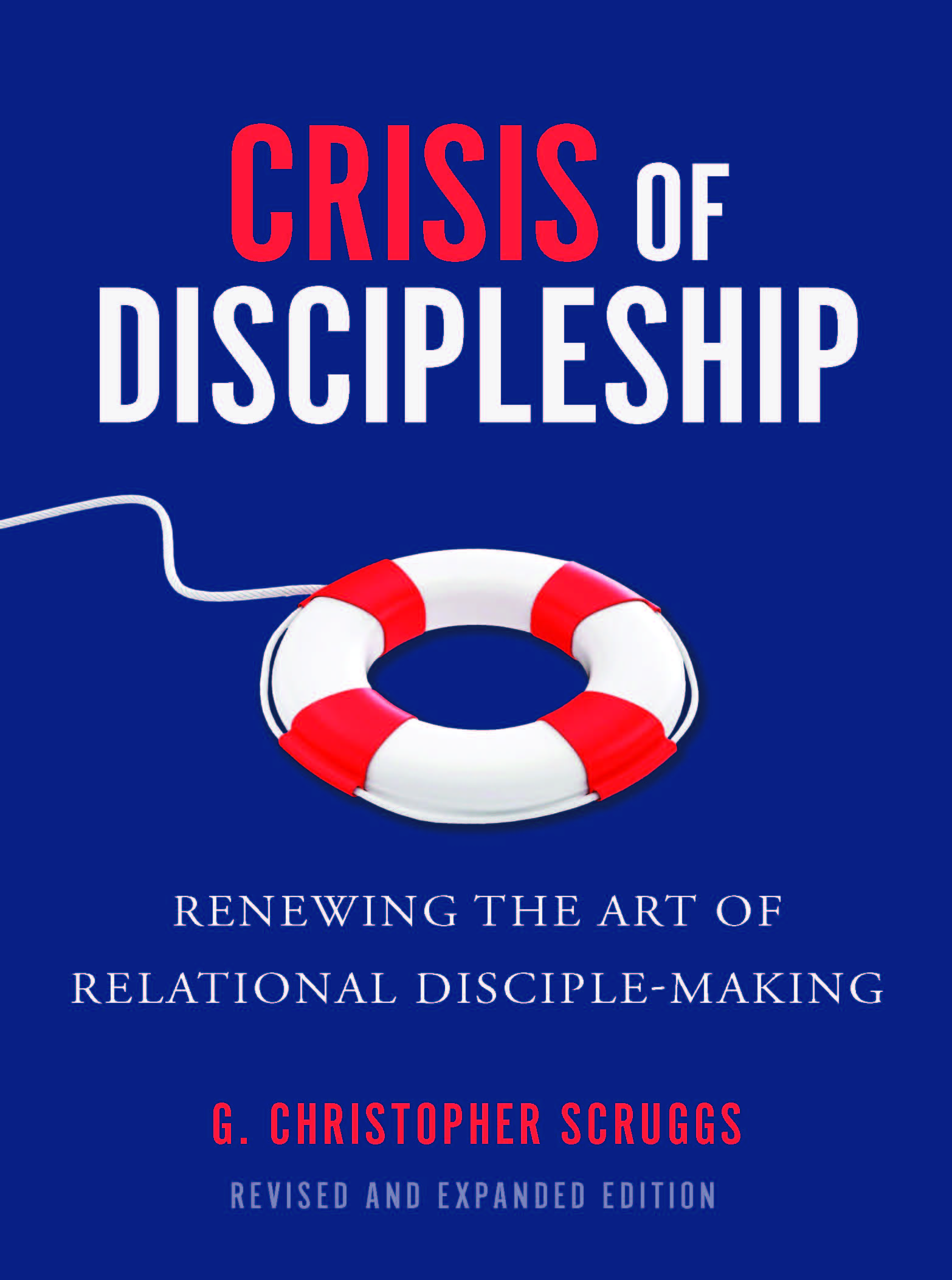
[3] G. Christopher Scruggs, Crisis of Discipleship: Renewing the Art of Relational Disciplemaking, Revised and Expanded Edition (Richmond, VA: Living Dialog, 2023), 49. This section of the blog is excerpted from the book, which can be obtained from Living Dialog Ministries.

[4] Fyodor Dostoevsky, The Brothers Karamazov, found at https://homepages.bluffton.edu/~bergerd/classes/las400/handouts/karamazov/book6chapter03c.html, and https://dostodec.wordpress.com/2016/12/18/some-of-my-favorite-zosima-quotes/ (Downloaded October 2, 2025). Volf’s lectures, Gifford Lectures 2025 Lecture 4: Dostoevsky and Genesis on Unconditional Love for the World, can be found at https://www.youtube.com/watch?v=-Pd9FsK7uf8. I recommend all his lectures.

[5] Pete Scazzero, Emotionally Healthy Discipleship: Moving from Shallow Christianity to Deep Transformation (Grand Rapids, MI: Zondervan, 2021), 134-5.

[6] Id, at 146-7.

Brown v. Board of Education: The Most Significant Case of the 20th Century

It is doubtful that there was any more significant Supreme Court decision in the 20th Century than Brown v. Board of Education. [1] Beginning in 1951, black students in Virginia and other states protested their unequal status in the state’s segregated educational system. Eventually, the NAACP proceeded with five cases challenging the school systems; these were later consolidated under what is now known as Brown v. Board of Education or “The Segregation Cases,” as Alexander Bickel refers to them in his book, The Least Dangerous Branch.[2]

Bickel had a unique understanding of the cases because he had clerked for Justice Frankfurter during the term immediately preceding the cases’ final hearing and decision by the court, and had drafted a memorandum for the justice outlining the history of the 14th Amendment as it pertained to the case. The case is important for The Least Dangerous Branch because it was the sensitive handling of this case (urged by Frankfurter), which was potentially politically explosive, that partially inspired Bickel’s book, which is an extended essay on how the Court can wisely exercise the powers it possesses under the Constitution.

Brown v. Board of Education and the Segregation Cases

In each of the Segregation cases as they reached the Supreme Court, Black minors sought admission to their local community public schools on a nonsegregated basis. The students had previously been denied entry to schools attended by white children under laws that mandated or allowed segregation based on race. The plaintiffs claimed that such segregation violated their rights to equal protection under the Fourteenth Amendment. In all but one case from Delaware, a three-judge federal district court denied relief to the plaintiffs, citing the so-called “separate but equal” doctrine established in its earlier decision in Plessy v. Ferguson. [3] Under Plessy, the state could argue that equality of treatment existed when the races were provided substantially equal facilities, even if those facilities were separate. The plaintiffs argued that segregated public schools are not truly “equal” and cannot be made so, and therefore, they are deprived of the equal protection of the laws. Recognizing the significance of the issue, the Court took jurisdiction, and the case was argued during the 1952 Term. Later in 1953, a re-argument was held to address specific questions posed by the Court. This re-argument focused on the historical situation surrounding the passage of the 14th Amendment and its intent.

Finally, on May 17, 1954, the Court rendered its decision.  Chief Justice Warren, speaking for the Court held that segregation of white and black children in the public schools solely based on race, pursuant to state laws permitting or requiring such segregation, denied to impacted children the equal protection of the laws guaranteed by the Fourteenth Amendment — even though the physical facilities and other “tangible” factors of white and Negro schools may be equal.

The Basis and Reasoning of the Court

As readers will recall, the 14th Amendment reads in part:

All persons born or naturalized in the United States, and subject to the jurisdiction thereof, are citizens of the United States and of the state wherein they reside. No state shall make or enforce any law which shall abridge the privileges or immunities of citizens of the United States; nor shall any state deprive any person of life, liberty, or property, without due process of law; nor deny to any person within its jurisdiction the equal protection of the laws. [4]

The earlier case of Plessy v. Ferguson had concluded that separation of the races was justified and constitutional if the education received was equal. The Reasoning of the Court

In their briefs to the Supreme Court, the plaintiffs argued that even where school districts provided equal resources and facilities to both white and black schools, the underlying rationale for segregation remained a belief that black students are inferior to white students, a message that detrimentally impacted Black children and their educational, mental and emotional development. The NAACP brief was a kind of “Brandeis brief,” filled with scientific and sociological evidence that supported the children’s plea. It relied heavily on historical and social science research to demonstrate the detrimental impact of segregation on black students. The Court agreed with the analysis. [5]

The Decision of the Court

Delivering the unanimous opinion of the Court In Brown v. Board of Education, Chief Justice Earl Warren seemed to accept this line of reasoning. He wrote of black children, “To separate them from others of similar age and qualifications solely because of their race generates a feeling of inferiority as to their status in the community that may affect their hearts and minds in a way unlikely ever to be undone.”

Two passages state the conclusions of the Court:

We come then to the question presented: does segregation of children in public schools solely on the basis of race, even though the physical facilities and other “tangible” factors may be equal, deprive the children of the minority group of equal educational opportunities? We believe that it does.[6]

Again, later in the opinion:

We conclude that, in the field of public education, the doctrine of “separate but equal” has no place. Separate educational facilities are inherently unequal. Therefore, we hold that the plaintiffs and others similarly situated for whom the actions have been brought are, by reason of the segregation complained of, deprived of the equal protection of the laws guaranteed by the Fourteenth Amendment. This disposition makes unnecessary any discussion whether such segregation also violates the Due Process Clause of the Fourteenth Amendment.[7]

The Court accepted the plaintiff’s argument that it was simply impossible for separate schools to be equal in any fundamental way, and that an educational system tallowingsuch a situation would inevitably be unequal, thus depriving students of Equal Protection under the law.

All Deliberate Speed

While Brown v. Board of Education declared the system of legal segregation of the races in schools unconstitutional, there was more to be done in order that its goal might be achieved. One year after the original decision the Court issued what is known as “Brown II.” [8] In Brown II, the Court ordered the states to end segregation with “all deliberate speed.” Generally, when a court enters an order, such as “Stop doing this,” the order has an immediate effect. With school desegregation, the situation was much different. In this instance, the Court concluded that, to achieve the goal of desegregation, the lower federal courts were to “enter such orders and decrees consistent with this opinion as are necessary and proper to admit to public schools on a racially nondiscriminatory basis with all deliberate speed the parties to these cases.”

For nearly a century, segregated school districts existed. There were duplicate buildings, teachers, administrators, and other resources that would have to be unified, or some schools would need to close while others opened. No single party in one lawsuit was directly affected. Changes had to be implemented not only in Topeka, Kansas, but in many other places. There was a significant danger that, especially in the South, public schools might be shut down entirely. Additionally, there was almost certain legal resistance led by certain southern politicians. In fact, to some extent, all the negative outcomes considered by the Supreme Court in their judgment did occur.

The Supreme Court, in Brown v. Board of Education, used the phrase “with all deliberate speed” with some degree of thought. Justice Oliver Wendell Holmes used the term in his 1912 decision in Virginia v. West Virginia, stating that “A question like the present should be disposed of without undue delay. But a state cannot be expected to move with the celerity of a private businessman; it is enough if it proceeds, in the language of the English Chancery, with all deliberate speed.” [9] Virginia v. West Virginia was a case stemming from the division of West Virginia and Virginia during the American Civil War. After the war, it was necessary to determine what proportion West Virginia should pay of the indebtedness of Virginia for improvements in that state at the time of their separation. [10]

Not everyone was satisfied with the Court’s decision in Brown II. As Thurgood Marshall (who argued the case and was later an Associate Justice) and other civil rights lawyers considered the second ruling, they tried to understand what the Court meant by adding the crucial phrase “all deliberate speed” to its opinion. It is reported that after reading the decision, a staff member checked a dictionary to confirm their worst fears — that the phrase “all deliberate speed” meant “slow,” and that the supposed victory was undermined because resisters were allowed to end segregation on their own timetable.

As a practical matter, the requirement for slowness resulted from discussions in the Court and the kind of compromise needed to reach unanimity on such an important decision. Certain members of the court agreed to join the unanimous majority opinion understanding that the eventual decree would allow for gradual enforcement by local courts as they implemented the decision in specific cases before them. [11]

Justice Felix Frankfurter used the phrase several times before Chief Justice Warren made it famous in Brown II. In fact, it was Frankfurter who argued for the phrase “all deliberate speed” clause in Brown II, a clause meant to prevent states and school boards from obstructing and delaying the law’s implementation, not simply to permit delay. In Cooper v. Aaron, the court clarified this point. In many cases, district courts could order immediate desegregation. However, the court was willing to adopt exceptions:

On the other hand, a District Court, after analysis of the relevant factors (which, of course, excludes hostility to racial desegregation), might conclude that justification existed for not requiring the present nonsegregated admission of all qualified Negro children. In such circumstances, however, the Court should scrutinize the program of the school authorities to make sure that they had developed arrangements pointed toward the earliest practicable completion of desegregation, and had taken appropriate steps to put their program into effective operation. It was made plain that delay in any guise in order to deny the constitutional rights of Negro children could not be countenanced, and that only a prompt start, diligently and earnestly pursued, to eliminate racial segregation from the public schools could constitute good faith compliance. State authorities were thus duty bound to devote every effort toward initiating desegregation and bringing about the elimination of racial discrimination in the public school system.[12]

 In Cooper v. Aaron, the court clarified that “all deliberate speed” was not intended to be used as a delay tactic or to create an environment that could undermine the decision. The phrase meant committing every reasonable effort to achieve the goal of desegregation. In retrospect, it is hard to see how the Court could have proceded more wisely or quickly.

Conclusion

At each critical juncture in the Least Dangerous Branch, Bickel references Segregation Cases. Throughout his book, he seeks to show the delicate balance required between an authoritarian, unelected judiciary and a more reasonable, democratic approach, which he calls the “approach of principle.” To create a democratic judiciary, the court must be willing to adhere to principles while also accepting the limitations on those principles as they are applied over time.[13]Bickel has had his detractors. One of them famously observed that his approach amounted to advocating “100% insistence on principle, 20% of the time.”[14]

Why did the Segregation Cases cast such a heavy shadow over the author? I believe the answer lies in the allure these cases held for the Court, an allure that the Warren Court found increasingly hard to resist. The lure was to apply what the justices perceived as the underlying principles of the Constitution in a manner that assumed “every right-thinking person” would ultimately agree. Unfortunately, this was not the case, leading to unintentional division within the nation and a loss of respect for the Court. Over the following 20 years, the court repeatedly fell into this same trap—nowhere more disastrously than its forays into fundamentally moral and sexual matters. That discussion, however, must wait for another day.

As one commentator put it:

In The Least Dangerous Branch and in subsequent writings, Bickel warned progressives not to race ahead too quickly; not to press the Court to recognize rights divorced from principles rooted in national experience; and not to forget that the Court undertakes its work in the context of a broader set of governmental and societal institutions.  Progressives and conservatives alike ignore those lessons at their own peril.[15]

For the time being, it is sufficient to remember that, in many ways, the Segregation Cases marked the end of a long march toward racial equality that began in 1861. During the 1960s, additional legislation and decisions were made, but the decisive battle had already been fought in the segregation cases. America would be desegregated and intolerant of attempts to reintroduce any form of racial segregation into American life. Behind Brown v Board of Education, there lurks the figure of Felix Frankfurter and his clerk, Alexander Bickel, who worked to be sure that the Court made the correct decision and in a way that would enhance the prestige of the Supreme Court, which the Segregation Cases clearly did.

I sometimes forget that these blogs are intended to reveal something about the wise and loving life for those interested in a deeper dive into wisdom. Plessy v. Ferguson and the earlier Civil Rights cases represented a court that was acting in immediate political expediency, forgetting the longer-term results of continuing the plague of segregation in the South. Brown v. Board of Education was a long-awaited righting of an ancient wrong. Our situation is not the same, and we do not always agree on what the wise and loving course of action might be—but it is seldom right to simply follow popular opinion and embrace the prejudices of an age.

In future blogs, I will demonstrate how certain mistakes made during Reconstruction and after its end harmed both the Court and the American people. This indicates that the Court is a court of law, not a mini-legislature. When the Court uses its power unwisely to support the “spirit of the age”, it often makes serious errors. Judges are not better than the rest of us in divining the future–and must avoid the delusion that they understand the best future for 300 million people.

Copyright 2025, G, Christopher Scruggs, All Rights Reserved

[1] Brown v. Board of Education of Topeka, 347 U.S. 483 (1954)

[2] Alexander Bickle, The Least Dangerous Branch: The Supreme Court at the Bar of Politics (Indianapolis, IN: Bobbs Merrill, 1962).

[3] Plessy v. Ferguson 163 U.S. 537 (1896).

[4] Constitution of the United States of America, Amendment XIV (1868).

[5] Makiah Lyons, & Paige Duggins-Clay, “Brown vi Board of Education—The Law in Education” (June 12, 2024) https://www.idra.org/education_policy/brown-v-board-of-education-the-law-in-education/ (Downoaded September 12, 2025).

[6] Brown v. Board of Education, cited above.

[7] Id.

[8] Brown v. Board of Education (No. II) 49 U.S. 294 (1955).

[9] Virginia v. West Virginia 222 U.S. 17 (1911).

[10] Virginia v. West Virginia, 220 U.S. 1 (1911).

[11] See John A. Powell “9. Why All Deliberate Speed?: Using Brown to Understand Brown” om  Stewart, Mac A. The Promise of Justice: Essays on Brown v. Board of Education. The Ohio State University Press, 2008. Project MUSE. https://muse.jhu.edu/book/27872 (downloaded September 25, 2025).

[12] Cooper v. Aaron, 358 U.S. 1 (1958).

[13] Least Dangerous Branch, 244.

[14] Gerald Gunther, The Subtle Vices of the “Passive Virtues”—A Comment on Principle and Expediency in Judicial Review, 64 COLUM. L. REV. 1, 3, 24 (1964).

[15] Adam White, “Bickel’s principled Prudence” Online Alexander Bickel Symposium August 15, 2012 https://www.scotusblog.com/2012/08/online-alexander-bickel-symposium/ (downloaded September 12, 2025).


How Is the Judiciary the Least Dangerous Branch?

In No. 78 of the Federalist Papers, Alexander Hamilton defended Article III of the Constitution, calling it “the least dangerous branch.” In his article, Hamilton assumed that the federal judiciary would be able to declare acts of Congress invalid:

The interpretation of the laws is the proper and peculiar province of the courts. A constitution is, in fact, and must be regarded by the judges, as a fundamental law. It therefore belongs to them to ascertain its meaning, as well as the meaning of any particular act proceeding from the legislative body. If there should happen to be an irreconcilable variance between the two, that which has the superior obligation and validity ought, of course, to be preferred; or, in other words, the Constitution ought to be preferred to the statute, the intention of the people to the intention of their agents.[1]

Hamilton held a traditional view of the courts as interpreters of the law. In the course of that duty, where the plain meaning of a legislative act was contrary to the Constitution, the Constitution would be controlling.

In the famous case of Marbury v. Madison, Justice Marshall, speaking for the court, established the principle that the Supreme Court has the power to declare acts of Congress unconstitutional if they conflict with the Constitution. [2]Soon after Marbury, this power expanded to include acts of state courts. [3]

In The Least Dangerous Branch, legal philosopher and scholar Alexander Bickel challenged the limited views of Hamilton and Marbury, offering a different perspective. He views the federal courts as protectors of specific fundamental values embedded in the Constitution, as they emerge through the nation’s political history.[4]

He states his thesis as follows:

It is, as I have argued, decidedly the Court’s function to proclaim principled goals, including some that it foresees may be incapable of immediate, full attainment.[5]

Note that Bickel’s mid-Warren Court view of the Constitution and the role of the courts differs dramatically from that of Hamilton and Marshall. The Supreme Court is not an instrument by which the Constitution is interpreted based solely on its language, but rather a source of values that the Court interprets in accordance with contemporary ideas. In this view, the courts influence public opinion and sway it by their decisions.[6] In other words, Bickel views the Court as an essentially political institution restrained not by its role as an interpreter of the Constitution, but by specific prudential rules that prevent it from losing its moral authority.

The Least Dangerous Branch

Bickel understood that traditional review poses challenges in a democracy. The idea that unelected judges should have the power to make laws, interpret laws, or interpret the constitution in ways that effectively create legislation conflicts with democratic principles. He also recognized that his theory has implications for the court and its legitimacy. [7] The current situation shows that he was right—and that the theory he advocates requires significant revision.[8]

Hamilton and Marshall derived their notion of judicial duty to declare legislative acts contrary to the Constitution from the position of the Constitution as the “supreme law” and the courts’ duty as interpreters of the law. Bickel supports a view of the judicial process as endorsing or rejecting measures of the representative branches as compatible or incompatible with fundamental principles embodied in the Constitution, thereby legitimating or condemning governmental action based on a principled decision that politics alone cannot provide.[9] To do so without undermining its own authority, the Court must proceed with wisdom and prudence.

Passive Virtues

Bickel’s central thesis is supported by his examination of “the passive virtues,” which the court uses to justify giving itself a greater role with some degree of judicial restraint. The Court’s duty to defend “the enduring values of a society” is often best served through judicial inaction or what he called “passive virtues.” Unlike the other two branches of government, which generally address immediate issues, the Supreme Court can and should choose not to decide right away and wait for a more appropriate time to weigh in. [10]

These passive virtues mean that it is wise for the court sometimes to choose not to exercise its power to grant certiorari and to conduct judicial review using various techniques, such as its right to refuse to hear a case, to reject an appeal because it is not “ripe for appeal,” or because it involves political questions, and so on. Bickel highlights the difference between expediency and principle. He believes that the Court should act to uphold certain principles, but he rejects the idea that the Court should always do so, especially when it would be unwise to do so.

While national emergencies may require the political branches to act quickly, Bickel argues that the Court should generally take time in decision-making and reserve its authority for deciding issues of significant long-term importance to American society. Even before Marbury, the Court declined to issue advisory opinions or enter into the political process by making proclamations, except in deciding cases brought before it.[11] For the Court to take jurisdiction over a matter, the plaintiff must have standing to be heard, and there must be an actual case in controversy before the Court. The Supreme Court has also taken the view that it will not take jurisdiction over a matter that is not ripe for a decision by the court.[12]

These and other passive virtues encourage the Court to avoid unnecessary decisions and to limit those it makes carefully. Both liberal and conservative Courts have sometimes made rulings that harm the Court’s legitimacy. This is especially true when the Court chooses to rule on social or political issues that are typically handled by Congress or state legislatures. Finally, as with the gerrymandering cases, the Court should steer clear of “political questions” that the Constitution assigns to the legislative or administrative branches.

There are no simple solutions to the question of when the Court should act. It is a matter of wisdom and judicial prudence born of experience. As one commentator puts it:

If passivity was at times the best posture for the Court, as Bickel argued, how were the Justices to know when a case called for principled adjudication and when it called for “the techniques and allied devices for staying the Court’s hand”? To this question, Bickel’s answer was prudence. [13]

In other words, law is essentially prudential, and the decision of the Supreme Court to hear cases is essentially one of prudential judgment.

Judicial Prudence

Bickel came to believe that the Warren Court, in its later years, became too aggressive in using the law to push social change, including changes he personally supported. He felt that the court had not developed the virtue of practical wisdom, which would help it avoid becoming involved in politically sensitive issues. Bickel believed that the court was increasingly stepping into the realm of principle, harming its higher purpose.[14] Judicial imprudence is not a virtue in defending principles—especially on highly contested moral issues. What the Court did in Brown v. Board of Educationshould not serve as a model for engaging in every possible controversial social issue—a temptation the Warren Court occasionally fell into. [15] Bickel sought to ensure the Court’s practical prudence and protect it from overextension and flawed reasoning.

It is essential to recognize that legal prudence is not the opposite of principle; instead, it’s a thoughtful approach to applying core human values to real-world situations. Due to the complexity of human institutions and the unpredictability of human nature, a prudent person knows when to stand firm and when to be flexible. Sometimes judicial prudence requires patience and a willingness to wait for the right moment, recognizing that occasionally imperfect compromises and messy solutions are the best judges can do—since reality rarely aligns perfectly with human ideals. Prudence enables judges to protect Constitutional principles while accepting the limits of what can realistically be achieved. Bickel believes his practical approach generally works better than ideological political decisions based on abstract dogmas, which often result in flawed solutions.[16]

It should not surprise anyone that this is a sentiment with which I agree, with the caveat that prudence never loses sight of the moral or ethical principles underlying the law or the negative impact on the legitimacy of the judiciary of imprudent or merely superficially pragmatic decision-making. Much subsequent criticism of Bickel and his thesis emphasizes this point. It is never moral or prudent to base a failure to address an issue merely on pragmatic or political considerations.

Conclusion

As mentioned, in the years after Brown v. Board of Education, Bickel became increasingly concerned that the Warren Court was applying judicial review too aggressively and divisively. Bickel understood that the Supreme Court is a “counter-majoritarian” force in American politics. He recognized that the Court has a role in resisting the tendency of majorities and social consensus to act unjustly against certain groups. On the other hand, fostering social change is not the primary duty of the judicial system. The primary duty of the judiciary is to defend and explicate enduring values enshrined in the Constitution. Although many argue that Bickel did not fully reconcile judicial review with democratic principles, his contributions to understanding the limits and proper use of judicial power remain unquestionably important.

Copyright 2025, G. Christopher Scruggs, All Rights Reserved

[1] Hamilton, Federalist Papers, No. 78.

[2] Marbury v. Madison 5 US 1, Cranch 137 137 (1803)

[3] Fletcher v. Peck 10 US 87 (1809).

[4] Alexander Bickel, The Least Dangerous Branch: The Supreme Court at the Bar of Politics (Indianapolis, IN: Bobbs-Merrill, 1962).

[5] Id, 141

[6] Id,140.

[7] Bickel understood that traditional review poses challenges in a democracy. The idea that unelected judges should have the power to make laws, interpret laws, or interpret the constitution in ways that effectively create legislation conflicts with democratic principles. He also recognized that his theory has implications for the court and its legitimacy. The current situation shows that he was right—and that the entire theory he advocates requires significant revision.

[8] Bickel can be seen as ushering in the end of “Legal Process Jurisprudence,” of which he was a major advocate. In recent years, his theory has been superseded on the left and the right by other theories. Nevertheless, his views are still relevant, and his work is one of the most read books in the field of jurisprudence.

[9] Herbert Wechsler, “Review of The Least Dangerous Branch: The Supreme Court at the Bar of Politics.” Alexander M. Bickel. Indianapolis; New York: Bobbs-Merrill Company, 1962. In the Yale Law Review, 1966 https://openyls.law.yale.edu/server/api/core/bitstreams/f22c144a-5495-4eb4-952c-d680050e291a/content (downloaded September 6, 2025).

[10]  Yale Law School, “Alexander Bickel, who Defined Supreme Court Paradox, Gets Consideration” (November 7, 2024)  https://law.yale.edu/yls-today/news/alexander-bickel-who-defined-supreme-court-paradox-gets-new-consideration (downloaded September 8, 2025).

[11] Least Dangerous Branch, 115.

[12] Id, 123.

[13] David, Wolitz, “Alexander Bickel and the Demise of Legal Process Jurisprudence” University of Tennessee College of Law Research Paper Series (June 2020), https://papers.ssrn.com/sol3/papers.cfm?abstract_id=3531249 (downloaded September 9, 2025); See also, Alexander M. Bickel, The Supreme Court, 1960 Term, Foreword: The Passive Virtues, 75 HARV. L. REV. 40, 40–42 (1961).

[14] Id, at 144.

[15] See, J Patrick White, “The Warren Court Under Attack: The Role of the Judiciary in a Democratic Society,” 19 Maryland Law Review 3(Summer 1959); “The Warren Court and Living Constitutionalism,” 10 Indiana Journal of Law 1 (2022).

[16] David, Wolitz, cited above at 144-145.

Celebrating our Constitution

The adoption of the Constitution on September 17, 1787, followed the Articles of Confederation and Perpetual Union (Articles of Confederation), which was the first attempt by the colonies to create a unified government. The Articles of Confederation essentially established a union of independent states. The problem with this federation was that it lacked key elements of a strong government: it had only a limited executive and judicial branch, meaning there was no effective way to carry out policies or enforce the states’ failure to meet financial and other obligations, leading to an ineffective government. There was no method of taxation, which kept the states near bankruptcy. Additionally, there was no practical way to prevent states from interfering with interstate commerce, resulting in trade disputes. The provisions for the United States to conduct foreign relations were also inadequate, creating a risk of war. Lastly, there was no effective way to establish a consistent and strong defense, leaving the new nation vulnerable to military intervention. As a result, in 1786, the first Constitutional Convention was convened.

The convention opened on May 25, 1787, in Philadelphia, Pennsylvania. The story of the convention is beyond the scope of this blog, but it merits study by every American. There are many fine studies of the event, the most popular of which is “Miracle in Philadelphia” by Catherine Drinker Bowen. [1] The convention is unique in history for the quality of its leadership and the experience and judgement of its members.

As its initial act, George Washington was elected its presiding officer. Washington did not talk a great deal during the convention, but his presence was important. Nearly everyone present knew that whatever form of government was chosen, Washington was its likely first leader. His prestige was such that, even without talking, he influenced events.

One of the delegates, future President James Madison, is of special note. During the course of the convention, three basic structures were suggested. Many delegates initially felt that the convention had been called to make amendments to the Articles of Confederation, and that the convention was neither authorized nor entitled to suggest the kind of sweeping change the Constitution ultimately embodied.

What is known as the “Virginia Plan” was the first presented and formed the course of the debate. Authored by James Madison of Virginia, this plan provided for three distinct branches of government (legislative, executive, and judicial) with the legislative branch divided into both an upper and lower house. Madison arrived well-prepared and with the basic books and materials he felt necessary for the intellectual guidance of the convention. He was the most crucial drafting force behind the final document. Madison’s notes taken as a journal during the convention are, next to the Federalist Papers, the most important primary source for interpreting the Constitution in light of the intent of its framers. [2]

Many smaller and southern states and delegates were unsure of the wisdom of the Virginia Plan.  They initially opposed Madison’s ideas. In response to Madison’s ideas, William Patterson of New Jersey submitted the “New Jersey Plan.” This plan was similar to the Articles of Confederation, with a unicameral legislature in which each state had a single vote. In fairness to this plan, it was probably much closer to what those who called the convention intended. Patterson is largely forgotten today, but he was one of the foremost intellectual figures at the convention.

Finally, the “moderate” Virginia plan and the more traditional New Jersey plan functioned to guide the debate towards a compromise. Still, it was not certain that the compromise would be practical. Alexander Hamilton then proposed “the Hamilton Plan,” which envisioned a much stronger central government along the lines of Great Britain. Under Hamilton’s plan, the national government would be supreme and would appoint state governors. There would be a strong national government with broad executive powers. It was unclear then, and remains unclear today, whether Hamilton was serious about the plan or whether its presentation was tactical to push the inevitable compromise towards a stronger central government.

In the end, two delegates from Connecticut, Roger Sherman and Oliver Ellsworth, proposed a way of breaking the deadlock between the larger and smaller states on the issue of legislative representation, which became known as ” the Connecticut Compromise ” or the ” Great Compromise. This compromise proposed a system of dual representation. There would be a House of Representatives in which each state’s number of seats would be proportional to its population. There would also be a Senate in which all states would have the same number of seats. [3] In July 1787, the Great Compromise was adopted by a one-vote margin, clearing the way for the adoption of a final constitution. The Constitutional Convention approved it on September 17, 1787.

Conclusion

The adoption of the Constitution is one of the great stories of human history. We were blessed that a competent group of leaders was chosen to address the problems of the Articles of Confederation. Naturally, they were human, and mistakes were made—as they are and always will be made within the boundaries of human history. Nevertheless, they did the best they could and structured a republican democracy that has endured for centuries.

The fact that they were willing to compromise is something needed in our current situation. The “all or nothing” politics of power that have characterized our political system for decades now are not functional and prevent the kind of practical compromise that is needed in many areas, taxation and the deficit being two significant examples. We need wise statesmanship.

The Constitution was not perfect when adopted, which is why a Bill of Rights was added soon after. The cost of any union was the continuation of slavery, a moral evil that required a Civil War to end, and its consequences still affect us today. The founders did not anticipate that the nation would incur the enormous debts it has now. Even a person so farsighted as Alexander Hamilton could not conceive that the federal government would require the vast sums it spends today.  I am confident they would have demanded a balanced budget if they had known. They could not foresee that the national government would be given the powers it now holds. The project the founders started is not finished, and it never will be as long as freedom remains. Still, we are fortunate that they made such a strong start.

As Lincoln put it so well, “It is for us the living, rather, to be dedicated here to the unfinished work which they who fought here have thus far so nobly advanced.”[4]


Copyright G. Christopher Scruggs, All Rights Reserved

[1] Catherine Drinker Bowen: Miracle in Philadelphia: The Constitutional Convention May to September 1787 (New York, NY: Little Brown and Company, 1966). This is a very well-done popular history. For those with a more scholarly bent, there are various others with a more academic tone. I believe her work to be unmatched, however.

[2] These notes are available both online and in printed form. See, “Notes of Debates in the Federal Convention of 1787” https://avalon.law.yale.edu/subject_menus/debcont.asp (Downloaded June 2, 2021). Printed versions are available on amazon.com.

[3] In the end, the Connecticut compromise was amended to base representation in the House on total white population of each state and three-fifths of the black population. This provision of the Constitution is the most debated today and the most criticized. As any close student of the debate knows, it was reluctantly agreed to because without it there could be no agreement and the convention would have failed. Nevertheless, it had predicable unfortunate consequences that took the American Civil War to resolve.


[4] Lincoln, Abraham. “The Gettysburg Address.” 1863.

Meditating on Charlie Kirk’s Death: Towards a Healthier Political Climate

When Charlie Kirk was killed, I promised to write a blog about the importance of a healthy, non-violent political climate in our country and the way in which the assassination of any political figure strikes at the root of what a good society must be and endorse. Before I start, I must admit that I have never listened to Charlie Kirk speak nor read any of his books. I can’t say that I agree with everything I’ve heard he supported politically or theologically. These admissions do not matter because the main point is: No one deserves to be killed for expressing their opinions on religious or political issues in a peaceful way.

The Bitter Result of a False Narrative

In the past, I have written about what Walter Wink calls “the myth of redemptive violence,” or the false (demonic) idea that society can be improved through violence. [1]This mistaken belief runs deep in the American consciousness, perhaps due to the Civil War and the view that the First and Second World Wars were “just wars.” The first false narrative is that violence can create a just or stable society.

More deeply, the violence of our society, and the increasing lack of tolerance for Christians and others in the political arena, is also the result of the loss of belief in truth and justice, and the Nietzschean notion of the “will to power.” In a world in which there is a lack of confidence in the existence of truth and justice, there will always be those who resort to violence as a way of achieving their personal or political ends. The second false narrative is that the foundation of morals and society is power and the will to power.

That the political left is currently uniquely in danger of falling victim to the myth of redemptive violence is not the necessary result of its fundamental political views so much as it is because of the vulnerability of the left to revolutionary ideology and the popularity of Marxist thought in our society. However, the political right is not immune to the disease of believing that good things can result from evil means.  We live in a culture that often justifies the means by the desirability of the ends we seek to achieve. The third false narrative is that the ends justify the means.

The bitter fruit of these false narratives is the violence we seek daily in our society—a violence that threatens our culture and indeed many societies all over the world.

Conversation and Dialogue

Fortunately, many observers believe that the modern world is nearing its end, and something new is emerging. What we call “postmodernism” is just the beginning of change and could be better described as “Hyper-Modernism” or “End-stage Modernism.” The decline of modern thought into “hermeneutics of suspicion,” “deconstructionism,” and various forms of nihilism is essentially critical reasoning pushed to its limits. The false narrative of modernity must give way to something new. Hopefully, there will be a revival of reason, spiritual values, moral principles, and similar core elements in the slow development of a healthier society. The extreme corporatization of our society may change as a new form of socio-economic organization emerges. In the process, one hopes that the idea of a purely secular, materialistic, and scientifically managed state, prone to violence, will fade away until it finds its place within a more humane form of society.[2]

My understanding is that Charlie Kirk’s ministry focused on conversation and dialogue. A conversation is naturally communal and aims to build connections among people. It involves a relationship where two or more individuals share their thoughts and lives in a way that promotes cognitive, emotional, physical, and spiritual understanding, ultimately fostering a stronger sense of community. Hopefully, their ideas, thoughts, and commitments will align during the conversation, with the potential to resolve conflicts and reduce fragmentation in our culture. The word “dialogue” comes from two words meaning to reason through. The idea is that by sharing and reasoning with each other, we open the door to a deeper understanding of people, our society, and our world.

We need a national commitment to conversation and dialogue. As part of a healthy, society-wide dialogue and conversation, the community can be rebuilt, shared values can be discovered and affirmed, and a new sense of the importance of our society’s search for a just social and political system can be found. Moreover, if a sense of national conversation and dialogue exists among the various groups active in our political system, then freedom, including freedom of speech, can be maintained in a setting of mutual respect and understanding.[3]

A Better Narrative

In the past, I have written about how the materialism of the modern world and the idea of the world as a machine, rooted in Newtonian physics, has been replaced by a more relational perspective. Recently, this materialistic view has been replaced by a model that emphasizes deep interconnectedness, relationships, freedom, and inner sensitivity. It is an “organic model” that sees the universe not as a machine but as an organism or a process. In my view, and the view of others, this older way of thinking has led modern politicians, policy-makers, and intellectuals into many errors. Henry Sapp explains it as follows:

[We] are faced today with the spectacle of our society being built increasingly upon a conception of reality erected upon a mechanical conception of nature now known to be fundamentally false. … As a consequence of this widely disseminated misinformation, “well informed” officials, administrators, legislators, judges, educators, and medical professionals who guide the development of our society are encouraged to shape our lives in ways predicated on known-to-be-false premises about “nature and nature’s laws.” [4]

A worldview informed by quantum physics and relativity theory encourages us to see the world more like an organism than a machine. At a fundamental level, the world does not seem to be made up of matter and energy. Matter is a form of energy. Even more mysteriously, fundamental particles appear to be ripples on a quantum field. There is both freedom and uncertainty in this emerging worldview, both at a fundamental level (quantum uncertainty) and at an everyday level (chaos theory). Finally, all of reality is interconnected at a basic level. From a political point of view, while there is a “You” and a “Me,” you and I are also “We.” We are all part of one another. Like an organism, the world is constantly changing and evolving: In other words, it is not at all like a watch that is designed once and for all. Instead, the world is evolving, growing, and constantly changing.

The inevitable result of all this is that reason, spiritual values, moral imperatives, and similar factors will reemerge as important in a wise society. The vision of a purely secular, materially driven, and scientifically managed state will fade away until it finds its place within a more comprehensive and human-centered society. Just as the world consists of an intricately linked web of reality, governments will realize that human politics must begin with smaller units, such as the family, and naturally expand into larger organizational structures with important but limited powers.

The idea of the all-powerful nation-state that controls territory through legal, administrative, and bureaucratic force will be shown to be insufficient. A truly post-modern vision will emphasize social bonds and the development of shared values. Whether this occurs because of a major crisis and collapse of the current nation-state, world-state visions, or organically through the decisions of wise leaders, depends on the choices we all make. One thing is certain: a wise, healthy, and genuinely post-modern political order will value dialogue as much as debate and decision.

Toning Down the Rhetoric

If Charlie Kirk’s tragic death can help create a more humane and peaceful society, then he will not have died in vain. It is unhelpful to use his death to further divide and politicize our society. Sadly, on both the left and right, some people are exploiting this tragedy to rally their supporters in a way that increases polarization—and even more so if press reports are accurate. I am quite sure that Charlie Kirk would not want his followers to act this way—and I am 100 percent completely confident that the God he serves does not want any of us to behave this way.

Recently, there has been no sign that either “the chattering class” in the media or the “attention-getting and voter-mobilization class” in politics plans to make the necessary changes. This is unfortunate because we need more from our leaders, specifically a strategic and moral vision that can create profound change in our politics and help reconstruct our national community and unity.

[1] Walter Wink, Engaging the Powers: Discernment and Resistance in a World of Domination Minneapolis, MN: Fortress Press, 1992).


[2] G. Christopher Scruggs, Illumined by Wisdom and Love: Essays on a Sophio-Agapic Constructive Postmodern Political Philosophy (Hunt, Texas: Quansus Press, 2024) 4-155. This portion of the essay is based on the argument made in that work.

[3] Id. This entire essay flows from the argument I made in this prior philosophical effort.

[4] Henry F. Sapp, “Whitehead, James, and the Ontology of Quantum Theory” 5(1) Mind and Matter (2007) downloaded at https://www-physics.lbl.gov/~stapp/WJQO.pdf (June 16, 2020), 85. In this quote, Sapp is not speaking of the exact phenomena that I am concerned with here—the tendency to view all reality as a machine—but his quote is equally applicable to what I am saying in this essay. Sapp is concerned with the assumption of materialistic theory that our experience of human freedom and the efficacy of human thought is an illusion.

Authentic, Healthy Community: A Sign of the Kingdom

For the past several weeks, Kathy and I have been spending a good bit of time with people with whom we have been in Bible studies, Prayer Groups, and other small groups over the past many years. Some of these friendships are now nearly 50 years old. Some of them are about five years old. At least one of them is even shorter. One constant theme in our meetings has been how blessed we feel to have had the opportunity to spend time in a deep, meaningful relationship with each other.

I’ve given my testimony many times, and it is included in Crisis of Discipleship, which I wrote shortly after retirement. [1] It’s worth repeating time and time again, just as the apostle Paul repeats his own testimony, time and time again, in his preaching and writing. In 1976, nearly 50 years ago, I attended a Bible study in Houston, Texas. I was asked to do so by a young lady who worked in the same law firm. Over the next few months, I returned to church from a long absence, became a much stronger Christian, and began my life as a Christian teacher and leader.

In 1991, after serving as a deacon, elder, Sunday School teacher, and small group leader, as well as holding other responsibilities at First Presbyterian Church of Houston, Texas, I attended seminary in Richmond, Virginia. We started a small group almost immediately after arriving there. I also participated in a small group led by Matt at the seminary. After graduating in 1994, we established several small groups in Brownsville, Tennessee, one of which continues to meet today. When I moved to Richmond, Virginia, we became involved in discipleship groups, reunion groups, Salt & Light groups, and many other small groups. I often attended small groups when we lived in Bay Village, Ohio. Finally, when I retired and moved to San Antonio, we almost immediately began a small group that met in homes. Small groups have always been a part of our lives.

The Kingdom of God and Small Groups

Last evening, we attended a worship service for a new church starting in San Antonio. The reason we were there was that we had been in small groups with many of the participants in this effort. We went to support them and show our love and encouragement. Additionally, we attended because we recognize that one of the most effective ways the kingdom of God grows is through fostering genuine Christian community. Many of the leaders of this new church participate in a men’s ministry Bible study that I sometimes attend on Thursday mornings. One of the things that this group does is meet in small groups as well as in the larger group, which can sometimes number as many as 50 men. The men in these small groups come from several churches, though one of the churches that began the group historically has the most attendees. These men love and support one another, creating in these groups a little piece of the Kingdom of God.

At the very beginning of my daily prayer guide, I have the following quotation from the Apostle Paul:

As God’s holy and beloved chosen ones, put on compassionate hearts, kindness, humility, meekness, and patience, bearing with one another. If anyone has a complaint against another, forgive them. Just as the Lord has forgiven you, you should forgive others. Above all virtues, put on love, which binds everything together in perfect harmony. Finally, let the peace of Christ rule in your hearts, to which you have been called in one body. Be thankful. Let the Word of Christ dwell in you richly, teaching and admonishing one another in all wisdom, singing psalms and hymns and spiritual songs to God with thankful hearts. And whatever you do, in word or deed, do everything in the name of the Lord Jesus, giving thanks to God the Father through Christ (Colossians 3:12-17).

These words by the apostle Paul show us why churches must build community both within their larger fellowship and in smaller groups. The Christian church is not meant to function like any other secular organization. Instead, it should be a place where people can experience the transformative love of Christ. I have served as the pastor of both small and large churches. The reality is, it’s not possible to create a single large, loving community in a church with 1000 members. It’s even difficult in a church with 200 members. One way to expand the reach of the kingdom of God is by focusing on small Christian communities where people can personally experience the kingdom of God.

Characteristics of the Kingdom

The little text I quoted from Colossians gives us a hint as to some characteristics that should be present in these small groups. First, they should be characterized by Christian love. Small groups are places where people can be compassionate with one another, learn, show kindness, humility, and the ability to be patient with the faults of others. (And, of course, those others will be learning patience by putting up with our faults!)

Forgiveness. Anyone who has been in a small group for any length of time knows that forgiveness is essential. We are all human and inevitably do things that hurt or at least annoy others. As I’ve grown older, I like to say, “I don’t have enough friends that I can afford not to tolerate the ones that I have!” This statement reflects that we all must forgive others constantly, for minor mistakes and sometimes for major ones. People who never learn to forgive can’t fully experience the kingdom of God. After all, God brings us into that kingdom by forgiving us! It’s the least we can do to forgive others.

Harmony. The kingdom of God is a place where people are in harmony with God. As theologians often say, the kingdom of God exists wherever God rules. Wherever God’s love, wisdom, justice, and patience are present, the kingdom of God is also present. It is the wise church leader who builds a team of servant leaders capable of reflecting God’s wisdom and love in their small groups, creating an atmosphere where the larger church can also experience the kingdom of God. This harmony that God desires to establish in human relationships is called “shalom” or peace. It represents the relationship in which the self-giving love of God, demonstrated by Christ on the cross, is experienced in tangible human relationships.

Christ-like Love. As Paul recognizes when writing to the Colossians, this harmony cannot exist without agape, love. In Philippians, he writes a church he dearly loves the following famous words:

So if there is any encouragement in Christ, any comfort from love, any participation in the Spirit, any affection and sympathy, complete my joy by being of the same mind, having the same love, being in full accord and of one mind. Do nothing from selfish ambition or conceit, but in humility count others more significant than yourselves. Let each of you look not only to his own interests, but also to the interests of others. Have this mind among yourselves, which is yours in Christ Jesus, who, though he was in the form of God, did not count equality with God a thing to be grasped, but emptied himself, by taking the form of a servant, being born in the likeness of men. And being found in human form, he humbled himself by becoming obedient to the point of death, even death on a cross.Therefore God has highly exalted him and bestowed on him the name that is above every name, so that at the name of Jesus every knee should bow, in heaven and on earth and under the earth, and every tongue confess that Jesus Christ is Lord, to the glory of God the Father (Philippians 2:1-11).

Of course, creating a Christian community is impossible through our own human abilities. Those of us with above-average skills need constant reminders that we cannot build the kingdom of God on our own. Our selfish ambition, self-conceit, and human pride all interfere with creating the kingdom of God. It can only be built by those who are unselfish, humble, and willing to serve others. The kingdom of God can only be created in relationships where the love of God the Father, shown to us by Christ the Son, is experienced through the power of the Holy Spirit.

I’ve had the opportunity to work for more than one troubled church. In my experience, the trouble always begins with some kind of human ambition, self-conceit, or pride. Sometimes it’s the ambition, self-conceit, or pride of a pastor. Sometimes, it’s the ambition, self-conceit, or pride of a group of leaders. Sometimes it’s even the ambition, self-conceit, or pride of those who wish they were the leaders. All of us, and especially the most capable of us, can fall into the delusion that we are capable of doing what only God can do. I’ve learned it’s a big mistake.

Some years ago, I had the privilege of working with an outstanding Christian leader. Interestingly, he’s also the least ambitious, conceited, or prideful person I’ve ever worked with. It would be hard to completely explain how often this person forgave others, poured oil on the waters of a potential conflict, and refused to get his own way. One little illustration comes to mind. The leadership of this church was faced with a difficult decision that divided the leadership team. Some people thought one decision should be made, and others thought otherwise. Another decision should be made. They couldn’t reach an agreement.

My friend endured this for a long time. Eventually, the leadership team made a decision he personally disagreed with. Still, he supported the decision, and the outcome was successful. I am very confident that the outcome wouldn’t have been successful if he had shown hurt feelings, voiced his reservations about the leadership’s decision, or tried to undermine the result. I don’t think the church would have split, but it could have been close. I’ve watched other Christian leaders take a different approach that has resulted in conflict and even church splits. In none of these situations was the kingdom of God visible.

Conclusion

In this blog, I didn’t want to cover ground that was previously covered in Crisis of Discipleship. There are specific ideas that can be embodied in any concrete small group discipleship program. They will vary from church to church, but the fundamental thing is to start groups of around eight to 18 people and nurture Christian relationships within those groups.

Some years ago, our church hosted a series of small groups that were social events, but they also included a time of prayer, a brief Bible study, and a service to the church or community. One day, the leader of one of these groups came to see me. His group is having trouble. I asked him what they did in their group. He told me that the group met together, had a few margaritas, ate dinner, talked a while, and then went home. They did say grace before dinner. I suggested that perhaps it would be a good idea to dispense with the margaritas, have a very short Bible study after dinner, share a prayer request, and participate as a group in a Christmas program our church sponsored.

When he left my office, I wasn’t sure if he agreed. But he did. Several months later, he returned and told me how much better their group had become since making those small changes. “It’s amazing what the Bible study and prayer have done for our group!” he said later. I have told many people that a great Bible teacher did not lead the small group where I renewed my faith in Christ. It was led by a group of participants, none of whom knew much about the Bible, at least I didn’t. However, we read the Bible together, discussed the passage, shared questions, and prayed for each other and our community at the end of the meeting. That’s all there was to it.

As I mentioned, we’ve stayed pretty close together over the years. Interestingly, we now live all over the country. Most members are leaders in the congregations they now attend. The beginning of their journey into church leadership was participating in a small Bible study group in Houston, Texas. This should be an encouragement to pastors and other church leaders: You don’t have to be especially good at organization, Bible, teaching, prayer, or any other element of the Christian life to share your Christian faith with others. You just have to be willing.

Copyright 2025, G. Christopher Scruggs, All Rights Reserved

[1] G. Christopher Scruggs, Crisis of Discipleship: Renewing the Art of Relational Disciplemaking (Richmond, VA: Living Dialog Ministries, 2023).

Worship and Disciplemaking

The other morning, I received a message in my inbox from one of my favorite church consultants, whom we had worked with many times during my ministry. The title of his missive was something like, “The Church of the Future Will be Nothing Like the Church of the Past.” American evangelicals have a seemingly endless appetite for discovering the ancient faith by doing something new, and this particular communication was designed to tap into this desire we have for something new that will improve (or “return to the early church”) the modern church.

In the past, I wouldn’t have paused to question whether this was true. This time, I did. At the urging of one of our children, we have occasionally attended an Orthodox congregation. In this case, their form of worship is several centuries old, dating back to around 1400. At the same time, we live very close to an Anglican congregation, whose form of worship is highly liturgical and only slightly updated from the Anglican worship of the Reformation. Both churches are growing and prosperous. One is in one of the least Christian communities in Texas, and our neighborhood is one of the most progressive in San Antonio. What is going on here?

When I first attended my daughter’s church, I was struck by how young and diverse it was. There were people from all over the world in attendance, many of whom worked in the high-tech industry. The average age was younger than that of my former church, which was young for a Presbyterian congregation. As I read and visited with the priest in the Orthodox congregation (a former main-line evangelical), I was interested to hear him say that one of the things he came to realize was that the worship of the early church was considerably more like the worship in an average Orthodox church than that of the average American Bible Church. As I researched the history of worship, I concluded that he was more right than wrong.[1]

I am pretty typical of a Protestant in many ways, so when I first started attending an Orthodox Church, I found the liturgy confusing. Later, when my wife and I visited several Episcopal and Anglican congregations, we noticed that their liturgies were often eerily similar to the Orthodox worship. Sometimes, the wording was even the same. When I was asked to preach for a traditional Lutheran congregation in an emergency, I noticed the same thing. Over time, I realized that Protestants might have a lot to learn from those congregations that practice more liturgical worship. It could be that the church of the future will also resemble the church of the past.

Balancing Word and Sacrament

Most of the churches that I served had communion either quarterly or once a month. Even before I retired, I was aware that this was an anomaly. Until the Reformation, there is no known period in church history during which communion was not a weekly practice. Several years ago, my wife and I became involved in a renewal ministry where communion played a central role. Over the next several years, I began to appreciate the Catholic view of the Eucharist, as well as the importance of receiving communion weekly. In retirement, I almost always attend an evening service at a local Episcopal Church if I have not been in a communion service on that day. It may seem like a small thing, but communion is a physical action involving a physical body. We take communion. It’s a constant reminder that Christian faith is not merely a mental thing. Faith involves the whole person.

At the same time, I began to appreciate the practice of weekly communion, I also began to notice how truncated many Protestant services have become. Often, sermons can be 30 minutes or longer. If the service is timed in an hour or an hour and 15 minutes, this is a substantial amount of the entire service. To make this work, numerous traditional elements of worship must be eliminated. One enormous difference between the ancient liturgies and much contemporary worship is a minute of prayer involved and (most surprisingly for evangelicals, the many readings from scripture and prayers based on scripture.

I’ve also noticed that “Bible preachers”, of which I was one, often speak too long. My wife is known to comment about one particular preacher that “He usually says everything he has to say in 15 minutes and then repeats it for another 15 minutes.” Unfortunately, the same thing might’ve been said of me upon occasion. The preaching of the word is important, but practically speaking, the average layperson gets the most out of a good sermon. That’s about 15 minutes long. This leaves plenty of time for liturgical elements.

Prayer

One characteristic of the Orthodox liturgy is that the entire service is punctuated by prayer. In some cases, one may pray for the very same things on more than one occasion during a given service. Once again, to the reductionistic Protestant mindset, this may seem excessive until one understands that the central element of their worship is prayer. In almost every case, the congregation repeats a refrain and joins in the prayer being spoken by a priest or the deacon in charge.

This leads me to another observation about liturgical worship. Often, Protestants pride ourselves on the fact that our worship is “participatory.” Actually, our worship is less participatory because much of the praying is done from the front by a church leader, and there is little to no participation from the people in those prayers. Liturgical churches avoid this by using refrains in their worship. Since a number of these refrains are sung, the rhythm of the prayer is powerfully reinforced.

Music

There is probably no aspect of Orthodox worship that differs more from Protestant worship than the role of music. Usually, a small choir leads the congregation in certain parts of the service, especially during the refrains in prayers. Although I miss traditional Protestant hymns and praise music, I have come to understand that a somewhat different perspective guides them. The goal of the music, like the prayers, is to draw the worshiper into the harmony with God’s being—Father, Son, and Holy Spirit. The aim of worship is not to evoke an emotional response, but to draw the congregation into God’s presence and very being.

In one of my favorite Orthodox congregations, I’ve noticed that after the worship service, when they eat together (another characteristic of the early church), some of the younger members take out their guitars and begin singing praise songs that I recognize immediately. It’s not that the church rejects contemporary music; it’s that the role of contemporary music is not in worship. The same might be said of highly orchestrated organ music or similar arrangements. It’s not a central part of the worship because it’s not aligned with what the worship is trying to do. The worship attempts to bring the worshiper into relationship (not contact) with the being of God.

What This Has to Do with Evangelism

One of my daughter’s favorite stories involves a church member who was unconnected to God or the church in any way. One morning, he got up and thought to himself, “I’m going to church this morning”. Right at the beginning, it is worth noting that Grace is proceeding with any activity of this young man. He got up, having not been to church in forever, and began thinking, “I’m going to church this morning.”

He then had to decide which church he would attend. He remembered having been in a Greek Orthodox church, admiring the artwork. He decided to visit an Orthodox church. He happened to end up at my daughter’s church. Just like me, he walked into the room. The liturgy began, and he was a bit lost. It’s also unfamiliar. It certainly isn’t anything like what you might see flipping through channels on television. By the time the worship service ended, he was in tears.

He began to attend the church. Eventually, he decided to become a Christian. He spoke to the priest. Now, he’s a member of the church. As someone who’s been involved in the leadership of churches for nearly half a century, I can tell you that there’s almost nothing about an orthodox service that one might call evangelical. There wasn’t an altar call. There wasn’t a free cup for visitors. (There was an invitation to stay for lunch.) I’m not sure, but I would bet money that there was never a call from the evangelism committee. (At least, they’ve never called me.) But God, in his sovereignty, reached down into the heart of the young man.

The Limits of Technique

I recall taking a course in seminary where we studied the evangelism techniques of the great 19th-century evangelist, Charles Finney, a Presbyterian, of all things! Finney believed that revivals and conversions could result from the use of specific techniques in worship. He advertised. He gave long emotional sermons in the vernacular of the day. He encouraged the active role of women and laypeople. Many 20th-century American evangelists have used updated versions of his techniques.

The key word here is “techniques.” Benjamin Warfield once famously observed that “God might be eliminated from it [Finney’s theology] entirely without essentially changing its character.” I am not sure that the criticism is entirely justified. Still, Warfield is making a point that all Christians should ponder: Are we so committed to the techniques of evangelism that our congregations might explode in size that we are forgetting the role that God plays in our efforts?

Crisis of Discipleship

A few years ago, I published a book titled “Crisis of Discipleship.” I wrote the book out of a concern for the direction. The American Christian Church was heading in all denominations. It’s very obvious that the techniques and assumptions that we have been living under for the past several hundred years no longer work. For some, this is an invitation for continuous change. I would suggest the possibility that another tactic needs to be adopted as well: We need to make a return to the tradition of the church before the Reformation, before the split between the east and the west, back to the earliest Christian churches. Our Journey back to “the early church may need to include a journey to the church of Antioch, Alexandria, Constantinople, Ephesus, and Rome as well as into our current image of the early church. I think it is a journey worth taking.

The next blog will talk about community.

Copyright 2025, G. Christopher Scruggs, All Rights Reserved

[1] Stephen De Young, The Religion of the Apostles: Orthodoxy in the First Century (Chesterton, IN: Ancient Faith Publishing, 2021).

On California, Texas, and Gerrymandering

For the past few weeks, the news has been filled with stories about Texas, California, and other states, focusing on the various redistricting strategies that majorities use to strengthen their control over states. The technical term for this is “Gerrymandering.” The word, written initially as “Gerry-mander,” was first used on March 26, 1812, in the Boston Gazette — as a reaction to the redrawing of Massachusetts state senate election districts under Gov. Elbridge Gerry. The Democratic-Republican Party handled the redistricting, and Gerry was the one who signed the bill in 1812. As a result, he earned the dubious honor of being associated with it, along with its negative connotations. In some ways, it is unfortunate that Gerry has received opprobrium for this tactic, as he was a prominent signer of the Declaration of Independence, a member of the Continental Congress, and participated in the Constitutional Convention with distinction. He had a distinguished career, particularly in his championing of the Bill of Rights during the first Session of Congress after the ratification of the Constitution.

Political Gerrymandering

In recent weeks, this topic has been circulating on social media. At first, Texas proposed a redistricting map that would likely increase Republican congressional seats. Then, California Governor Gavin Newsom entered the discussion, threatening further redistricting in California. Other governors and political figures also chimed in. When someone posted on X particularly damning examples of gerrymandering, I suggested they were unconstitutional. But I was wrong (at least partly). Since I suggested last week that the 14th Amendment applies, I decided to research why the answer to this is “Not generally.”

Advances in detailed and comprehensive voter databases, along with the increasing sophistication of mapping software, have resulted in more skewed redistricting maps. This practice is known as political gerrymandering—that is, gerrymandering done solely for political gain. Since it appears that both the threat from the California governor and possibly the entire Texas redistricting process involved this very issue, I decided to learn more about it, especially in light of my recent blogs discussing a “Balanced Personalist” view of Constitutional interpretation.

History of Gerrymandering and the Constitution

Partisan political gerrymandering—the drawing of legislative district lines to weaken the supporters of one party and entrench a rival party in power—is an issue that has long troubled the federal courts. Before the 1960s, the Supreme Court held that challenges to redistricting plans involved political questions that were not suitable for judicial resolution and should be addressed by the political branches of government.

Then, in 1962, the Court held in the landmark case of Baker v. Carr that a constitutional challenge to a redistricting plan could be justiciable. [1] Baker v. Carr involved a situation in which demographic changes had been ignored in redistricting decisions, penalizing urban areas. In subsequent years, although the Court invalidated redistricting maps on grounds of equal protection—cases involving population disparities among districts or racial gerrymandering—it did not strike down maps based on partisan gerrymandering.

In Davis v. Bandemer, the Court ruled that partisan gerrymandering in state legislative redistricting could be justiciable under the Equal Protection Clause of the United States Constitution. [2] Although the vote was 6-3 in favor of justiciability, a majority could not agree on a proper standard for determining when partisan gerrymandering becomes unconstitutional. Following Bandemer, the Court acknowledged that claims of unconstitutional partisan gerrymandering could be reviewable but did not establish a clear standard for adjudicating such claims. Similarly, after Bandemer, the Court was unable to reach a consensus on the proper test for several years.

“Justiciability” refers to the types of matters that courts are equipped to handle. If a case is “non-justiciable,” the court should not hear the case because it lies beyond the power of the judiciary to handle. Justiciability rulings typically arise when a court either (i) lacks the power to hear the case under the Constitution or (ii) when it is imprudent to exercise judicial power. In particular, Federal courts should not hear cases dealing with issues that the Constitution assigns to another branch of government. This is important for redistricting because Section 4 of Article One grants states the power to regulate the congressional election process and Congress the right to alter those regulations or make its own, as follows:

The Times, Places and Manner of holding Elections for Senators and Representatives, shall be prescribed in each State by the Legislature thereof; but the Congress may at any time by Law make or alter such Regulations, except as to the Places of chusing Senators. [3]

In other words, on the face of it, it is within the power of the states and Congress to deal with issues such as redistricting. This Constitutional provision sits at the core of the courts’ general unwillingness to address redistricting issues. Nevertheless, there are circumstances in which the courts will address redistricting, as in cases where the 14th Amendment has prohibited racial bias.

In Vieth v. Jubelirer, a plurality would have overturned Bandemer, returning to the view that political gerrymandering claims are nonjusticiable. [4] Justice Kennedy, concurring and casting the deciding vote, agreed that challengers had not yet articulated neutral or comprehensive principles for drawing electoral boundaries but expressed hope that future cases might establish a limited and precise rationale for such claims. Such a neutral rationale for judicial intervention was never found.

Finally, in Rucho v. Common Cause, the Court ruled that it was unable to identify any judicially manageable standards to decide claims of unconstitutional partisan gerrymandering, effectively overruling Bandemer. [5] The Court stated that federal courts are not equipped to allocate political power fairly and that fairness in this area is a concern. As a result, claims of unconstitutional partisan gerrymandering are considered “nonjusticiable political questions” and cannot be reviewed by federal courts. Writing for the majority, Chief Justice Roberts acknowledged that excessive partisan gerrymandering is unjust, emphasizing that the ruling did not endorse it but reminding that the Framers gave Congress the authority to address partisan gerrymandering under the Elections Clause.

Rucho v. Common Cause

As mentioned above, in Rucho et al. v. Common Cause et al. (Rucho), the Court held that Partisan gerrymandering claims present political questions beyond the reach of the federal courts because they lack the kind of justiciability required for the courts to handle them. In particular, Chief Justice Roberts relies upon Article 1, Section 4 of the Constitution, noting that the framers of the Constitution were consciously aware of the issues raised by gerrymandering but decided to leave such matters to Congress and the state legislatures. [6] Thus, Roberts ruled that:

The conclusion that partisan gerrymandering claims are not justiciable neither condones excessive partisan gerrymandering nor condemns complaints about districting to echo into a void. Numerous States are actively addressing the issue through state constitutional amendments and legislation placing power to draw electoral districts in the hands of independent commissions, mandating particular districting criteria for their mapmakers, or prohibiting drawing district lines for partisan advantage. The Framers also gave Congress the power to address partisan gerrymandering in the Elections Clause. That avenue for reform established by the Framers, and used by Congress in the past, remains open.[7]

Thus, for the majority in Rucho, it was enough that the framers initially assigned responsibility for this area to the states and later to Congress. There is a strong rationality behind this view that is hard to argue against. The question, of course, is, “Did the 14th Amendment change things?” It certainly did change things when race is used as a criterion for decision-making. In Shaw v. Reno, the court held that racial gerrymandering violates the Equal Protection Clause of the 14th Amendment. [8]

Conclusion

This is one of those cases when an instinct for fairness does not answer the Constitutional issue. The Courts have understood the issue of fairness and disapprove of partisan gerrymandering. In dissent in Rucho, Justice Kagan asks the simple question, “Is partisan gerrymandering how American democracy was supposed to work?” The answer is, of course, “No.” [9] Kagan also notes that modern “big data” and associated technology have allowed legislatures to turn gerrymandering into an art. [10] As Kagan puts it:

Mapmakers now have access to more granular data about party preference and voting behavior than ever before. County-level voting data has given way to precinct-level or city-block-level data, and increasingly, mapmakers avail themselves of data sets providing wide-ranging information about even individual voters.[11]

There is no simple answer to her critique. The only viable response is that, although what she says is true, the Constitution assigns the issue to Congress and state legislatures, not to the federal courts. This allows me to share something I have long wanted to express in these blogs: We often view natural law and justice as concepts limited to the duties of courts and judges. Nothing could be further from the truth. The legislative and administrative branches of government share the moral duty to pursue justice as well as what’s in the best interests of themselves, their supporters, and their constituents. The assignment of this matter to Congress and legislatures was not an invitation to injustice in our voting system to gain a partisan advantage.

One place to start might be with a comment made by Justice Kennedy in Veith and quoted by Kagan in her dissent in Rucho:

If districters declared that they were drawing a map “so as most to burden [the votes of] Party X’s” supporters, it would violate the Equal Protection Clause.” [12]

It so happens that, in recent public debates, certain state governors and politicians have made similar statements.

It is clear that if the primary purpose and intent of the legislature were solely to disenfranchise a minority party, such actions should be condemned. This indicates that the politicians were not aiming to serve the public but instead to disenfranchise supporters of another, minority party. Such conduct breaches their duty to act in the public interest rather than for personal gain or partisan advantage. To ensure compliance with Article 1, Section 4 of the Constitution, the court’s remedy should be to send the case back to the state legislature for further work on the matter.

In a way, political gerrymandering highlights the issue of a “person-centered” approach to constitutional interpretation. People are not the only factor to consider. As Roberts points out in his opinion in Rucho, the matter was assigned to the state legislatures and Congress by the Constitution, so the courts have a limited role. As Kagan states in her dissent in Rucho, the courts should step in only in the worst and most blatant cases of abuse to protect the rights of minorities to a meaningful vote—but that does not mean they should not step in where partisan gerrymandering has occurred in an especially damaging way.

A person-centered theory of Constitutional Interpretation cannot ignore this issue. Neither can a theory that emphasizes the “Will of the People.” As Kagan points out, excessive gerrymandering not only harms individuals who belong to a minority party but also undermines the social fabric that holds our society together.

Copyright 2025, G. Christopher Scruggs, All Rights Reserved

[1] Baker v. Carr  369 US 186 (1962)

[2] Davis v. Bandemer 478 U.S. 109 (1986)

[3] US Constitution Article 1: Section 4.

[4] Vieth v. Jubelirer 541 U.S. 267 (2004). In 2006, in League of United Latin American Citizens v. Perry, the Court again failed to adopt a standard but did not overrule Bandemer, instead deciding such claims were nonjusticiable.

[5] Rucho v. Common Cause 588 U.S. ___ (2019).

[6] Rucho, 2.

[7] Id, 5.

[8] Shaw v. Reno (509 U.S. 630 (1993).

[9] Rucho, 7

[10] Id, 9.

[11] Id.

[12] Veith at 312, Rucho at 12.

Announcing Leviathan & the Lambs (Available by Christmas 2025)

Hopefully, before Christmas, I will publish the final book in a series I have been writing. Leviathan & the Lambs will be the third book in a series of three novels that recount the story of Arthur and Gwynn Stone. Each of these novels has a financial crime, a murder or series of murders, and a spiritual struggle. For those who have not read the first two novels, Marshland and Peace at Battle Mountain, it may be helpful to briefly describe Arthur Stone’s life and career.

In Marshland, Arthur Stone appears as a young attorney in Houston, Texas, employed by a large law firm. He is involved in a transaction in the mid-1980s during the Texas savings and loan crisis. Arthur is at a crucial point in his personal life and legal career. He is in a romantic relationship with one of his colleagues, Gwynn Murray, another brilliant up-and-coming young attorney. Arthur may or may not be made a partner in his law firm, Winchester & Wells. The transaction involved is for an important but difficult client, Jackson Winchester. This novel describes the coming of age of Arthur Stone. The spiritual theme of this book is the reality of the spiritual world and our human response. We sometimes call this “faith.”

The second novel, Peace at Battle Mountain, finds Arthur Stone as a highly successful Texas trial lawyer involved in a large, complex litigation. This particular novel takes place during the time of the collapse of Enron. Arthur is now a middle-aged lawyer. His relationship with Gwynn is troubled and tragic. His children are difficult, especially his eldest son, who is now a challenging adolescent. In this novel, Arthur struggles with the breakdown of his marriage and the difficulties of his professional life. The spiritual theme of this book is the relationship between love and forgiveness and the problems humans face in forming and maintaining deep, caring relationships. Love is the theme of the book.

Leviathan & the Lambs finds Arthur in a new position with new challenges. It is nearly a decade into the 21st century. Arthur Stone is now the Attorney General of Texas. The nation is experiencing the Great Recession, which began in 2007. Despite his success, Arthur’s accomplishments have not brought him the happiness he hoped for. He feels hopeless, abandoned, and burned out. In this novel he is called upon to face new challenges— the most perplexing of his life and career.  The spiritual theme of this book is hope and the limits on the earthly accomplishment of our hopes and dreams. All humans strive for happiness and fulfillment, but even if we are successful, we all face limitations and unfulfilled dreams.

In this final novel in Leviathan & the Lambs, the characters face a global financial crisis with implications greater than those involved in the first two novels. Interestingly, this economic crisis originated in the mortgage industry, the same industry that led to the savings and loan crisis of the 1980s. Thirty years have passed since the series began. Nevertheless, the human problems are the same. Human greed is the same. The danger that greed may lead to criminal behavior is the same. The results of foolish and criminal behavior are the same.

For conciseness, the author refers to these novels as “the Arthur Stone series.” However, the series could easily be referred to as the “Gwynn Stone series,” as she plays a vital role in each novel. Though their relationship is sometimes troubled, Gwynn is Arthur’s true counselor and life-companion. The series might also be called the “John Mirador series” because Mirador appears in all three books, though under different names. Mirador is a strong, straightforward, and prudent person who represents the best in all of us. Additionally, this series could be named the “EJ Mueller series,” since EJ Mueller features in the first and last novels and is significant to the overall message. There is just a little bit of EJ Mueller in all of us, or at least there is in the author!

Perhaps most appropriately, the series could be called the “Ahn Winchester series.” Ahn appears in all three books and plays an essential role in each of them. The author often tells friends she is his favorite character, which is true. Ahn plays a special role in all the books, and a vital role in the final book.

Arthur Stone is the hero of these novels, but any hero depends upon many characters essential to the hero’s life and success. This is true in both life and literature. Arthur’s success depends upon the sacrifice, wisdom, and concern of those surrounding him. He is an important actor on the stage, but not the only one. Without Gwynn and Ahn, Arthur would often stumble or fail. He is a decent, but not flawless, person. He is smart and capable, but he makees mistakes and is often unsure of himself. In this respect, the Arthur Stone may be truer to life than the hero of many novels.

The given author of the three novels is Alystair West, a pen name. You can learn more about Alystair West and the meaning of the name on my website. Since I have written both philosophical and religious works under my own name, I felt it was a good idea to write these books under a pseudonym. It helps to separate the two vocations.

Finally, these three novels have common purposes: First, these novels hope to open up secular people to the potential for spiritual and moral realities. Our culture suffers the onsequences of the loss of belief in spiritual and moral realities.

Second, the novels examine some of the common moral features that accompany financial crises and fraud. I have lived long enough to experience several financial crises caused in no small part by human greed and misguided national financial policies.

Third, the novels tell a perennial story that applies to the human condition in every age. As readers of the first two novels already know, the story of Arthur Stone is one of those mythic stories told in many cultures with many different charactures and social backgrounds. When people ask me who were the real people behind the story, I respond that the characters, if they lived at all, lived a thousand years ago. I have only brought them back to life to tell a story about our own day and time.

For the author’s part, he thanks all of the actors on the stage of his life and hopes all readers enjoy the stories.

Copyright G. Christopher Scruggs, All Rights Reserved

Republican Constitution No. 5: Where Do We Go From Here?

Randy Barnett is not just an academic publishing so he won’t perish. He is making a case for what he calls “a Republican Constitution” and a judiciary committed to protecting the rights of every American, including those whose views are out of favor with the majority at any given moment. In his analysis, the fight for what I will call “a person-focused theory of constitutional interpretation” has three phases: from the Founding until the Civil War, from Reconstruction to the New Deal and Great Society, and finally from the Rehnquist Court (1986) until today. In this view, the years since 1986 have marked an “on again/off again” journey towards recovery of a more person-centered or what he would call a Republican Constitution.[1]

From Enumerated Powers to a New Federalism

These constitutional eras are conveniently understood as:

  • “Enumerated Powers Federalism,” where the states remained the final sovereign power and the Federal government was limited to those expressly found in the Constitution (1789 to 1865);
  • “Fundamental Rights Federalism (1865 to about 1976,” where the states were limited in their sovereignty by the fundamental rights guaranteed by the 13th and 14th Amendments and the gradual expansion of federal power over the nation’s economy; and
  • “State Sovereignty Federalism” (1976 to the present), what I call “Balanced Federalism,” in which the Court tries to preserve the role of state governments without rolling back the substantial expansion of Federal power since the Civil War Balanced Federalism has tended to slightly roll back some of the most controversial progressive constitutional innovations of the 20th century. [2]

Balanced Federalism provides greater autonomy to the states from congressional oversight by using a textually faithful safeguard, aiming to combine Enumerated Powers Federalism with Fundamental Rights Federalism to create a more balanced federal system. The goal is to maximize state sovereignty and restrict the federal government to its enumerated powers, except when states violate the 14th Amendment or other constitutional provisions.[3]

Separation of Powers

A critical aspect of Balanced Federalism is the doctrine of Separation of Powers. Those not familiar with constitutional history often decrie the fact that there are significant Constitutional restraints on what a president, Congress, and the courts can do. This was not accidental. The founders understood that it was dangerous to concentrate power in any one branch of government and that it was profitable to create checks and balances on the actions of any department. The doctrine of separation of powers is a mechanism by which the Constitution prevents one branch of government from abusing its power without constraint.

The object of both the Separation of Powers and the situations in which the Constitution requires approval of one branch for the actions of another (such as Congressional approval of presidential nominees) is precisely to limit the powers of one branch by allowing other branches to be involved in certain decisions. For example, the President appoints but Congress approves nominees to federal judgeships, which acts as a constraint on both the President and Congress, as well as the Courts.

When one party controls both the Congress and the Presidency for a substantial period, the prevailing ethos allows a particular group to wield substantial power, as happened during the long Presidency of Franklin Roosevelt. More troubling, however, has been the growth of what is called the “Administrative State.” [4] During the period from the New Deal until recently, Congress often passed legislation that was pretty vague on complex matters, such as the environment, leaving various agencies free to create substantial bodies of law with minimal checks and balances. Even more worrisome is the fact that these agencies promulgate regulations, enforce those regulations, and often adjudicate claims under such regulations —a patent violation of the principle of separation of powers. There was simply no check on bureaucratic power.

In Dep’t of Transp. v. Ass’n of Am. Railroads, Justice Thomas put the problem well:

At the center of the Framers’ dedication to the separation of powers was individual liberty. The Federalist No. 47, at 302 (J. Madison) (quoting Baron de Montesquieu for the proposition that “‘[t]here can be no liberty where the legislative and executive powers are united in the same person, or body of magistrates’ ”). This was not liberty in the sense of freedom from all constraint, but liberty as described by Locke: “to have a standing rule to live by . . . made by the legislative power,” and to be free from “the inconstant, uncertain, unknown, arbitrary will of another man.” Locke §22, at 13. At the heart of this liberty were the Lockean private rights: life, liberty, and property. If a person could be deprived of these private rights on the basis of a rule (or a will) not enacted by the legislature, then he was not truly free.[5]

Thomas went on to conclude:

We have too long abrogated our duty to enforce the separation of powers required by our Constitution. We have overseen and sanctioned the growth of an administrative system that concentrates the power to make laws and the power to enforce them in the hands of a vast and unaccountable administrative apparatus that finds no comfortable home in our constitutional structure. The end result may be trains that run on time (although I doubt it), but the cost is to our Constitution and the individual liberty it protects.[6]

In various ways, from the late 19th century to the early 21st century, the courts, in the name of judicial restraint, actually allowed the creation of a nearly unrestrained federal bureaucracy. Justice Thomas believes that it is necessary to rebalance the power structure impacting bureaucracies to avoid an unhealthy concentration of power.[7]

Avoiding Arbitrary and Irrational Laws

In addition to supporting the separation of powers, Barnett emphasizes that the court must define the limits of the powers granted to bureaucracies by the Constitution. One reason a federal judiciary was deemed necessary was the concern that the legislative or administrative branches might favor their interests and exceed their constitutional authority. Specifically, when the courts adopt a policy of upholding a piece of legislation or legislative rule if a reasonable person could believe it is the right course of action, they have essentially abandoned their constitutional duty to protect the people from the other two branches of government. Congress must enact laws and cannot pass this responsibility along to unelected bureaucracies.

Additionally, the judiciary must be cautious not to act as a kind of super-legislature. Since the adoption of the 13th and 14th Amendments, the Court has been tempted to create rights or impose limitations on rights not explicitly found in the Constitution, often through what might be called a substantive due process approach. Before the period around the New Deal and extending through the end of the Progressive Era, courts were enticed to find substantive unenumerated rights in the Constitution.

As Barnett points out, this was not the approach the courts took even after the 13th or 14th Amendments were ratified. Instead, these amendments protected the right of individuals not to be deprived of their rights without due process—such as a trial before imprisonment—and to be treated equally in similar situations. For due process to be correctly applied to individuals, there must be an impartial judiciary (not a politicized one) making an unbiased judgment on whether a specific statute or administrative act exceeds or stays within the powers of the government. This is a duty that courts cannot pass on to anyone else. When faced with such questions, courts must perform a two-step analysis.

  1. Was the legislature or administrative agency acting within the enumerated powers given to it under the Constitution? This implies that the courts must be willing to look at the restrictions on federal power contained in the Constitution and determine whether the federal agency acted within its powers.
  2. Was the restriction necessary and proper to the accomplishment of the responsibility given by the constitution? In other words, there must be a judgment of whether or not the action was excessive.[8]

In Barnett’s view, in several areas, the courts have been willing to let Congress legislate or administrative agencies legislate, enforce, and adjudicate matters that are not necessarily appropriate for the federal government. For example, it’s highly unlikely that either the founders or the drafters of the 13th and 14th amendments considered that they were giving the federal government the right to prevent private individuals from growing crops for private consumption on their own private property.[9]

Recovering a Person-Centered Constitution.

During the Progressive Era, legislation was often upheld if any hypothetical person could find a rational reason why it was appropriate. Such a stance deprives individuals of the ability to complain about how that legislation or administrative action affects them personally. At the core of restoring a Republican Constitution—what I call a Person-Centered Constitution—is a judiciary that safeguards individuals from excessive restrictions on their personal freedoms guaranteed by the Constitution. This can only happen if the judiciary is willing to act when, in response to popular demand or the interests of various vested groups, Congress or administrative agencies impose improper limits on that freedom.[10]

To secure the future of our form of government, Barnett believes that several steps need to be taken. Among them or the following:

  • A concentrated effort to educate citizens concerning our constitutional heritage;
  • Selecting judges who can and will place the interest of individual citizens above the “collective will” as determined by Congress or administrative agencies.
  • Enacting constitutional amendments that limit the federal income tax, establish term limits for members of Congress, and create some kind of repeal process for federal legislation vested in the states.

Besides those Barnett suggests, I believe there are two others that are of significant importance:

  • A constitutional amendment to bar the federal government from issuing unfunded mandates.
  • A constitutional amendment requiring the federal government to balance its budget, except during times of war or declared national emergency, without needing a two-thirds approval from Congress.
  • A constitutional amendment prohibiting Congress members, Senators, and their families and associates from trading stocks based on inside information or profiting from federal contracts, directly or indirectly.

Much of the distortion of our federal system could be reduced if the federal government did not have an unlimited amount of money to waste on questionable projects and lacked the authority to use funding to influence state governments. Congress would also benefit from a balanced budget amendment because it would help focus attention on fair and appropriate taxation levels and whether funding requested by private interests or federal agencies is genuinely necessary.

Recent disclosures reveal that federal agencies are essentially recycling federal dollars to private organizations, which then flow back into the pockets of political parties. In some cases, politicians personally profited by these schemes.  This should be made a crime.

Conclusion

I recommend that my blog readers buy Our Republican Constitution and read it themselves. Although I have spent five weeks on this project, I had to skip over many very interesting and important parts of the book. I am not a constitutional scholar in my ability to render for my readers the depth of his argument is limited.

I’ve mentioned before that this is part of a longer-term project I’m working on to understand. Still, I already believe some fundamental issues are distorting our political system in ways that harm our way of life and could impoverish our children. Additionally, longtime readers of my blog know that, although this emphasizes the importance of persons, my general philosophical legal theory does not discount the power of communities to shape the lives of their members. Barnett essentially works within a post-Enlightenment, modern way of thinking about politics and constitutional law. I wonder if there needs to be a recognition that constitutional law should acknowledge both the will of the people and the rights of individuals within a new framework for addressing the problems involved. That is the question I am trying to answer.

Copyright 2025, G. Christopher Scruggs, All Rights Reserved 

[1] Unfortunately, in our current politically charged environment, readers often understand the terms “Republican Constitution” and “Democratic Constitution” with reference to the current political parties by those names and react to the argument based upon their preferences. In order to avoid this, I am using the terms “Person Centered Constitution,” “Collective Will Constitution,” and “Balanced Constitution” to refer to certain options.

[2] Randy E. Barnett, Our Republican Constitution: Securing the Liberty and Sovereignty of We the People (New York, NY: Broadside Books (Harper Collins, 2016), 189-198.

[3] Id, at 199-200.

[4] In 1900, the federal workforce was relatively small, primarily focused on traditional government functions. Today, federal employment is about 3,000,000 people. In 1900, that number was minuscule.

[5] Dep’t of Transp. v. Ass’n of Am. Railroads 575 U.S. __ (2015), at 10 (slip opinion).

[6] Id, at 27

[7] As mentioned last week, there is reason to believe that the Court sees this problem and is attempting to correct it. In Loper Bright Enterprises v. Raimondo v National Resources Defense Council No. 22–451, 603 U.S. __ (2024), the Court overruled their 1984 decision in Chevron v. Natural Resources Defense Council 467 U.S. 837 (1984), which gave rise to the doctrine known as the “Chevron Doctrine.” Under that doctrine, if Congress has not directly addressed the question at the center of a dispute, a court was required to uphold the agency’s interpretation of the statute as long as it was found to be reasonable on some ground.

[8] Id, at 231.

[9] Wickard v. Filburn 317 U.S. 111 (1942). This case involved the expansion of the Commerce Clause to growing wheat by a farmer for his private use. In recent years, the Court has backed away from this overly expansive stance. United States v Lopez 514US 549 (1995).

[10] Id, at 245.

Recovering Our Lost Constitution No. 4: The Progressive Era to Brown v. Board of Education

The United States Constitution was created during a pivotal moment in history. It reflects the ideas of the Enlightenment, also known as the Age of Reason, which followed the Renaissance and was influenced by discoveries from Isaac Newton and the emergence of modern Natural Science. During this era, Western Europe made significant advances in science, philosophy, government, and law. Concerning legal philosophy, the founders were most influenced by John Locke and British Empiricism, as well as pre-French Revolution rationalism. Had the Constitution been written earlier, Americans might have had a king. If it had been created later, our revolution could have turned out more like the violent French Revolution and subsequent uprisings in Russia and elsewhere. Instead, the founders designed a unique form of government unlike any other before or since.

Perhaps sadly, Europeans often viewed American culture as somewhat backward, and European intellectual trends have had a significant influence on American intellectuals. This pattern can be observed during the Post-Civil War era of the Industrial Revolution and also in the fascination that American intellectuals have displayed toward the “isms” of the modern age, from Marxism to Maoism, from existentialism to postmodernism. This week, I cover the so-called Progressive Movement and the period between 1900 and the later part of the 20th Century. During this nearly century-long period, there was a continuous expansion of the national government’s power over the economy. At the same time, Americans also saw substantial progress in racial relationships. Finally, during this period, the United States emerged as the leading global power, raising new issues that required constitutional adaptation.

Before launching into this week’s effort, I need to repeat that the words “Republican” and “Democratic” as used in Randy Barnett’s work do not mean “Republican Party” or >Democratic Party.” Moreover, I am trying to understand something in these blogs, and my views are not yet ready for publication.

The Progressive Movement

In the last blog, I mentioned the work of James Bradley Thayer and his significant law review article published in the Harvard Law Review in 1893.[1] Randy Barnett mentions a feature of Thayer’s article that is emblematic of the modern mind—the focus on power. Thayer’s analysis focuses on when the judiciary should use its power to declare acts of the other two branches of government unconstitutional. In Thayer’s view, such power must be used with restraint, giving legislatures the maximum flexibility to design social legislation. Power needs to be used and, in some cases, restricted. It is, therefore, not surprising that so much 20th-century debate has been on the extent and use of judicial power. This focus on power and judicial decision making reached its nadir with Justice Holmes’ view that justice is simply what the majority wants bad enough to enforce.[2] This inclined Holmes and his followers to defer to whatever the popular mandate of the people might enact.

From Theodore Roosevelt’s presidency to the end of the 20th century, the Court was increasingly influenced and shaped by the Progressive Movement. Under the influence of the views of Roosevelt, Woodrow Wilson, Holmes, Frankfurter, and Brandeis, the Court increasingly provided judicial support for the various social engineering ideals of the Progressive movement—a support that Randy Barnett sets out in detail in Our Republican Constitution: Securing the Liberty and Sovereignty of We the People. [3] This was particularly evident in the various cases in which progressive judges initially opposed and then supported economic enactments that clearly limited individual freedom over their own property.

Gradually, especially after Roosevelt’s “Court Packing Plan,” the Supreme Court initially bowed to progressive ideology and then advanced it, as the appointees of successive presidents influenced the court’s rulings. As expected, the outcomes are mixed. Looking back, one can see that the Court increasingly permitted restrictions on economic and various public freedoms, while expanding what might be called “purely private” freedoms, occasionally without specific justifications for its decisions.

In Barnett’s way of thinking, the courts were striking a deal with the devil: they would permit restrictions on property rights but cover their tracks by focusing public attention on areas like pornography, abortion, etc. In doing so, they significantly expanded judicial power to create rights that the Constitution reserved for the states, as Justice Black noted in a famous dissent that, while the Court can declare laws unconstitutional, it does not have that power where the Constitution provides no explicit grounds for such decisions. Where the court does so, it undermines both the rule of law and its own legitimacy

My point is that there is no provision of the Constitution that either expressly or impliedly vests power in this Court to sit as a supervisory agency over acts of duly constituted legislative bodies and set aside their laws because of the Court’s belief that the legislative policies adopted are unreasonable, unwise, arbitrary, capricious, or irrational. The adoption of such a loose flexible. uncontrolled standard for holding laws unconstitutional, if ever it is finally achieved, will amount to a great unconstitutional shift of power to the courts which I believe and am constrained to say will be bad for the courts, and worse for the country. [4]

The history of the court since Black’s comment reveals its core wisdom. The Court has significantly damaged its public reputation by increasingly being perceived as nothing more than an unelected legislature. Moreover, the court has become more of a supporter of the emerging highly intrusive regulatory state, where unelected bureaucrats create, enforce, and interpret their powers without adequate checks and balances on those powers. [5]

Brown v Board of Education

This does not mean that good decisions were not made or that the court did not rectify some important past mistakes. None of these mistakes was more essential to rectify than abandoning the “separate but equal” doctrine in favor of the kind of integration the 14th Amendment was designed to achieve. This occurred in the case of Brown v. Board of Education. [6] Brown was actually a consolidation of cases arising in Kansas, South Carolina, Virginia, Delaware, and Washington, D.C., relating to the segregation of public schools based on race. In each case, African American students were denied admission to segregated public schools based on laws allowing public education to be segregated by race. They argued that such segregation violated the Equal Protection Clause of the Fourteenth Amendment.

The plaintiffs were denied relief in the lower courts based on Plessy v. Ferguson, which held that racially segregated public facilities were legal as long as the facilities for blacks and whites were equal. [7] (This was known as the “separate but equal” doctrine.) Brown was a victory for the view that the court’s role is to ensure that the intentions of the Constitution’s writers are honored; in the case of Brown, the writers of the 14th Amendment intended to eliminate the disadvantages associated with slavery, despite the majority opinion in much of the country.

Conclusion

For most of English history, and especially in the period leading up to the British “Glorious Revolution” and the American Revolution, some form of “natural law” theory captured the minds of most lawyers and was important in their formation. Modern “natural law” theory was an outgrowth of the optimism of the early Enlightenment, with its assumption that all reasonable people would agree as to the most fundamental principles of faith, morals, and law. In this way of thinking, there was a just answer to most legal questions, and judges and juries have to find that just result.

By the turn of the century, the ancient quest for a just society had shifted to a new perspective on law—a perspective centered on power, particularly judicial power in courts. Confidence among elites waned, viewing the ancient rights of “life, liberty, and the pursuit of happiness” as merely lofty words whose real meaning depended on those in power. Sadly, Justice Holmes’ idea that justice is whatever the majority demands strongly enough to impose on others had become the unofficial basis of government. This has led to an increasingly manipulative elite and a slow erosion of freedoms once bought with the modern equivalent of “bread and circus.” It remains to be seen whether 21st-century Americans can save their nation from these outcomes.

Next week, I will bring this series to a close, but I plan on returning to the subject at a later date. I would like to reiterate my statement that I am attempting to understand how a post-modern approach might mediate between the right and left in our current constitutional debates. I am not able to say any firm conclusions. I am learning. I do believe that Barnett’s books deserve the closest reading, closer than I am capable of giving them. One aspect of any movement is to reject the modern focus on power and return to the view that “the life of the law is neither logic nor experience, but the eternal search for justice.”[8]

Copyright 2025, G. Christopher Scruggs, All Rights Reserved

[1] James Bradley Thayer, “The Origin and Scope of American Constitutional  Law” 25 Harvard Law Review 7 (1893).

[2] Holmes was a complex thinker and not systematic in his approach to legal or philosophical issues. As a materialist, he lacked Peirce’s faith in the reality of such abstract universal notions as “Justice.” As a committed evolutionist, he saw the law as a constantly evolving body of rules for human behavior. As a Social Darwinist, he was inclined to support the powerful and socially successful over the weak, poor, and powerless. See, Seth Vannatta, Justice Holmes the Social Darwinist 14 The Pluralist 1 (Spring 2019). This aspect of Holmes’ philosophy is by far the most often critiqued.

[3] Randy E. Barnett, Our Republican Constitution: Securing the Liberty and Sovereignty of We the People (New York, NY: Broadside Books (Harper Collins), 2016).

[4] Griswold v. Connecticut, 521-522

[5] This deference requires its own article, especially in view of the recent overturning of what is known as the “Chevron Doctrine” by which bureaucratic interpretations were upheld by the Court unless manifestly unreasonable. In Loper Bright Enterprises v. Raimondo v National Resources Defense Council No. 22–451, 603 U.S. __ (2024)  , the Court overruled their 1984 decision in Chevron v. Natural Resources Defense Council 467 U.S. 837 (1984), which gave rise to the doctrine known as the “Chevron Doctrine.” Under that doctrine, if Congress has not directly addressed the question at the center of a dispute, a court was required to uphold the agency’s interpretation of the statute as long as it was reasonable.

[6] 347 US 483 (1954).

[7] Plessy v. Ferguson, 163 U.S. 537 (1896).

[8] In 1881, Holmes published a series of lectures titled The Common Law, in which he announced an empirical theory of the law, saying:” The life of the law has not been logic; it has been experience.” Oliver Wendell Holmes, The Common Law, Mark D. Howe, ed (Boston, MA: Little Brown & Co., 1881, reprinted 1963). I think he represents the modern belief that all that exists are “matter and force.” A constructive postmodern approach will return to the reality of belief in ideals like justice.


Recovering Our Lost Constitution No. 3: From Agrarian Society to Economic Power

During the period before the Civil War, the United States was a federal republic, with primary sovereignty residing in the states. The Constitution enshrined a form of joint sovereignty in which the federal government was sovereign as to certain specific matters delegated to it, and the states retained primary sovereignty. Theoretically, this remains true today; however, in reality, the national government is supreme, with broad powers to control the activities of the states and local authorities. Whether this situation should continue unchanged is a matter that requires the most profound thought and consideration.

The Civil War ultimately settled the issue on the battlefield in favor of a strong central government. The 13th, 14th, and 15th amendments to the Constitution effectively enshrined federal dominance in the Constitution’s fabric. This dominance became increasingly apparent over time, particularly as a result of the Great Depression and the significant expansion of federal authority it entailed. Some of the most challenging situations that the Supreme Court would face occurred during the Great Depression.

Culturally, the United States entered the Civil War as a primarily agrarian nation, with an emerging industrial base primarily in the northern portion of the country. As a result of the Civil War, the process of industrialization in the United States was accelerated. By the end of the War, the United States had become an industrial power with a unique military experience that would enable it to project its power overseas. The Spanish-American War proved that the United States was a competitor to the imperialistic European powers. By the time the First World War ended, the United States had become the world’s dominant industrial nation.

This week, we examine the constitutional developments that coincided with the emergence of the United States as a global industrial power. This particular study, though perhaps not immediately relevant to most is relevant, for American society is currently undergoing a change as rapid and as important as the change after the American Civil War, and its implications are just as significant.

Reconstruction and Its End

After the Civil War, the South had to be reconstructed in a manner that would prevent the recurrence of the conflict. It was occupied by union forces, an occupation that lasted for about a decade. Over time, it became apparent that the Civil War had only changed the legal status of the former slaves, and the social system that had evolved during slavery would change more slowly. The Supreme Court was compelled to address highly complex and socially challenging cases arising from the Reconstruction era. Eventually, the court narrowed the application of the 13th and 14th Amendments to slavery and those social incidents that were addressed by the 14th Amendment. In so doing, it impacted America for many generations, not always positively.

The Civil Rights Act of 1875 affirmed equality of all citizens in the enjoyment of transportation facilities, in hotels and inns, and in theaters and places of public amusement. Although privately owned, these businesses were akin to public utilities, performing public functions for the benefit of the public and, thus, felt to be subject to public regulation. In five separate cases, a Black person was denied the same accommodations as a White person in violation of the 1875 Act.

These cases reached the United States Supreme Court in what are known as the “Civil Rights Cases.” [1] In the Civil Rights Cases, the court held that the 13th and 14th Amendments did not provide a basis for Congress to pass laws protecting African Americans from discrimination by private individuals. Regarding the 13th Amendment, the court held that it relates only to slavery and involuntary servitude (which it abolishes). Although Congress could pass laws directly enforcing its provisions, such legislative power extends only to the subject of slavery and its incidents. The private denial of equal accommodations in inns, public conveyances, and places of public amusement (which is forbidden by the sections in question) did not impose a badge of slavery or involuntary servitude. The prohibitions of the 14th Amendment, applied only to state laws and acts done under State authority, but do not extend to private activity. [2]

However, the Court did not completely eviscerate the 14th Amendment, for it did recognize that:

In this connection, it is proper to state that civil rights, such as are guaranteed by the Constitution against State aggression, cannot be impaired by the wrongful acts of individuals, unsupported by State authority in the shape of laws, customs, or judicial or executive proceedings. The wrongful act of an individual, unsupported by any such authority, is simply a private wrong, or a crime of that individual; an invasion of the rights of the injured party, it is true, whether they affect his person, his property, or his reputation; but if not sanctioned in some way by the State, or not done under State authority, his rights remain in full force, and may presumably be vindicated by resort to the laws of the State for redress. [3]

 In dissent, Justice Harlan made a distinction between the legal institution of slavery and those badges and burdens of disability, which are implicit in the social status of former slaves. He formed the intellectual basis for what would later be an expansion of the 14th Amendment by suggesting that the court had the right to declare unconstitutional laws that might involve the “incidents and badges” of slavery.

Economic Regulation and the 14th Amendment

As a result of rapid industrialization, after the Civil War, states began passing legislation to protect workers. However, sometimes this “protection” also aimed to benefit entrenched interests by helping them maintain their economic status. The Supreme Court took two very different approaches to this issue, sometimes “deferring to state legislatures” and at other times overturning laws seen as unreasonable or that violated a specific Constitutional mandate. Generally, the Court applied the Due Process Clause of the 14th Amendment, deciding cases based on the “reasonableness” of restrictions on individual rights to life, liberty, and property. [4]

Transitioning from evaluating the reasonableness of a restriction to adopting a deferential approach to decision-making, the court ultimately determined that a legislative limitation would be deemed reasonable if there was any rational basis for a person to believe it was reasonable. The concept of “judicial deference” was articulated in a significant law review article published in the Harvard Law Review in 1893 by the prominent legal scholar James Bradley Thayer, a close friend of Oliver Wendell Holmes.[5]

This led to one of the most controversial Supreme Court decisions, Plessy v. Ferguson, where the court ruled that a restriction preventing blacks from sitting in areas of a train reserved for whites was constitutional. Plessy upheld the constitutionality of racial segregation under what is now known as the “separate but equal” doctrine. The Court ruled that state laws requiring separate facilities for black and white citizens did not violate the Equal Protection Clause of the Fourteenth Amendment, as long as the facilities were of equal quality and equal in every respect.[6] In making this decision, the Court was “deferring” to the legislative judgment of the citizens of Louisiana (and the entire South, as well as much of the rest of the country) in a way that followed majority will but denied the rights of individual black citizens. Today, nearly all scholars view Plessy as wrongly decided. Moreover, the tact taken in Plessy created additional problems, as will be seen below.

Economic Regulation and the 14th Amendment

Over time, the theory of “judicial deference” enunciated by Thayer was enshrined in several cases in which what had begun restricting the 14th Amendment in Southern Civil Rights cases bore fruit in the area of economic regulation. In thinking about this issue, it is essential to remember the wording of the 14th Amendment:

All persons born or naturalized in the United States, and subject to the jurisdiction thereof, are citizens of the United States and of the state wherein they reside. No state shall make or enforce any law which shall abridge the privileges or immunities of citizens of the United States; nor shall any state deprive any person of life, liberty, or property, without due process of law; nor deny to any person within its jurisdiction the equal protection of the laws. [7]

Without question, the 14th Amendment was intended to enshrine the notion that all citizens, regardless of race, color, or socio-economic class, had the right to “life, liberty, and property,” which rights were inalienable. The phrase “without due process of law” almost certainly refers to the fact that people can be executed, imprisoned, and their property taken under certain circumstances if due process of law is followed. This happens all the time, for example when a public body forces a sale of property. This clearly implies that economic freedoms, as well as other freedoms do not involve a total lack of restriction and regulation.

As industrialization sped up after the Civil War, states increasingly passed economic laws, some of which were aimed or at least claimed to improve conditions for the now urban working classes. The decision in Lochner v. New York highlights the Court’s involvement in this area[8]

As background, New York state’s baking industry came under scrutiny when the New York Press published a muckraking report titled “Bread and Filth Cooked Together” in September 1894. The article, which detailed “vermin and dirt abound” and “a grind that makes ambition for personal cleanliness impossible,” drew the attention of reformers, organized labor, and politicians. Unsafe working conditions were not unique to the baking industry; they were also prevalent in other industries. Still, the momentum generated by this exposé led the New York State Legislature to pass the Bakeshop Act in the spring of 1895. The act implemented standards for sanitation and working conditions in bakeries. It also limited working hours for bakers to a maximum of 10 hours per day or 60 hours per week. [9]

As with many such pieces of legislation, the virtue of the New York legislation is somewhat questioned by the fact that it. In the case of Lochner v. New York, the petitioner, Joseph Lochner, was the owner of a small bakery in New York. In April 1901, Lochner was arrested and charged with violating the Bakeshop Act. One of his employees, Aman Schmitter, worked more than 60 hours in one week. The state trial court fined him $50 and sentenced him to 50 days in jail. Lochner appealed. Both state appeals courts upheld the law, citing a need to protect worker safety and public health. Lochner appealed his case to the Supreme Court.[10]

The majority opinion of the Court held that the health risks associated with the baking industry do not justify the state legislature’s interference with the right to work or Lochner’s liberty of contract. In this light, the Bakeshop Act was an improper exercise of the state’s power to legislate for the health, safety, and welfare of the public and deprived workers of their contractual rights. A minority dissent argued that the state legislature’s determination that the conditions in bakeries posed legitimate public health concerns was reasonable. Justice Oliver Wendell Holmes filed a separate dissenting opinion, criticizing the majority for using the Fourteenth Amendment’s Due Process Clause to protect a right not explicitly stated in the Constitution.[11]

Lochner was a landmark case in what is known as “Substantive Due Process.” The opinion in Lochner did not address a failure to follow proper procedures in restricting the contractual rights of individuals, but rather a substantive right that the Court found in the Constitution. Although the court has long walked away from the implications of Lochner in the area of economic regulation, it has continued to apply the doctrine in other areas. This has resulted in the development of a highly complex body of law, which will be addressed in a later blog. It is enough for now to note that, during the Great Depression and thereafter, the Court retreated from its decision in Lochner.

Conclusion

If you are like me, it is hard to distinguish between Due Process and Equal Protection. Simply put, Due Process safeguards individuals from government actions that unfairly interfere with their rights or stop them from exercising those rights without proper procedures. In addition, some fundamental rights cannot be limited no matter the level of due process—this is known as “Substantive Due Process.” Equal Protection ensures that people in similar situations are treated equally. It requires the government to apply laws fairly and not discriminate without a good reason. Essentially, individuals in similar circumstances should receive comparable treatment under the law. Initially, the goal was to ensure that former slaves received the same legal protections as those born free.

If the government deprives a fundamental right by treating similarly situated people differently, then both an equal protection claim and a due process claim may be raised. Essentially, a Substantive Due Process Claim can also serve as an Equal Protection Claim if a fundamental right is involved.

Even today, the nation continues to grapple with the legacy of Lochner and the Court’s development substantive due process under the 14th Amendment. During mid to late the 20th century, the Court established a doctrine of non-economic due process, striking down government actions that unjustly infringe on what was viewed by the Court as fundamental rights. Recently, however, the Court has avoided invalidating government actions based on substantive due process. That story is still evolving.

Copyright 2025, G. Christopher Scruggs, All Rights Reserved

[1] Civil Rights Cases 109 US 3 (1883.

[2] Id.

[3] Id, at 108.

[4] Randy E. Barnett, Our Republican Constitution: Securing the Liberty and Sovereignty of We the People (New York, NY: Broadside Books (Harper Collins) (2016), 125

[5] James Bradley Thayer, “The Origin and Scope of American Constitutional” Law 25 Harvard Law Review 7 (1893).

[6] Plessy v. Ferguson, 163 U.S. 537 (1896). Plessy was not overturned until Brown v. Board of Education of Topeka, 347 U.S. 483 (1954).

[7] Constitution of the United States of America, Amendment XIV (1868).

[8] Lochner vs. New York 198 US 45 (1005).

[9] “Lochner vs, New York” in Supreme Court Historical Society discussion at https://civics.supremecourthistory.org/article/lochner-v-new-york(downloaded July 28, 2025)

[10] Id.

[11] Id. Despite his sympathy with the legislation, Holmes’s dissent contained mischievous language that would impact the Court’s later history. I think that the word liberty in the Fourteenth Amendment is perverted when it is held to prevent the natural outcome of a dominant opinion, unless it can be said that a rational and fair man necessarily would admit that the statute proposed would infringe fundamental principles as they have been understood by the traditions of our people and our law. It does not need research to show that no such sweeping condemnation can be passed upon the statute before us. A reasonable man might think it a proper measure on the score of health. Men whom I certainly could not pronounce unreasonable would uphold it as a first instalment of a general regulation of the hours of work. Whether in the latter aspect it would be open to the charge of inequality, I think it unnecessary to discuss.” Id =. Holmes was repeating Thayer’s precise language and theory articulated in his earlier article. Worse, the question of justice and truth are vitiated by the language “any reasonable man.” Reasonable men are mistaken and even evil all the time.

Our Republican Constitution No. 2: To The Civil War Amendments

The notion that the Constitution should be malleable to the will of a majority finds its philosophical basis in the work of the philosopher Rousseau, who was not influential among the founders of our Constitution, but whose work became more and more important during the 19th Century. Marx, with his notion that governments would eventually be under the sway of the “Will of the Proletariat, derives support for his theories directly from the thought of Rousseau.

The Ghost of Rousseau

Rousseau is the originator of the notion of a “General Will” expressed by the voters in a democratic society. Many people think of it as his foundational achievement as a social and political philosopher. If the idea of a Social Contract provides a vehicle to construct a society of atomized individuals, the General Will as a political idea is an answer to the question the mechanism that can form a society based on the Social Contract.

While ancient writers focused on ideas like “The General Good” or “Public Peace” (transcendent public goods inherent in human society), Rousseau develops the concept of a “General Will” of the people. From the beginning, one can observe the individualistic and power-driven nature of modernity. The General Will is not something outside the human individual; society seeks it, and it is part of the human condition to be imposed. As a “General Will” of the people, it has no inherent limitations. This idea underpins the modern tendency toward large-scale tyranny. A more modest perspective might be to view the general will and general good as goals we strive for as a society, but which our human finiteness and self-centeredness make it impossible to fully realize.

For the modern progressive movement, it was essential to establish that the Constitution was a human document to be interpreted in accordance with the will of the people at a given point in time. This notion of the will of the people transfers the discussion from one of the duty of the state to proto individuals to a discussion of the extent of the power of the government to institute the given “will of the people. In the process, the role of government is inevitably changed to accomplishing the presumed will of the people, not the protection of the rights of individuals.

The Democratic Party, initially formed by Andrew Jackson, embraced the notion of the will of the people as part of its belief that the will of the majority was embodied in the Democratic Party and its principles. President Martin Van Buren, who followed Andrew Jackson as President, adopted the view that the will of the people, as embodied in the policies of his party, was and should be the ultimate guide to determining the meaning of the Constitution. [1]

This view shifted the notion of the sovereignty of the people from being inherent in each individual citizen to an abstract concept of a discernible will of the people that existed in the collective. This notion is not different from the Nazi notion that there was a will of the German People or the Communist view of a Will of the Russian Proletariat. And interestingly enough, this will could be used in each case to enshrine in law the prejudices of its proponents, in the case of the early Democratic Party, the notion that slavery should and could be constitutionally protected.

In the years prior to the Civil War, successive Democratic Party leaders sought to find a way around the problem of slavery. Many of the founding generation, including some such as Washington, Jefferson, and Madison, disliked slavery and thought it incompatible with the ideals of the Declaration of Independence. Nevertheless, to address the problems of the Articles of Confederation, they were required to delay resolving the issue of slavery. Congress tried successive strategies, such as the Missouri Compromise (1820) and the Kansas and Nebraska Act (1854), but these only made matters worse as the nation became divided between those committed to the abolition of slavery and those who would protect the institution.

Salmon Chase, an early abolitionist lawyer, Senator from Ohio, and Lincoln’s Secretary of the Treasury, argued early that no legislature, state or federal, could abrogate the fundamental laws of nature, of which personal freedom was the first and most basic.[2] As a Senator, he put the matter plainly: “What kind of popular sovereignty is it that allows one portion of the people to enslave another portion?”[3] Thus, the pre-civil War Republican Party was characterized by its belief that the people had rights reserved by the Constitution, which a majority cannot abrogate, however large.

The Kind of Natural Rights Protected

During the Civil War, Lincoln and the Republicans in Congress took the position that the president was entitled to free any slaves, whether in a slave or free state, as a matter of military necessity. This is the genesis of the Emancipation Proclamation. After the war, Congress enacted the Civil Rights Act of 1866 designed to protect the rights of former slaves to make and enforced contracts to sue and be sued, to give evidence in court, to inherit property, and to purchase, lease, cell holding convey real and personal property and have the full and equal benefit of all the laws and proceedings for the security of persons and property, as enjoyed by any other citizen of the United States.[4] When President Andrew Jackson vetoed the major, Congress drafted the 14th Amendment to the Constitution, which overruled his veto and put the matter beyond alteration by the Supreme Court.

14th Amendment

On April 9, 1868, three years after the war’s end, the Fourteenth Amendment was ratified by the requisite number of states. Section 1 of this Amendment provides as follows:

All persons born or naturalized in the United States, and subject to the jurisdiction thereof, are citizens of the United States and of the state wherein they reside. No state shall make or enforce any law which shall abridge the privileges or immunities of citizens of the United States; nor shall any state deprive any person of life, liberty, or property, without due process of law; nor deny to any person within its jurisdiction the equal protection of the laws. [5]

The 14th Amendment makes it abundantly clear that citizens of the United States have certain rights that cannot be taken away from them without due process, including life, liberty, and property. In other words, those rights “reserved to the people” by the Constitution, and which rights presumably preceded the Constitution, cannot be abrogated by either state or federal government.[6]

Selective Incorporation

The plain language interpretation of the 14th Amendment suggests that the Bill of Rights applied to both the states and the federal government. However, in the Slaughterhouse cases of 1873, the Court seemed to close the door on applying the Bill of Rights to state governments. [7]Nevertheless, starting in 1897 and continuing throughout the 20th century, the Court issued several decisions indicating that the Due Process and Equal Protection Clauses of the 14th Amendment also apply to state governments and other governmental entities, such as schools. They did so using a case-by-case approach known as “Selective Incorporation.”  Today, the vast majority of the Bill of Rights has been held to apply to both state and federal authorities. Nevertheless, it is my view that Selective Incorporation ignores the plain language of the 14th Amendment that “no state” may impair the privileges and immunities of citizens of the United States.

Conclusion

The Civil War and the amendments that resulted from it went a long way toward securing the fundamental rights of all citizens of the United States. It was left to a specific constitutional amendment to ensure women’s rights to vote. [8]However, on the whole, the Civil War’s amendments can be seen as supportive of the notion that each individual American has certain civil rights that no government, however majoritarian, can infringe upon. Unfortunately, the Progressive Movement of the late 19th and 20th Centuries placed stresses on this view which may only now be being overcome.

Copyright 2025, G. Christopher Scruggs, All Rights Reserved

[1] Randy E. Barnett, Our Republican Constitution: Securing the Liberty and Sovereignty of We the People (New York, NY: Broadside Books (Harper Collins), (2016), 88.

[2] Id, at 94

[3] Id, at 97.

[4] Id, at 102. Civil Rights Act of 1866 14 Stat. 27 (1866).

[5] Constitution of the United States of America, Amendment XIV (1868).

[6] Id, 107,

[7] The Slaughter-House Cases, 83 US (16 Wall.) 36 (1873)

[8] Constitution of the United States of America, Amendment XIX (1920).

Our Republican Constitution No. 1

This week, I am launching a new series of blogs on the Constitution based on Randy Barnett’s book, Our Republican Constitution: Securing the Liberty and Sovereignty of We the People. [1] Due to the excessive politicization of our culture, it is important right at the outset to note that the word “Republican” is used as in political science and philosophy and not in its partisan meaning.

A republic consists of a form of government in which the leadership is not vested in a king, tyrant, or dictator, but in constitutionally designated leadership. A republic is organized in such a way that governing power belongs to that body of citizens entitled to vote, and the legislative and executive powers of government are exercised by the leaders and representatives elected by those citizens to govern according to law. [2] The United States of America is a republic in this sense of the word, and the founders were very deliberately forming a constitutional republic.

Before the adoption of the Constitution, the United States was not a republic. It was a confederation of sovereign states, which were themselves republics. This form of government did not work well, leaving the United States militarily, economically, and politically weak and unable to function. Thus, the Constitutional Convention was called in 1987. The convention opened on May 25, 1787 in Philadelphia, Pennsylvania. The story of the convention is beyond the scope of this blog, but it merits study by every American. There are many fine studies of the event, the most popular of which is “Miracle in Philadelphia” by Catherine Drinker Bowen. [3] The convention is unique in history for the quality of its leadership and the experience and judgment of its members, in particular James Madison, whose leadership and scholarship profoundly impacted the convention and its outcome.

The Preamble of the Constitution reads:

We the People of the United States, in Order to form a more perfect Union, establish Justice, insure domestic Tranquility, provide for the common defence, promote the general Welfare, and secure the Blessings of Liberty to ourselves and our Posterity, do ordain and establish this Constitution for the United States of America. [4]

Barnett’s book is a detailed discussion on the meaning of the term “We the People of the United States” and defends his view that the term should be understood as referring to individuals rather than as a collective, “the People.” As this blog continues, you will see that a lot is at stake in how one interprets the Constitution—as either a collective or as referring to individuals.

“Republican” vs. “Democratic” Constitution

Barnett begins by defining just what he means by a “republican” as opposed to a “democratic” constitution:

Under a democratic constitution, the only individual rights that are legally enforceable, or a product of majoritarian will whether the wheel of the majorities in the legislature who create ordinary, legal rights or the Will of majorities who ratify the constitution and it’s amendments and created constitutional rights. [5]

Under a republican constitution, then, the first duty of government is to equally protect these personal and individual rights from being violated by both domestic and foreign transgressors. The agents of the people must not themselves use their delegated powers to violate the very rights they were empowered to protect.[6]

The first tradition maintains that today’s majority should not be limited by the influence of past majorities in interpreting the Constitution. The Republican view argues that the Constitution’s meaning should not change over time and that it primarily exists to protect individual freedoms from the tyranny of hostile majorities. A Republican Constitution considers the individual rights of the people to be more important than the collective rights of a majority or their representatives.

Protection of Individuals

In Barrett’s view, the idea that the “will of the people” should necessarily dominate political discussion and allow courts to disregard the explicit language of the Constitution is mistaken. The “will of the people” was not what the Constitution aimed to protect. Instead, the Constitution was designed to safeguard the rights of individuals against the government and its leaders at any given time. Individual rights come first, and after individual rights, the government. Those in government are to serve and be subordinate to, not an abstract concept, but the actual people who make up the citizenry at any moment.[7]

In the Declaration of Independence, the Continental Congress put it this way:

We hold these truths to be self-evident, that all men are created equal, that they are endowed by their Creator with certain unalienable Rights, that among these are Life, Liberty and the pursuit of Happiness.–That to secure these rights, Governments are instituted among Men, deriving their just powers from the consent of the governed, –That whenever any Form of Government becomes destructive of these ends, it is the Right of the People to alter or to abolish it, and to institute new Government, laying its foundation on such principles and organizing its powers in such form, as to them shall seem most likely to effect their Safety and Happiness. [8]

For the drafters of the Declaration of Independence, people have rights (what have been historically called “Natural Rights”) that precede the institution of government because they are inherent in the human condition. One reason the defense of personal rights against majorities is so challenging today is the decline of a natural law orientation in government and among those governing.  If government is merely the rules made by those in power, then there are no such things as “unalienable rights to life, liberty, and the pursuit of happiness.”

This idea conflicts with the views often expressed by Justice Oliver Wendell Holmes, whose opinions remain influential even today, years after his last decision as a justice of the United States Supreme Court. Holmes’s theory of law starts with the idea that the majority of people (what the “dominant forces of the community want through their elected representatives” and “want hard enough to disregard whatever inhibitions stand in their way”) can do whatever they wish. Therefore, Justice Holmes saw law as a tool for achieving an end set by the lawmaker, with almost no fixed constitutional limits on what the majority might want to do. As one commentator said:

Holmes believed that the Supreme Court presides over an empty Constitution — empty of purpose, of moral content, of enduring meaning — bereft of any embedded principles defining the relationship between man and the state. This distinctively Holmesian view, novel in 1905, is today’s orthodoxy. It dominates constitutional interpretation, defines public debate, and furnishes a litmus test for evaluating nominees to the Supreme Court.  [9]

In short, Holmes’s perspective is that the dominant powers of an era and society create or deny rights through acts of legislative, administrative, or judicial will, enforced by the state’s police power. Holmes believed that objective values would prevail in the “marketplace of ideas:”

But when men have realized that time has upset many fighting faiths, they may come to believe even more than they believe the very foundations of their own conduct that the ultimate good desired is better reached by free trade in ideas — that the best test of truth is the power of the thought to get itself accepted in the competition of the market, and that truth is the only ground upon which their wishes safely can be carried out. That, at any rate, is the theory of our Constitution. [10]

In my view, this is precisely where America is today. With the ascendancy of postmodernism, which denies the kind of objective reality that Holmes and his followers assumed, made more toxic by a revolutionary Rousseauian notion of democracy in which there should be no limitations on the power of dominant groups and their leaders, we find ourselves in a much different  (and dangerous) position.

It seems to me that one avenue out of the dangerous situation in which we find ourselves is a recovery of the notion that the Constitution protects the rights of every individual American, whether they are part of the majority or not. No one doubts that leaders, elected by the majority of the people, should have the freedom to enact the policies for which the public voted. However, in our system of government, that freedom is limited by our commitment to protecting the rights of minorities. This is an essential aspect of the Constitution that is currently at risk.

There is a biblical proverb that reads, “A deep respect for the Lord is the beginning of wisdom, and humility goes before honor” (Proverbs 15:33). Respect for the Lord, which biblical translators literally translate “fear of the Lord” is that respect that we give to a being more powerful than we are who we cannot necessarily control. The humility and respect for the Eternal brings is that respect we have because we understand that we are limited, finite, and do not always see things correctly or with a view toward the consequences that emerge. Therefore, we must be careful in what we say and do.

A commitment to a personalistic view of the protections that the constitution provides to people will only work if we understand that the reason this is so important is because the majority are very often wrong. Sometimes, as in the French and Russian revolutions, they are tragically wrong with long-term consequences for millions of people. Therefore, when implementing any public policy, we must be careful, and we must protect the rights of everyone, especially the minority and most vulnerable. This is the essential element for maintaining a free society where people have the freedom to pursue “life, liberty, and happiness.”

Copyright 2025, G. Christopher Scruggs, All Rights Reserved

[1] Randy E. Barnett, Our Republican Constitution: Securing the Liberty and Sovereignty of We the People (New York, NY: Broadside Books (Harper Collins), (2016).

[2] See “Republic” in Merriam-Webster Dictionary (Online) https://www.merriam-webster.com/dictionary/republican (downloaded July 7, 2025).

[3] Catherine Drinker Bowen: Miracle in Philadelphia: The Constitutional Convention May to September 1787 (New York, NY: Little Brown and Company, 1966). This is a very well-done popular history. For those with a more scholarly bent, there are various others with a more academic tone. I believe her work to be unmatched for interested laypersons.

[4] US Constitution, Preamble.

[5] Our Republican Constitution, 21.

[6] Id, at 23

[7] Id, at 34.

[8] Declaration of Independence (US 1776).

[9] Tom Bowden, “Justice Holmes and the Empty Constitution” The Objective Standard (Summer 2009),https://ari.aynrand.org/issues/government-and-business/individual-rights/justice-holmes-and-the-empty-constitution/ (downloaded July 8, 2025).

[10] Abrams v United States 1250 US 616  (1919), Holmes dissenting at 630.

Moral Inversion and Moral Posturing

Woe to those who call evil good and good evil, who put darkness for light and light for darkness, who put bitter for sweet and sweet for bitter! (Isaiah 5:20)

This week, I revisit a subject that is crucial for the moral and spiritual renewal of our civilization: overcoming its widespread moral decline. One of the most unfortunate legacies of Rousseau’s Romanticism, combined with Marx’s dialectical materialism, is the widespread immorality present in modern societies, along with the common belief among many, including numerous elites, that immoral actions are justified in the pursuit of political victory which they identify with their vision of the common good. Frequently, this masquerades as support for “democracy” and the need to accomplish the “will of the people.” [1]

As I write this week, a report has been issued indicating that a former Attorney General, who presents himself as a Christian well-versed in the works of certain Christian writers on moral and political philosophy, engaged in deliberate deception to harm the election chances of a candidate he disapproved of. To achieve this, he was joined by several high-ranking law enforcement and intelligence officials. Behind this activity was their moral conviction that they were entitled to lie because it was in the public interest.

To understand what is wrong in the actions of certain (often political) actors in our society, it is crucial to clarify in one’s mind what is meant by moral inversion and moral posturing.

  1. Moral Inversion: Moral inversion means exactly what it says. It is a distorted morality where committing an immoral act is justified by a morally impoverished actor influenced by the pervasive ideologies of our society.
  2. Moral Posturing. Moral Posturing involves claiming support for widely accepted ethical positions that cost the speaker nothing, which suggests they are not genuinely moral agents. It often includes expressing opinions or stances aligned with popular views to appear ethical. Moral posturing is typically aimed at gaining power or social approval without taking meaningful action.

Taken together, these two moral perversions characterize much of the moral discourse of our time.

Moral Inversion

In his writings, the philosopher of science Michael Polanyi describes a process he calls “moral inversion,” which he believes is a common trait of totalitarian regimes on both the right and the left. Soviet Russia, Nazi Germany, and Communist China were all driven by an extreme moral energy disconnected from any form of traditional morality. Moral inversion, Polanyi argues, is the demonic force behind dehumanizing and violent social movements and the oppressive governments they establish. Despite the destruction they cause, the leaders and their followers in these movements see themselves as working toward utopian visions of the common good, shaped by their narrow worldviews. Moral inversion, unfortunately, is not limited to totalitarian regimes.

In his book, Logic of Liberty, Polanyi describes the phenomenon (speaking of Russian Marxists and German Nazi’s) as follows:

“In such men, the traditional forms for holding moral ideals had been shattered and their moral passions diverted into the only channels which a strictly mechanistic conception of man and society left open to them. We may refer to this as the process of moral inversion. The morally inverted person has not merely performed a philosophic substitution of moral aims by material purposes, but is acting with the whole force of his homeless moral passions within a purely materialistic framework of purposes.” [2]

Human beings are, by nature, motivated by moral passions. When by education or training they are denied an intellectual ground for their moral passions, these passions, like a river that has run out of its banks, flow in an uncontrolled flood into whatever channel lies conveniently at hand. In modern, materialistic societies, that channel has been revolutionary action designed to create a new society along strictly materialistic notions. Communism or some form of national socialism has been the preferred channel. The disasters of the 20th and 21st centuries have been fueled by a moral energy resulting from the misdirected channeling of human moral passions.

The materialistic impulse of moral inversion does not necessarily have to be connected to radical movements like Nazism or communism. For example, I might simply be a capitalist who believes that any action I take to make money is justified. I might feel it was perfectly right to stretch accounting principles or engage in dubious tax avoidance schemes. In each case, I have decided to make something that is fundamentally immoral, moral on materialistic grounds. This is why I sometimes call “moral inversion” “moral reductionism.” Not only does moral inversion result in immoral acts being held good (“Violence is justified to bring in a more perfect state”) but it also can involve taking one value (working hard) and turning it into a supreme value the pursuit of which allows one to ignore other values as or more important.

Moral Posturing

With the Enlightenment and its celebration of critical reason, Christian faith and morals—as well as the beliefs of other world religions and philosophical systems—were subjected to the dissolving power of reductionist, critical thinking. The materialism of the modern world reduces all reality to material particles and forces acting upon them. Ultimately, this way of thinking led to Nietzsche’s critique that God (spirit) is an illusion, Christianity is a slave religion, and the Will to Power is the ultimate trait of sound moral reasoning. The widespread acceptance of this view among elites has led to the terrible, irrational immorality evident in contemporary politics, where winning is everything, and any action—no matter how immoral—is justified if it advances a particular group’s moral ideal.

Many people in modern society who identify as Christians or followers of other major moral systems sometimes use their moral statements to gain a sense of power and boost their social standing within their group. They aren’t genuinely trying to uphold morals but are more focused on gaining others’ approval. This is the essence of moral posturing. We’re not truly acting morally. We’re not making difficult moral sacrifices. We’re simply putting on a show to seek approval.

Politics and Moral Inversion and Moral Posturing

Nowhere is moral inversion and moral posturing more prevalent than in politics and on social media. Politicians constantly make moral statements not because they genuinely believe in them or even think they are true, but because they aim to gain power from voters who may agree with these statements. Even more troubling, they often encourage others to commit immoral acts, such as destroying the lives, reputation, or property of others. This occurs on both the right and the left. In any given political debate, there is usually an intentional effort by one or both parties to label the other as immoral due to their political beliefs, with the aim of creating hostility that they believe will give them a political advantage.

In response, people often make moral statements on social media that cost them nothing. They are frequently the reverse of ethical statements. A good example exists whenever we say that the government ought to do something that we wouldn’t do if we had to pay for it. (To give current examples, I would have to enter into current debates, which I try not to do in these blogs.) Suppose, for instance, that I was a slaveholder before the American Civil War, publicly declaring that I agree with the abolition of slavery from my home in New York City, but continuing to own slaves on my plantation in South Carolina. That would be a perfect example of moral posturing. I don’t intend to take any moral action. I just intend to gain the approval of others and avoid their moral judgment of my behavior.

Politicians often act in ways designed to influence us into voting for them, even when they have no real intention of keeping their promises. For instance, a politician might say they will cut defense spending but then fail to follow through because they receive large donations from defense contractors. This pattern can apply to any government program, regardless of political affiliation, where powerful financial interests support politicians with the expectation that they will push their special projects. Whenever anyone makes moral statements that contradict or don’t involve moral actual behavior, they are engaged in a form of moral posturing.

Absolutizing Relative Values

The Christian writer, C. S. Lewis, insightfully discusses the danger of relative values that are removed from their context in a larger moral framework. Christianity, Judaism, Hinduism, Islam, and Taoism are all complex and comprehensive systems of morality. In any such system, my moral actions in specific situations involve applying various moral principles within a complex context. Too often, modern moral systems involve the ideological adoption of certain principles while ignoring others. The result can be a kind of moral confusion or even madness.

In his short book, The Abolition of Man, Lewis discusses the harmful consequences of Ignoring or downplaying the importance of the great moral systems throughout history. After introducing the central moral ideas of Christianity, Judaism, Hinduism, Buddhism, and Taoism, Lewis suggests that the results are the creation of people without the kind of heart understanding of morality and wise action upon which civilization depends. We have, he says, created “men without chests,” that is, humans lacking the character needed for a civilization to thrive. [3]

Throughout most of human history, people have recognized that although not everyone agrees on all the values of a particular group, there is a moral basis for human action. When we remove the complex foundations of moral reasoning within a tradition of moral thinking and acting, we inevitably leave people relying on their own prejudices, upbringing, and the social and immediate pressures they face. This inevitably leads to moral failure.

A civilization in which the moral leaders of society, from individual family leaders, to neighborhood and community leaders, to church leaders, to state and federal leaders, have forsaken the “Tao,” as Lewis puts it, has taken a road that cannot help but lead to moral and social decay and human suffering.

Dialogue and Moral Discourse

One of the most serious effects of moral inversion and moral posturing is that it prevents true dialogue about important issues. For dialogue to occur, both parties must respect each other, understand their own position and its potential weaknesses, and be open to considering the political or moral issue from another perspective. Even more importantly, as the theologian Martin Buber emphasized, we must be willing to see others as a “Thou” and not as an object or an “It.” In other words, we can’t reduce human beings to objects; we must see them as persons with inherent value.[4]

To overcome the dysfunction and fragmentation of modern society, a different approach needs to be adopted. To overcome the fragmentation of our society, its fundamental paradigm for understanding reality (atomistic materialism and individualism) and its fundamental view of how to change that reality (material power) need to be changed. The process of change involves communication in the form of dialogue. Creative transformation in which fragmentation is overcome can be achieved through dialogue.

In the philosopher and physicist David Bohm’s view, the Greek roots of this term shed light on its meaning. “Dia,” meaning “through,” and “logos,” meaning “reason.” Dialogue occurs when two or more people share meaning by exchanging views. Of course, there can be honest and dishonest attempts at dialogue. In honest dialogue, new understanding arises as meaning is conveyed and differing perspectives illuminate reality. For two individuals to engage in real dialogue, they must commit to a mutual exchange of ideas and information to better understand reality. Authentic dialogue involves a continuous flow of meaning. Those participating in the dialogue are immersed in a moving flow of information and thought that constitutes the dialogue itself. A dialogue implicitly seeks a truth that the parties are humble enough to recognize and requires sharing ideas, thoughts, and perspectives.

Dialogue is more than just discussion. “Discussion” shares the same root as percussion or concussion. In a debate, conflicting views are expressed to undermine or challenge the other’s argument. People try to win, score points, and prevail in a discussion. Discussion and debate can create more fragmentation. In genuine dialogue, however, participants aim to discover new meanings and reach mutual understanding. Through this process, fragmentation and its negative effects can be overcome.

Participatory Thinking and Transcendental Ideals

Bohm views the search for knowledge as a scientist does. In practice, science involves a continuous dialogue or exchange of reasoning as investigations are conducted, results and theories are published, criticisms are made, and adjustments are implemented. This scientific way of reasoning should continue to be used in practical activities, but in delicate areas like religion and politics, it is often difficult due to blockages—emotional, ideological, and other types. These blockages hinder communication and the flow of understanding, blocking new discoveries and change. As a result, modern society is marked by widespread fragmentation and conflict. This fragmentation can be addressed through a kind of participatory dialogue where people share meanings and attempt to understand one another.

The significance of transcendental ideals (or potentials) for political thought is that such potentials reveal themselves to a community under concrete circumstances in a provisional but appropriate way.  Each determination is provisionally valid in a specific context. There can be no permanent and unchanging specification of justice as an abstract concept but there can be contextually valid approximations. [5] Because of the inner relationships among people and institutional structures, every determination of justice in a specific context, is relative to, and may be modified by a new emerging context and future understandings. Thus, no determination of justice can be final or fixed but is part of the movement of society, toward a more comprehensive understanding of justice and social peace. [6]

These insights have profound implications not only for our understanding of physical reality but also for our understanding of the social reality in which we live. As Bohm states in , the fragmentation and conflict in society arise from an outdated worldview. promotes, is leading to a loss of social coherence and meaning, as well as the decay of Western democratic institutions. To reverse these trends, a new perspective and approach to social reality are necessary.

Copyright 2025, G. Christopher Scruggs, All Rights Reserved

1 This blog is partially based on prior blogs and a book I have written on the subject of a postmodern political theory. G. Christopher Scruggs, Illumined by Wisdom and Love (College Station, TX: Virtual Bookworm, 2024). Our current situation is the continuation of a long line of moral reductionism. In recent years, the aging of what has been called the “Enlightenment Project” has given rise to a form of cultural and political nihilism. The power orientation of our culture is a part of its plausibility structure. Lesslie Newbigin, Truth to Tell: The Gospel as Public Truth(Grand Rapids, MI: William B. Eerdmans, 1991).

[2] Michael Polanyi, The Logic of Liberty (Indianapolis Indiana, Liberty Fund, 1998), 131.

[3] Id, 35.

[4] Martin Buber, I and Thou 2nd ed. New York, NY: Charles Scribner’s Sons, 1958)

[5] David Bohm, Wholeness and the Implicate Order (London ENG: Routledge, 1980), at 151.

[6] Id, at 157

Wisdom for abundant living